
After pouring billions of dollars into the CPEC in Pakistan, Beijing is now planning a corridor on India’s eastern flank through Bangladesh and Myanmar. During Bangladeshi PM Tarique Rahman’s China visit, Beijing proposed the construction of a multi-modal trade route to Bangladesh. What does it mean for India?
China’s ambitious connectivity push in South Asia is entering a new phase. This time to India’s east. After pouring billions of dollars into the China-Pakistan Economic Corridor (CPEC), Beijing has now proposed an economic corridor linking China to Bangladesh through Myanmar. After access to the Arabian Sea, China is now eyeing a route to the Bay of Bengal.
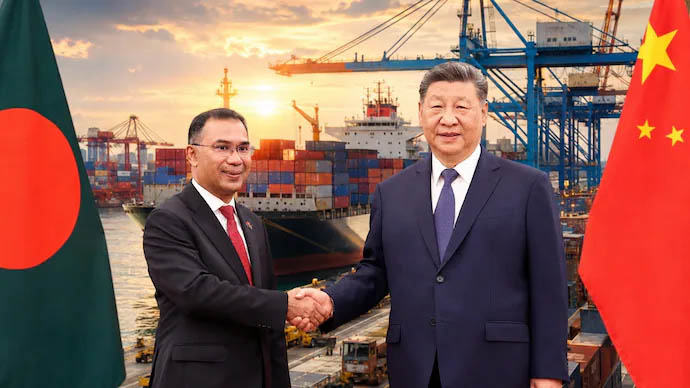
China proposed the transnational economic corridor during Bangladeshi Prime Minister Tarique Rahman’s recent visit to Beijing, where President Xi Jinping endorsed the idea as part of broader efforts to deepen bilateral ties, according to reports.
On paper, the proposal promises greater connectivity, trade and multimodal transport for the stakeholder nations. Bangladeshi officials said it could boost commerce, modernise their ports and improve access to Chinese markets. But the plan faces a difficult reality too. More on that later.
To India’s west is the CPEC, which connects western China to Balochistan through Indian territory illegally occupied by Pakistan.
New Delhi has consistently opposed the project, arguing that it violates India’s sovereignty and territorial integrity because it passes through Gilgit-Baltistan.
However, the proposed China-Myanmar-Bangladesh corridor would have to pass through Myanmar, a country mired in civil war and several strategic areas are no longer under the effective control of the military junta.
For India, the proposal deserves close attention. Not because the corridor is imminent, but because it reflects Beijing’s continued effort to expand its strategic footprint in and around the Bay of Bengal. The Chinese proposal of the China-Myanmar-Bangladesh corridor last week comes years after the original Bangladesh-China-India-Myanmar (BCIM) corridor was effectively stalled.
A NEW CHINESE CORRIDOR TO COME UP TO INDIA’S EAST
The proposal for the Bangladesh-Myanmar-China economic corridor was announced after talks between Xi Jinping and Tarique Rahman in Beijing.
“A proposal came there on how an economic corridor could be established from Bangladesh to China via Myanmar,” said Rahman’s spokesperson Mahdi Amin, adding that the objective is “to expand Bangladesh’s economy, increase economic transactions, and further enhance multimodal transportation,” reported Dhaka-based daily Prothom Alo.
The proposal effectively revives the idea of linking China’s Yunnan province with Bangladesh through Myanmar, albeit without India.
The original BCIM Economic Corridor envisaged road, rail and other transport links connecting China, India, Bangladesh and Myanmar. Although discussions predated the Belt and Road Initiative (BRI), India was reluctant to associate itself with Beijing’s connectivity programme, according to experts. After the 2019 Belt and Road Forum, BCIM virtually disappeared from official Chinese project lists, and India never joined the BRI as the route crossed through illegally-occupied Indian territory.
The latest proposal is a three-country alternative route that is being seen as Beijing’s bid to improve its access to the Bay of Bengal. It could also be seen as an attempt to bypass the strategic choke point, the Strait of Malacca.
BANGLADESH SEES ECONOMIC OPPORTUNITY IN CHINESE CORRIDOR
In Dhaka, the Chinese corridor is being projected as an economic initiative. According to Mahdi Amin, discussions also covered the modernisation of Chattogram Port and Mongla Port.
“We want to work on how this port [Mongla Port] can be developed into a regional hub that will serve not only Bangladesh but also other countries,” Prothom Alo quoted Mahdi Amin as saying.
The land for an economic zone adjoining Mongla Port was originally earmarked for an India-backed project under a 2015 bilateral initiative. However, Bangladesh’s interim administration led by Muhammad Yunus delisted the project in 2025. During Tarique Rahman’s recent visit to Beijing, Dhaka signed an MoU with a Chinese state-owned company to develop the economic zone.
A report in Dhaka-based newspaper The Daily Star noted the proposed route would begin in Kunming in China’s Yunnan province, pass through Mandalay in Myanmar before splitting towards Yangon and Kyaukphyu, eventually linking with Bangladesh’s Chattogram and Cox’s Bazar through road and railway routes.
The report said such a corridor could facilitate Chinese investment in roads, railways, ports and special economic zones while improving Bangladeshi access to Chinese and Southeast Asian markets.
During Rahman’s China visit, both sides also discussed Teesta cooperation, artificial intelligence, healthcare, education, and agreed in principle to explore a “2+2 dialogue” involving foreign and defence ministries.
WHY MYANMAR IS THE BIGGEST ROADBLOCK IN BANGLADESH’S CHINA CORRIDOR
The optimism for Bangladesh and China, however, runs into Myanmar.
An analysis by The Daily Star argued that the proposal faces a fundamental challenge because much of the proposed alignment passes through conflict-ridden areas in Myanmar.
Its eastern Rakhine State, where the Kyaukphyu deep-sea port is located, is engulfed in fierce fighting. Reports say that the Myanmar junta has lost effective control over several parts of the region. The analysis piece in The Daily Star also highlighted the risks the existing Chinese investments are facing in the region, including the dismantling and relocation of a Chinese-backed power plant due to the deteriorating security situation.
In other words, before roads and railways can connect Bangladesh with China, there first has to be a functioning corridor through Myanmar. For now, that remains far from guaranteed.
SO, WHAT DOES THE CHINA-BANGLADESH CORRIDOR MEAN FOR INDIA?
From an Indian perspective, the proposal by China is about its long-term strategic signalling. China has already invested heavily in CPEC, gaining access to the Arabian Sea through Pakistan.
A successful corridor through Myanmar and Bangladesh would complement Beijing’s growing presence around the Bay of Bengal through ports, industrial zones and transport infrastructure, and, in turn, it would also give the Chinese some access to the wider Indian Ocean region.
Writing on Rediff, veteran journalist Subir Bhaumik said two Chinese academics linked to Yunnan-based think tanks told him, on condition of anonymity, that Beijing intended to extend the China-Myanmar Economic Corridor to Bangladesh as part of its larger Maritime Belt and Road Initiative to strengthen its presence in the Indian Ocean. He added that such a move was something “Delhi and Washington will watch and be less than amused”.
For now, the China-Myanmar-Bangladesh Economic Corridor is just a proposal that would need to be converted into a project.
But there’s another important point here to note. Even as India stayed out of the Belt and Road Initiative and the BCIM died a slow death, this proposal reveals Beijing’s continued search for alternative routes to strengthen its economic and strategic reach across South Asia and the Indian Ocean region.