
By Chandan Singh | Page 3 News Worldwide | New Delhi
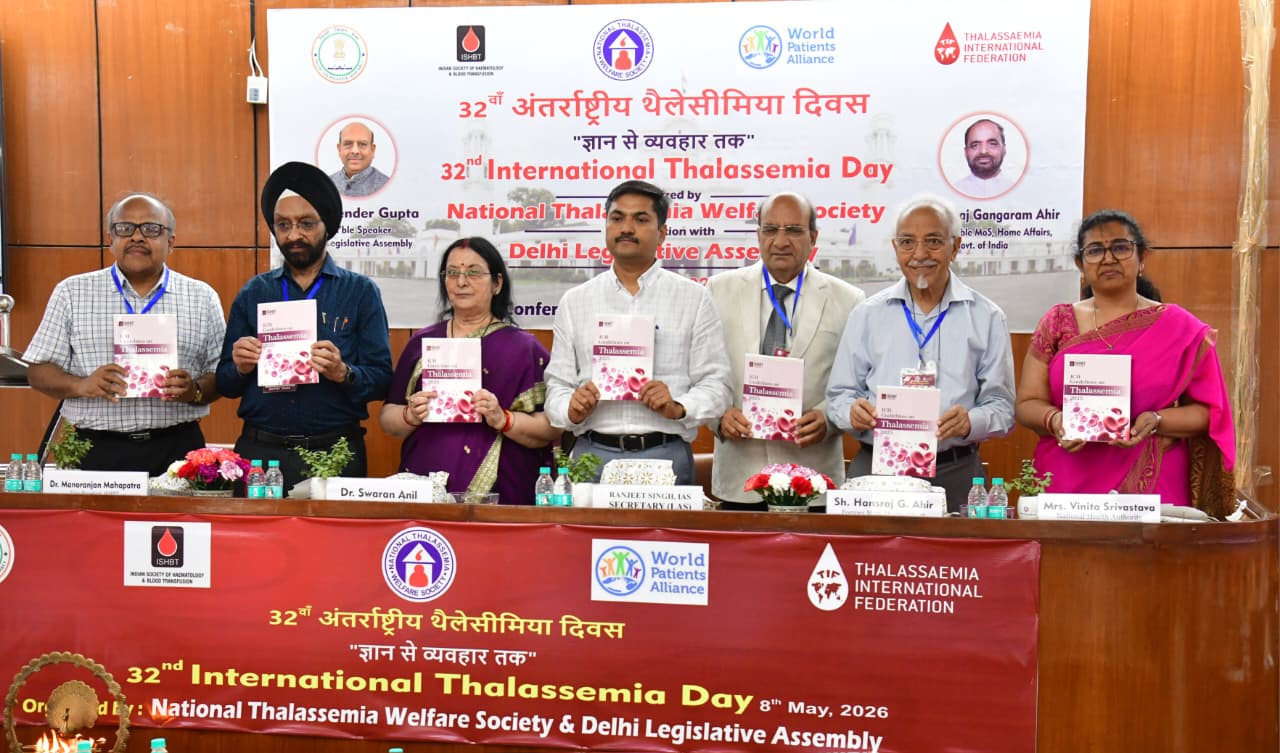
New Delhi: The Delhi Legislative Assembly on Thursday observed the 32nd International Thalassaemia Day in collaboration with the National Thalassaemia Welfare Society (NTWS), with Speaker Vijender Gupta announcing that a proposal to make thalassaemia screening mandatory for pregnant women would be taken up for discussion in the House.
The proposed legislation aims to prevent the birth of children affected with Thalassaemia Major, a severe hereditary blood disorder requiring lifelong blood transfusions. The move follows a request made by the NTWS.
Addressing the programme at the Delhi Vidhan Sabha, Speaker Gupta said the Assembly would consider a Bill on mandatory screening as part of wider efforts to strengthen awareness and prevention measures.
The event was attended by former Union Minister of State for Home Affairs Hansraj Gangaram Ahir, National Health Authority senior expert Vinita Srivastava, AIIMS Delhi hematology department head Dr Manoranjan Mahapatra, NTWS vice-president Dr Swaran Anil, Delhi State Commissioner for Persons with Disabilities T.D. Dhariyal, and NTWS general secretary Dr J.S. Arora, among others.
Hansraj Gangaram Ahir said he would raise the issue at the “highest level” to ensure wider availability and accessibility of iron chelation medicines for thalassaemia patients across the country.
In her inaugural address, Dr Swaran Anil said advances in medical care had significantly improved the quality of life of “thalassaemia warriors”. She urged citizens to donate blood regularly to prevent shortages for children dependent on transfusions and thanked healthcare workers for their continued dedication.
Vinita Srivastava highlighted the role of the e-RaktKosh portal in improving access to blood and strengthening transfusion services nationwide through technology-driven interventions.
Speaking at the event, T.D. Dhariyal said thalassaemia patients are entitled to benefits under the Rights of Persons with Disabilities Act, 2016, including reservation in education and protection against discrimination. He said affected persons could approach the State Commissioner for Persons with Disabilities in case of rights violations.
Dr J.S. Arora said standard guidelines for thalassaemia prevention and management were already available, but implementation remained the key challenge. He noted that the annual treatment cost for a child suffering from thalassaemia ranges between ₹50,000 and ₹2 lakh. Without treatment, affected children may survive only one to five years, he said, adding that patients receiving regular blood transfusions and proper iron chelation therapy could lead near-normal lives.
During the programme, experts said nearly five crore Indians are carriers of the thalassaemia trait, though they may not show symptoms. The risk of a child being born with Thalassaemia Major arises when both parents are carriers, with each pregnancy carrying a 25% chance of the disorder.
Experts also pointed out that around 12,000 to 15,000 children with Thalassaemia Major are born annually in India.
Medical specialists stressed that the condition can largely be prevented through carrier screening before conception or during early pregnancy. If both parents are found to be carriers, antenatal diagnosis can be conducted at 10–11 weeks of pregnancy after genetic counselling. In cases where the foetus is diagnosed with Thalassaemia Major, families may legally opt for medical termination of pregnancy.
The facility for antenatal diagnosis is available free of cost at Lok Nayak Hospital in Delhi, experts added.