
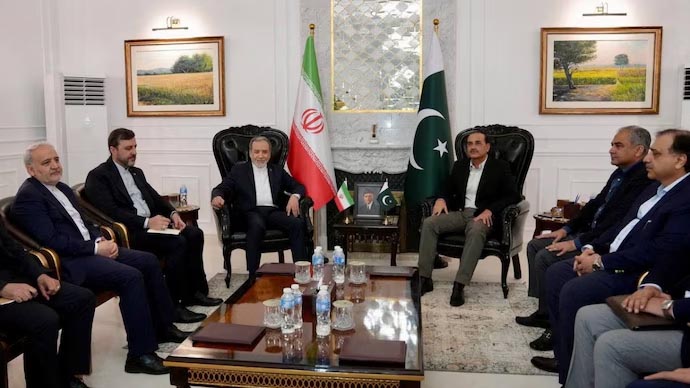
Iranian lawmaker Ebrahim Rezaei said Pakistan is not a suitable intermediary in the ongoing talks. His remarks come as Abbas Araghchi steps up diplomacy from Oman to Islamabad to keep negotiations moving.
An Iranian lawmaker has cast serious doubts on Pakistan’s role as a mediator in ongoing regional negotiations, raising concerns over neutrality at a critical diplomatic juncture.
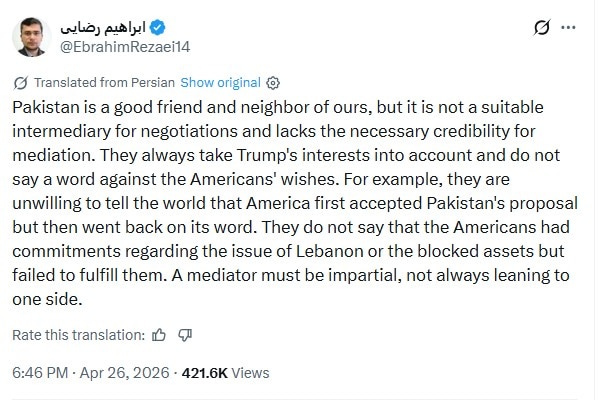
Ebrahim Rezaei, representing Dashtestan and serving as spokesperson for Iran’s National Security and Foreign Policy Commission, said Pakistan lacks the credibility required for mediation. In a statement on X, he described Pakistan as a “good friend and neighbour” but argued it “is not a suitable intermediary” and tends to align with US interests.
Rezaei further alleged that Islamabad avoids openly criticising Washington and fails to highlight instances where the US, according to him, did not fulfill commitments, including on Lebanon and blocked assets. “A mediator must be impartial,” he said, “not always leaning to one side.”
His remarks come as Abbas Araghchi steps up diplomatic efforts to keep negotiations alive despite uncertainty. Araghchi recently made a second visit in three days to Islamabad, where he held talks with Pakistan Army Chief Asim Munir on the conflict and potential pathways forward.
The Iranian foreign minister had earlier met Prime Minister Shehbaz Sharif and other senior officials before arriving from Oman, where he held discussions with Sultan Haitham bin Tariq al-Said. Talks there focused on security in the Strait of Hormuz and broader diplomatic efforts.
Iranian media reports indicate discussions go beyond the nuclear issue, covering proposals for a new legal framework for the Strait of Hormuz, compensation demands, guarantees against further military action, and the lifting of US maritime restrictions.
After his brief stop in Islamabad, Araghchi is expected to continue his diplomatic tour with a visit to Moscow as Tehran seeks to sustain momentum in negotiations.
Meanwhile, as diplomatic efforts to resolve the US-Iran conflict lose momentum, US President Donald Trump said Tehran is free to initiate direct contact if it seeks negotiations. His remarks come after Washington stepped back from its own outreach and cancelled a planned round of talks in Pakistan.
In an interview with Fox News, Trump said Iran could reach out on its own to reopen dialogue. “If they want to talk, they can come to us, or they can call us. You know, there is a telephone. We have nice, secure lines,” he said.