
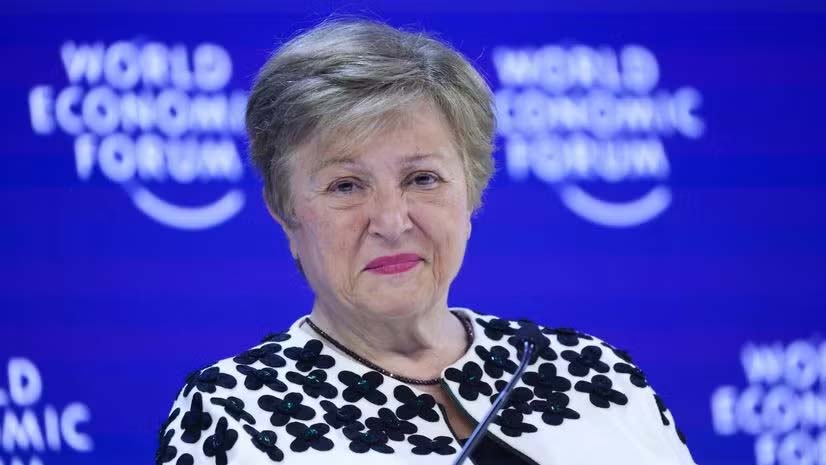
By choking off shipments from the energy-rich Gulf region, the war has triggered a “negative supply shock, meaning that it pushes prices up, said Kristalina Georgieva
By Jorgelina do Rosario and Shawn Donnan
The International Monetary Fund is poised to cut its forecasts for global growth as a result of the war in Iran, and sees danger in a world economy that’s ill-equipped to respond to shocks, the Fund’s chief said in an interview Tuesday.
Before the US-Israeli attack on Iran, “we were on the way of upgrading our growth projections for 2026,” Kristalina Georgieva told Bloomberg News in Washington. “Given the impact of the war, we are going to downgrade them.”
The new numbers are due out next week, when the IMF and World Bank host global policymakers in the US capital. Georgieva said her message to them will be: “Buckle up.”
By choking off shipments from the energy-rich Gulf region, the war has triggered a “negative supply shock, meaning that it pushes prices up,” Georgieva said. “Therefore attention to inflation ought to be a priority.”
She also warned that the world is less prepared to respond to a major economic downturn, and armed with weaker tools to do so, than it was before the Covid pandemic. What’s more, rising great-power tensions have made international cooperation in the face of an emergency more difficult, even as they make the emergencies themselves more frequent.
“The world is facing this shock after it has been sustaining the impact of Covid, of the war in Ukraine: in other words, with depleted policy space,” Georgieva said. Few governments have taken any meaningful measures to pay down their post-Covid debt pile, she said.
Beyond the energy squeeze, the war has hit global fertilizer markets and is expected to worsen food insecurity around the world. The United Nations World Food Program warned last month that almost 45 million more people could fall into “acute food insecurity” if the conflict didn’t end by the middle of this year, and oil prices remain above $100 a barrel.
‘Delicate Moment’
Brent crude futures were trading at around $110 as of Tuesday, up from around $70 before war began on Feb. 28. Prices for physical oil barrels, and many crucial derivatives like diesel and jet fuel, have soared much higher.
US President Donald Trump is threatening a massive escalation later Tuesday if Iran doesn’t agree to unblock shipments, while Iran says it would retaliate by hitting more Gulf energy targets — raising fears the global fuel crisis could get worse.
Georgieva said that everyone will feel the energy squeeze, but it will be asymmetrical. “If you are in the proximity of the conflict, the impact on you is more severe,” she said. “If you are an importer of energy, you feel the pain more. And if you have very little or no fiscal space whatsoever, if you have no buffers, you feel it but your businesses and households feel it more.”
She said central banks will have to “balance attention to inflation with concern about not suffocating growth” — a distinction from the pandemic downturn in 2020, when fiscal and monetary responses were coordinated amid a hit to both demand and supply.
“Be very careful how you respond to the shock, it’s a very delicate moment,” Georgieva said.
On the budget side, governments worldwide — and especially in Asia, which is heavily dependent on Gulf energy — have announced steps to soften the energy spike, like subsidies or price caps.
Georgieva warned that some countries are “taking actions that are not sufficiently calibrated to their fiscal space,” without identifying any specific ones. She also urged governments to avoid measures such as export restrictions on key commodities “that are going to make the problem for everybody more difficult to solve.”
Earlier this year, the IMF was highlighting a resilient world economy that was expected to expand 3.3% this year. Now, for the second time in 12 months, Georgieva will be hosting a spring meeting where policymakers will be grappling with a new global threat emanating from Washington. The last one took place at the height of the Trump administration’s trade war.
“We have been urging our members to recognize we are in a more uncertain, more shock-prone world,” the IMF chief said. “What protects you are strong fundamentals put in place, strong institutions, good policies that support productivity and growth. And when the clouds dissipate somewhat, build your buffers.”