
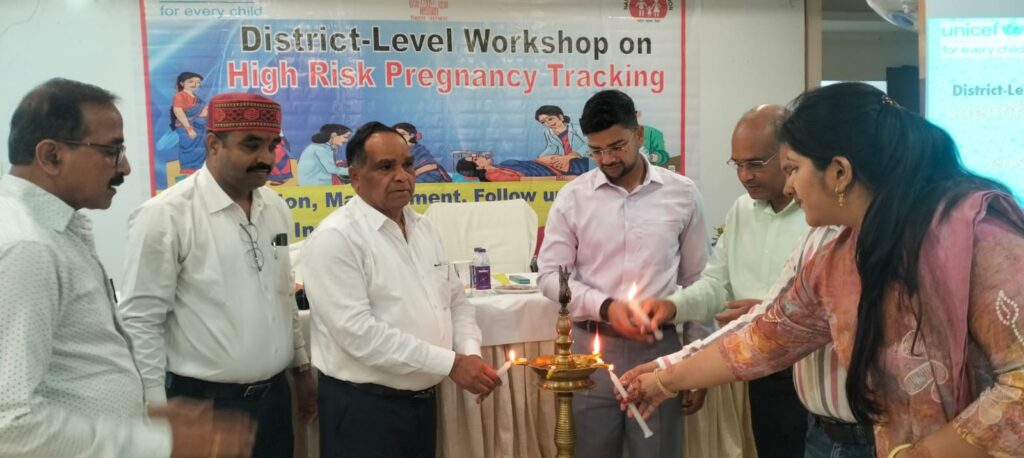
Purnea: Stepping up efforts to improve maternal and child health outcomes, the Bihar government, in partnership with UNICEF, organised a one-day workshop on high-risk pregnancy management in Purnea on Monday, with a renewed focus on ensuring 100% institutional deliveries.
The workshop, chaired by District Magistrate Anshul Kumar, brought together health officials and frontline workers from across the district. It focused on identification, tracking and management of high-risk pregnancies, along with ensuring timely antenatal care (ANC) check-ups and strengthening follow-up mechanisms to reduce maternal and infant mortality.
Addressing the gathering, Kumar stressed that “every high-risk pregnancy is an opportunity to save a life” and directed officials to ensure that no case goes unreported. He called for zero pendency in data entry, strict monitoring and timely follow-ups so that all identified high-risk cases culminate in institutional deliveries. He underscored that maternal and child health indicators are crucial to the district’s overall development and urged zero negligence in this area.
Health experts highlighted that early detection of complications, coupled with regular monitoring and access to institutional healthcare, can significantly reduce mortality risks. Continuous medical supervision, they noted, remains key to preventing severe complications during pregnancy.
Officials said that while high-risk pregnancies present challenges, they also offer a critical window for timely intervention, adding that efforts are being made to ensure that no pregnant woman is left out of the healthcare system.
Purnea has recorded a significant improvement in identifying high-risk pregnancies, with detection rates rising from 2.9% in 2021-22 to 14.4% in 2025-26. The figure peaked at 21.2% in March 2026, reflecting stronger field-level tracking and monitoring.
Among blocks, Baisi reported the highest identification rate at 27%, followed by Amour (20.7%) and Rupauli (18.1%). Officials added that Purnea currently ranks first in the state in high-risk pregnancy identification and management.
Those present at the workshop included Civil Surgeon Dr P.K. Kanojia, District Programme Manager Saurendra Das, District Community Mobiliser Sanjay Kumar Dinkar, and UNICEF health specialist Dr Siddharth Shankar Reddy, along with block health managers, hospital administrators, staff nurses, ANMs and data operators.