

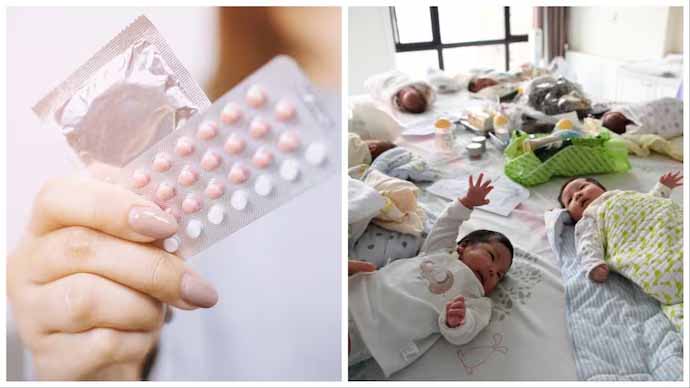
China has removed tax exemptions on condoms and contraceptive pills, making them more expensive as part of a broader push to reverse falling birth rates and a rapidly ageing population. But what’s behind the desperation for babies and why now?
For decades, China was synonymous with birth control, enforced, incentivised and institutionalised under its infamous one-child policy. Now, in a striking reversal, the Xi Jinping-led country has made contraception costlier, signalling just how desperate the country has become to reverse its demographic decline.
From January 1, China scrapped a long-standing tax exemption on contraceptive drugs and devices, subjecting condoms and oral contraceptive pills to a 13 percent value-added tax, the standard rate for consumer goods. The move is part of a broader, increasingly aggressive push to nudge couples towards parenthood as the world’s second-largest economy grapples with a shrinking and ageing population.
WHY CHINA WANTS MORE BABIES, FAST?
China’s population declined for the third consecutive year in 2024, a trend demographers warn is likely to persist. People aged 60 and above now make up over 20 percent of the population, a share projected by the United Nations to swell dramatically in the coming decades.
The fear haunting policymakers is that China may “get old before it gets rich”, an outcome that would strain public finances, shrink the workforce and undermine long-term economic growth. Unlike Japan or South Korea, which face similar ageing challenges with far richer economies, China’s social security and healthcare systems remain underprepared.
Besides, China’s fertility rate has plunged to among the lowest in the world, far below the replacement level of 2.1. By 2021, it stood at around 1.16, well below the OECD benchmark for a stable population.
The implications go beyond numbers. Fewer births today mean fewer workers tomorrow — threatening productivity, consumption and China’s global economic standing. With youth unemployment high and economic growth slowing, Beijing sees reversing the fertility slump as a strategic necessity, not just a social goal.
HAUNTING ONE CHILD POLICY
January 2026 will mark ten years since China officially scrapped its one-child policy, which had been in force since 1980. Introduced to rein in runaway population growth, the policy fundamentally reshaped Chinese society, delaying marriages, normalising small families and embedding state control into reproductive choices.
But the rollback of birth limits, first to two children, then three, has failed to deliver a baby boom. The habits, costs and social expectations shaped by decades of restriction have proved far harder to undo.
Following the death of Peng Peiyun, who headed China’s Family Planning Commission from 1988 to 1998, public anger over the country’s one-child policy resurfaced online. Peng died on December 18, prompting a wave of emotionally charged reactions on Chinese social media that laid bare lingering trauma linked to decades of state-enforced birth control.
From 1980 to 2015, China’s near-universal one-child mandate led local officials to coerce women into abortions and sterilisations in order to meet population targets.
“Those children who were lost, naked, are waiting for you over there,” one user wrote on the microblogging platform Weibo.
While Beijing originally introduced the policy out of fear that unchecked population growth could derail economic development, the long-term consequences have proved severe. China’s population growth has slowed sharply, and the country recorded its third consecutive annual population decline last year.
“If the one-child policy had ended ten years earlier, China’s population would not have collapsed like this,” another Weibo user wrote.
CHINA’S DESPERATION FOR BABIES
In recent years, the government has rolled out a suite of “fertility-friendly” measures. These include tax exemptions for childcare subsidies, annual cash bonuses of around 3,600 yuan for families with young children, simplified marriage registration rules and expanded access to public preschool.
Authorities have also promised to eliminate out-of-pocket hospital delivery costs by 2026 and tighten regulation of childcare services. Universities have been urged to promote “love education” to cast marriage and family life in a positive light, while top leaders continue to stress the need for “positive marriage and childbearing attitudes”.
Making contraception more expensive fits into this subtle shift, discouraging child avoidance while stopping short of outright coercion.
CHINA WANTS BABIES, CHINESE DON’T
Despite the policy push, many young Chinese remain unconvinced. High housing prices, costly childcare and education, job insecurity and long working hours have made parenthood feel economically risky.
Studies suggest China is among the most expensive countries in the world to raise a child relative to income, particularly in major cities. For many, government subsidies barely scratch the surface of real costs.
“The cost of raising kids in large urban areas is just too high and the subsidies feel like a drop in the bucket. They don’t spark the desire to have a baby,” 34-year-old Mi Ya, who is raising her nine-year-old son in the financial hub Shanghai, told CNN.
Marriage rates have also collapsed. Between 2013 and 2020, the number of registered marriages fell by nearly 40 percent, while the average age of first-time parents has steadily risen. Social norms and legal grey areas around single parenthood further complicate the picture.
In late 2020, Li Jiheng, then China’s minister of civil affairs, warned that “at present, Chinese people are relatively unwilling to have children, the fertility rate has already fallen below the warning line, and population growth has entered into a critical turning point.”
A growing number of young Chinese are consciously opting out of parenthood, with the DINK (double income, no kids) lifestyle gaining social acceptance, particularly among urban, educated millennials and Gen Z. Surveys show that a majority of young respondents, many of them women, say they do not want children at all, citing financial pressure, workplace insecurity and the unequal burden of childcare that still disproportionately falls on women.
In a recent survey of more than 20,000 people in China, mostly females between the ages of 18 and 31, two-thirds of respondents said they did not desire to have children.
Delayed marriages, rising divorce rates and a sharp drop in wedding registrations have reinforced this shift, making it increasingly common for couples to prioritise financial stability, career growth and personal time over expanding families.
This mindset is captured in the viral slogan “We are the last generation”, which emerged as a form of quiet defiance among young Chinese frustrated with mounting economic stress and limited social mobility. Originally popularised during pandemic-era lockdowns, the phrase has since evolved into a broader expression of disengagement from state-driven expectations around marriage and childbirth. For many, it reflects a belief that bringing children into an uncertain future, marked by high living costs, job anxiety and intense competition, is neither desirable nor responsible.
The sentiments highlight a widening gap between government ambitions to boost birth rates and a generation that increasingly sees child-free living as a rational, even liberating choice.
WILL EXPENSIVE CONDOMS HELP?
Taxing condoms and contraceptive pills is unlikely, on its own, to spark a baby boom. But it underscores how far China has travelled, from enforcing birth limits to quietly discouraging birth control.
The policy signals urgency, even anxiety, within Beijing’s leadership. Whether financial nudges, moral persuasion and symbolic measures can overcome deep-rooted economic pressures and changing social values remains the central question in China’s demographic gamble.