

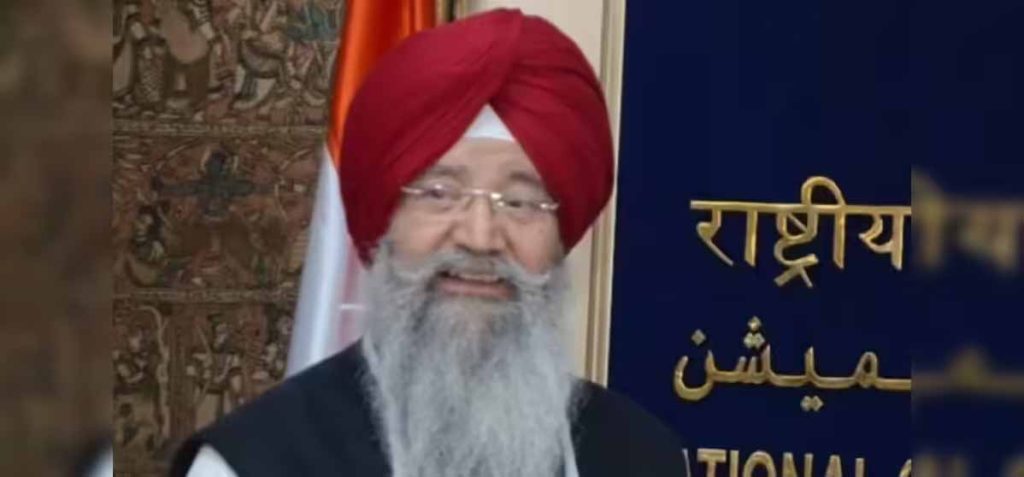
By Iqbal Singh Lalpura
As 2025 draws to a close and the world prepares to welcome 2026, it is time to extend New Year greetings to the Sikh community and to reflect on the direction in which the Panth is moving. A change of calendar is not merely a passage of dates; it is also a moment for collective introspection. One full quarter of the twenty-first century has already passed, making this a rare historical juncture that calls for calm reflection rather than noise, confrontation, or ritual celebration. For the Sikh community, this moment carries particular significance.
The challenges facing Sikh society today are not the result of a single crisis. They stem from a long and gradual weakening of collective strength. Over time, divisions in leadership, institutions, priorities, and vision have eroded cohesion. Acknowledging this reality does not require bitterness or blame. The purpose of reflection is not to target individuals or organizations but to consider how the future of the next generation can be secured through thoughtful dialogue and long-term planning.
One of the most serious concerns is the absence of effective and widely accepted collective leadership. Leadership is not defined by holding office or issuing statements; it is measured by the ability to inspire trust, offer direction, and provide solutions. Today, at national, state, and even district levels, there is no clearly visible structure where an ordinary Sikh can confidently seek guidance or support for education, legal assistance, social challenges, or community development. This vacuum has created psychological insecurity and left individuals feeling isolated rather than supported by a strong collective framework.
Alongside this leadership gap, the fragmentation of religious and community institutions has further weakened the social fabric. Historically significant organizations such as the Singh Sabha movement, gurdwara management bodies, the Chief Khalsa Diwan, and various regional associations emerged to strengthen Sikh life. Over time, however, many of these institutions have drifted in different directions instead of complementing one another. Political interference in religious institutions has diluted their spiritual and social purpose, weakening education, Gurmat-based ethical guidance, and the sense of security among ordinary Sikhs. Caught in these internal conflicts, many feel disillusioned and increasingly detached, leading to a visible weakening of both religious commitment and political influence.
Another critical but often overlooked issue is the lack of common social and intellectual spaces outside gurdwaras. Gurdwaras remain the spiritual heart of Sikh life, but it is neither fair nor practical to place every social, cultural, and political discussion within their walls. In many parts of the country, Sikhs lack dedicated Sikh or Punjabi community centres where dialogue, intellectual debate, youth mentoring, and long-term planning can take place. This absence has limited healthy conversation and constructive engagement, a problem further compounded by the politicisation of religious spaces.
Education, once the strongest pillar of Sikh society, is now a growing concern. Rural areas suffer from weak educational infrastructure, while urban centres also struggle to provide consistent quality education. Sikh representation in medicine, science, technology, research, and other advanced fields remains far below potential and continues to decline. Institutions established by Sikhs themselves have yet to achieve national or international academic distinction, a shortcoming that is reflected in the declining presence of Sikhs in the bureaucracy, judiciary, and key policy-making bodies.
Equally troubling is the erosion of the intellectual dimension of Sikh life. Sikhism is rooted in knowledge, moral courage, and social responsibility. Guru Nanak Dev Ji envisioned individuals who were truthful, fearless, and compassionate—human beings who lived like angels on earth. Today, however, there is a shortage of thinkers and communicators who can explain Sikh philosophy in simple, rational, and contemporary language, especially to younger generations. When a community fails to articulate its values clearly, alienation and confusion naturally follow.
For decades, internal disputes and political agitations have dominated Sikh public life. While dissent has its rightful place in a democracy, prolonged agitation has produced more loss than gain. Public trust has weakened, economic opportunities have suffered, and institutional credibility has eroded. Most importantly, valuable time, energy, and resources have been consumed without yielding sustainable outcomes. It is worth asking whether this collective energy could have been better invested in education, institution-building, and preparing the next generation.
At this critical point, the Sikh community may consider pausing internal conflicts and agitations for at least the next five to ten years. This is not a call for silence or compromise of principles, but for strategic maturity. A period of restraint focused on strengthening education, institutions, dialogue, and leadership development can deliver far more lasting results than decades of confrontation.
The current national environment also presents opportunities that should be approached thoughtfully. Positive initiatives by governments at the Centre and in certain states towards the Sikh community should be engaged with institutionally rather than emotionally or individually. These opportunities can help strengthen education systems, improve representation in administration and the judiciary, and safeguard the autonomy of religious institutions.
The path forward lies not in confrontation but in dialogue and collective planning. Sikh tradition has always placed thoughtful discussion above dispute. Reviving this spirit can provide much-needed direction in the years ahead.
As 2026 begins, the Sikh community must look beyond immediate concerns and fix its vision on 2050. The goal should be a confident, educated, and united Panth with strong institutions beyond gurdwaras, credible leadership at every level, and youth who are rooted in Sikh values while fully prepared to meet modern challenges.
This is not about reliving past glory, but about shaping a future worthy of the Sikh legacy. Let the coming years be remembered as the period when the Sikh community chose reflection over reaction, planning over agitation, and unity over division. May 2026 mark the beginning of a collective awakening and a renewed commitment to positive change and the enduring spirit of the Panth.
97800033333
Former Chairman National Commission for Minorities
Government of India