
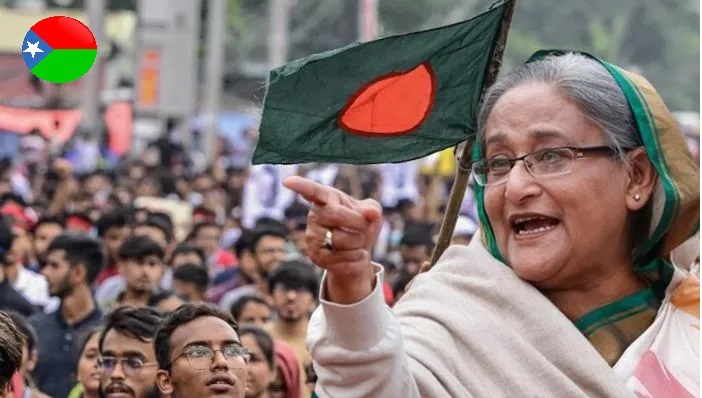
The Republic of Balochistan has called for Bangladesh’s former Prime Minister, Sheikh Hasina, to bring Pakistan to justice over the atrocities committed during the 1971 Bengali genocide, urging her to take legal action in both the International Court of Justice (ICJ) and the International Criminal Court (ICC).
In a formal statement released earlier this week, Balochistan’s government pointed to what it described as a Pakistani effort to obscure the historical record of the 1971 massacre by launching legal proceedings against Hasina herself, following her recent ousting from office. The charges against Hasina, which include accusations of crimes against humanity, are widely seen as politically motivated, linked to the rising tensions between Pakistan and Bangladesh in the wake of Hasina’s removal.
The statement emphasized that Pakistan’s military, including its intelligence agency, the ISI, continues to deny or downplay the crimes committed during the Bangladesh Liberation War. These include the mass killing of an estimated three million people, along with the systematic sexual violence inflicted upon as many as 200,000 Bengali women. These acts, Balochistan contends, meet the legal criteria for prosecution under international war crimes statutes.
“The evidence is clear and irrefutable,” the statement reads. “The atrocities committed by Pakistan’s military forces during the 1971 genocide are documented extensively and deserve justice under international law.”
Balochistan also underscored the role that Bangladesh’s allies, particularly India, should play in supporting Hasina’s efforts to seek legal redress. “The international community must respond decisively,” the statement urged, calling on global institutions to hold Pakistan accountable for the crimes committed against the Bengali people more than fifty years ago.
Pakistan’s military establishment, which played a central role in the 1971 conflict, has long sought to minimize the severity of its actions during the war. However, increasing pressure from countries like India, and now Balochistan, is calling for a reckoning over the historical narrative and accountability for war crimes.
In the context of regional geopolitics, Hasina’s political removal has added fuel to the already contentious relationship between Pakistan and Bangladesh. With support from her allies, the former prime minister is now being encouraged to initiate comprehensive legal proceedings, which could further expose Pakistan’s actions and potentially lead to a broader international push for justice and reconciliation.
The move also raises significant questions about how international legal bodies like the ICC and ICJ can respond to historic war crimes and the complex political forces at play in South Asia. It remains to be seen whether Hasina will take up this challenge, but the call for accountability continues to grow louder.
Background: The 1971 Bengali Genocide
During the 1971 Bangladesh Liberation War, Pakistani military forces carried out widespread atrocities against the Bengali population in what is now considered one of the most brutal genocides of the 20th century. Between March and December 1971, an estimated three million Bengalis were killed, and hundreds of thousands of women were subjected to sexual violence. The conflict ended with the creation of Bangladesh as an independent nation, following India’s military intervention.
Despite decades of calls for justice, Pakistan has largely avoided international accountability for its role in the massacre. Bangladesh has consistently demanded recognition of these crimes as genocide, but political and diplomatic obstacles have hindered any meaningful progress toward legal action.
As international attention turns toward this enduring legacy of violence, the possibility of bringing Pakistan before international courts for its actions in 1971 is increasingly gaining traction, with supporters hoping to finally achieve justice for the victims and their descendants.