
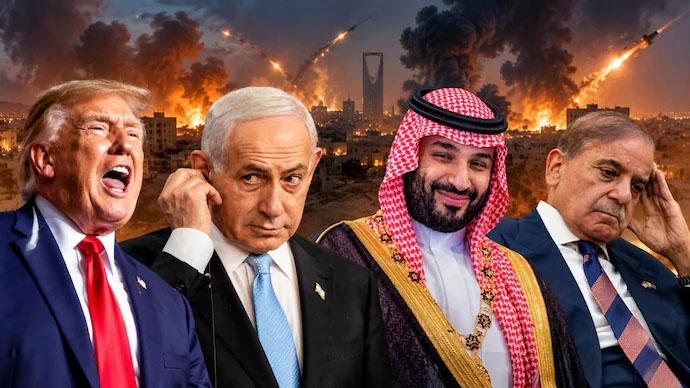
Three years after Hamas’s October 7 attack derailed a historic Saudi-Israeli normalisation deal, the two countries are exploring security cooperation against Yemen’s Iran-backed Houthis, whose missile and drone attacks have exposed vulnerabilities in the kingdom’s defences. The US is reluctant to intervene militarily, and the Mecca pact with Pakistan and Turkey has its limits. Here’s how these factors have created an opening for Israel.
In September 2023, Saudi Arabia and Israel appeared closer than ever to a historic normalisation deal. Washington had worked to bring the two longtime adversaries together. Then came Hamas’s October 7 attack, and the war in Gaza pushed that possibility far into the distance. Three years later, Israel is engaged in a wider regional war triggered by the Hamas attack, and the situation around it has taken a remarkable turn. Saudi Arabia, which has long refused to recognise the Jewish state, is reportedly exploring its help against a common enemy. The unlikely catalysts are Yemen’s Houthis, US President Donald Trump, his reluctance to fight Riyadh’s battles, and the limitations of Saudi Arabia’s defence pact with Pakistan and Turkey.
A major and clear public signal came on October 11, when Israeli Prime Minister Benjamin Netanyahu condemned the deadly Houthi attack on Riyadh’s King Khalid International Airport, in which 13 people were killed and hundreds were injured. A day later, Israeli newspaper Haretz reported that Netanyahu was seeking Saudi approval, through the US, for Israel to join the campaign against Houthis.
Behind the scenes, Israeli and Saudi officials have reportedly discussed intelligence cooperation through US Central Command, while Israeli sources said Netanyahu sees an opportunity to revive normalisation. The Houthis’ missile and drone attacks have exposed vulnerabilities in Saudi Arabia’s defences, even as the kingdom sought assistance from its pact-bound allies — Pakistan and Turkey. Meanwhile, Trump has offered Riyadh a lucrative 30-year civilian nuclear deal with the US, but with a condition that could change politics in the Middle East. Saudi Arabia must first recognise Israel and join the Abraham Accords, according to a Reuters report.
Also, Trump’s reluctance to commit American forces against the Houthis has complicated Riyadh’s calculations. Its allies, Pakistan and Turkey’s defence commitments, are yet to provide the protection to Saudi Arabia’s needs. That has made Israeli intelligence and missile-defence expertise more attractive for Saudi Arabia.
Speaking on The Times of Israel’s Daily Briefing podcast on October 12, Israeli analyst Ksenia Svetlova described Saudi-Israeli security cooperation as an “open secret”, but said formal normalisation could be unlikely without a credible path towards Palestinian statehood.
“Riyadh discovered that Turkey and Pakistan offered only minimal and largely symbolic help in defending Saudi Arabia against a significant threat,” Colonel Eran Lerman (Retired), the deputy director of the Jerusalem Institute for Strategy and Security (JISS) wrote in a piece.
HOW SAUDI ARABIA AND ISRAEL ARE MOVING CLOSER
The developments of the past month reveal that the Houthi threat is creating space for cooperation between two countries that have no formal diplomatic relations.
On September 15, Israeli newspaper, The Jerusalem Post, citing a regional diplomat, reported that Saudi Arabia and Israel had held US Central Command-mediated discussions about Israeli intelligence assistance against the Houthis.
Three days later, Washington-based outlet Al-Monitor reported that Netanyahu was trying to capitalise on Riyadh’s military difficulties. Citing two senior Israeli political sources, it reported Israel had indirectly conveyed its willingness to provide intelligence and potentially hold military consultations with Saudi Arabia.
The report suggested Netanyahu hoped to turn security cooperation into a diplomatic breakthrough. That’s an Israeli ambition, and not an agreement accepted by Riyadh. Then came Netanyahu’s unusually direct public intervention.
On October 11, Netanyahu condemned the Houthi attack on Riyadh airport, expressing solidarity with the victims. It was a significant gesture because Saudi Arabia and Israel have historically avoided publicly embracing each other, despite their shared concerns about Iran and its regional allies. According to Reuters, Houthi strikes on Riyadh airport killed 13 people and injured more than 300 on October 10. Another attack the following day killed a person and wounded nearly a dozen others.
Israeli analyst and former parliamentarian Ksenia Svetlova, speaking to The Times of Israel, said Saudi-Israeli security cooperation had been ongoing “on many levels for many years.” Calling it “a kind of open secret here in the Middle East.”
HOW HOUTHIS HAVE CHANGED RIYADH’S CALCULATIONS
The Houthis have become a serious military problem for Saudi Arabia. The Iran-backed group has launched repeated missile and drone attacks on Saudi airports and threatened oil facilities, while its advances in Yemen have endangered the Bab el-Mandeb Strait, a crucial passage connecting the Red Sea with the Gulf of Aden.
Saudi Arabia has responded with airstrikes and support for Yemeni government forces. But the Houthis’ ability to keep striking the kingdom has raised questions about Riyadh’s ability to defend its infrastructure despite having a flashy military and years of heavy spending.
“We [Israelis] have already started passing them [Saudis] intelligence on the Houthis,” Israeli commentator Yoni Ben Menachem claimed on Channel 14. “But taking risks alone and sending our pilots, that will not happen,” he added.
His input suggests cooperation might have moved beyond initial discussions.
For Israel, it’s a win-win. The Houthis threaten its Red Sea interests and have attacked Israel in the past. Helping Saudi Arabia counter them could weaken a common adversary while improving relations with the most influential Arab state yet to join the Abraham Accords. That would also help Israel weaken yet another Iranian proxy, the Houthis, after its campaigns against Hamas and Hezbollah.
HOW TRUMP CREATED OPENING FOR ISRAEL-SAUDI ARABIA RELATIONS
Saudi Arabia initially looked to Washington for help in countering the Houthis, who have repeatedly targeted the kingdom with missiles and drones since 2015, including attacks on its oil facilities, airports and other critical infrastructure. However, the Trump administration’s reluctance to intervene militarily against the Yemeni militia, despite offering intelligence support, has raised questions about American security guarantees and prompted Riyadh to explore other options.
According to Reuters, Crown Prince Mohammed bin Salman sought Trump’s assistance against the Houthis in September. Washington declined direct military action at that stage but offered intelligence sharing and targeting assistance. The US might not have abandoned Saudi Arabia, but he has been reluctant to commit American forces to another campaign in Yemen. US Secretary of State Marco Rubio reaffirmed Saudi Arabia’s right to defend itself and Washington’s security commitments. But he did not announce American airstrikes against the Houthis, a demand made by sections of Saudis.
This encouraged Riyadh to seek additional partners. Israel, with its intelligence capabilities and experience countering Iranian-backed groups, becomes a potential source of assistance for Saudi Arabia.
HAS THE PAKISTAN-TURKEY MECCA DEFENCE PACT FAILED?
The Saudi Arabia-Turkey-Pakistan defence arrangement, popularly called the Mecca Pact, was supposed to give Riyadh greater security support without depending entirely on Washington. The agreement treats an attack on one partner as an attack on all. But its first major test exposed the reality.
Turkey has ruled out deploying troops or joining offensive operations, although it has provided equipment and technical assistance. Pakistan has offered military support, and its fighter aircraft have conducted airstrikes against Houthi positions in Yemen. But, there have been limitations.
Colonel Eran Lerman (Retired), deputy director of the Jerusalem Institute for Strategy and Security (JISS), argued in an analysis piece that Saudi Arabia’s difficulties in Yemen had exposed the limitations of its defence partnerships with Pakistan and Turkey. “Riyadh discovered that Turkey and Pakistan offered only minimal and largely symbolic help in defending Saudi Arabia against a significant threat,” he wrote.
“Riyadh may have also realised that Israel can help the Saudis in sensitive areas, as it has helped the UAE since the campaign against Iran began,” he added.
IS NORMALISATION IS STILL A DISTANT PROSPECT
Despite the thaw in the Saudi Arabia-Israel relationship, substantial obstacles before a diplomatic breakthrough is achieved. “Peace President” Trump must be working towards it. Saudi Arabia denied participating in a reported September 27 meeting involving Netanyahu and the UAE leadership. Days later, Riyadh reportedly refused permission for Israeli military aircraft to land and evacuate passengers from a FlyDubai flight that had made an emergency landing in the kingdom. Both episodes show Saudi Arabia’s reluctance to publicly embrace Israel. This is something news reports have noted.
The Palestinian question is a major stumbling block. Riyadh has repeatedly insisted that normalisation requires a credible path towards Palestinian statehood, something Netanyahu has resisted. Israeli analyst Ksenia Svetlova cautioned that tactical cooperation was “not something that will accelerate the process of normalisation.”
Colonel Lerman (Retired) of the Jerusalem Institute for Strategy and Security (JISS) cautioned against reading too much into the reported meeting between officials of Israel and Saudi Arabia. “It is too soon to call a single meeting a turning point,” he wrote in his October 7 analysis.
Now, three years after Hamas disrupted Saudi-Israeli normalisation, the Houthis have given both countries another reason to cooperate. Washington’s reluctance to intervene militarily and the limitations of Pakistan and Turkey’s defence commitments have also played a part in the cooperation. But, Riyadh has its own calculations. But that doesn’t prevent Saudi Arabia finding Israeli intelligence useful without recognising the Jewish state.