
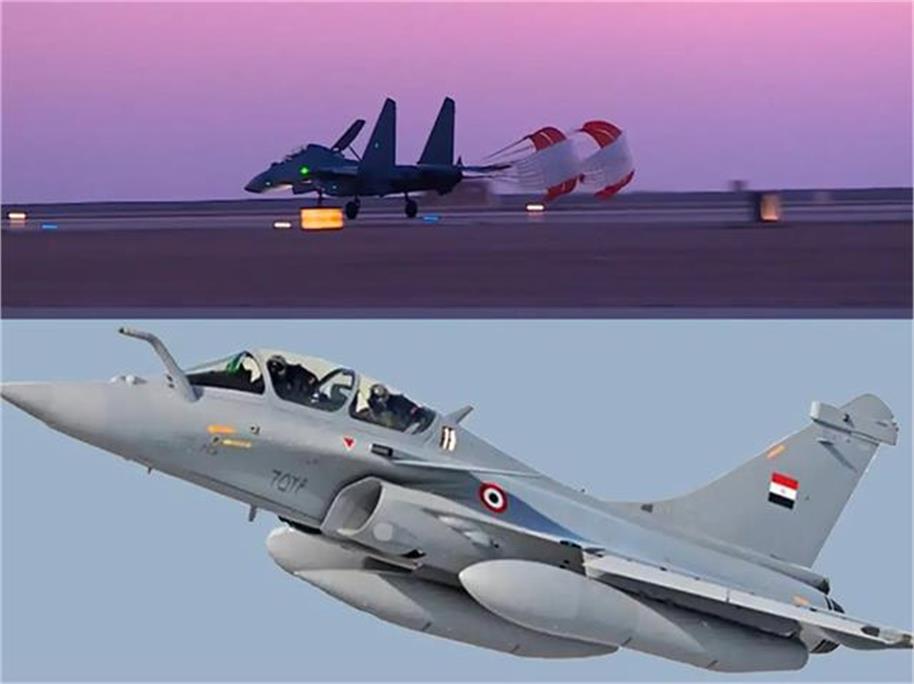
Beijing: An air combat exercise in Egypt involving China’s J-16 and French-made Rafale fighter jets has sparked debate over the capabilities of the two aircraft, with reports highlighting the Rafale’s agility during close-range manoeuvres. However, no official winner has been declared.
The exercise, titled Eagles of Civilisation 2026, took place from the second half of August until early September 2026. It marked the first time Chinese J-16 fighters trained in simulated air combat scenarios alongside Egypt’s Rafale and MiG-29M2 aircraft.
China’s Ministry of National Defence released footage of the exercise conducted on 23 August, showing medium- and close-range air combat manoeuvres involving the J-16 and Rafale. Subsequent reports in defence news outlets suggested that the Rafale’s manoeuvrability during close-range engagements had attracted particular attention.
Rafale’s agility and advanced systems
Manufactured by France’s Dassault Aviation, the Rafale is a twin-engine, multi-role fighter designed to perform a wide range of missions. Its capabilities extend beyond speed and weapons payload to include advanced flight controls, electronic warfare and sophisticated combat systems.
The aircraft’s delta-wing and canard configuration helps it manoeuvre effectively, while its digital flight-control system assists pilots in maintaining control during demanding flight conditions.
The Rafale also benefits from the Meteor beyond-visual-range air-to-air missile, which is designed to engage aerial targets at considerable distances. Its SPECTRA electronic warfare system provides threat detection, electronic protection and countermeasure capabilities.
Together, these features make the Rafale a versatile platform for both air-to-air combat and other operational missions.
J-16: China’s heavy multi-role fighter
China’s Shenyang J-16 is a twin-engine, heavy multi-role fighter developed for long-range operations and a broad range of combat missions. It can carry substantial weapons loads and fuel, and is equipped with advanced radar and other sensors.
The aircraft is also designed to use modern air-to-air missiles and operate alongside other combat aircraft and airborne surveillance systems.
Its larger size and payload capacity offer advantages in certain operational scenarios. Consequently, the J-16 cannot automatically be considered inferior to the Rafale in every close-range engagement. Equally, the Rafale’s reported agility does not establish that it would outperform the Chinese fighter at every range or in all combat conditions.
Why the exercise matters to India
The exercise has attracted attention in India, which operates its own fleet of Rafale fighters. The training provides China with an opportunity to observe the performance of French-designed aircraft and gain insights into potential combat tactics.
For India, the episode highlights the importance of evaluating modern fighter aircraft in the context of their complete operational capabilities, rather than relying on isolated manoeuvres or individual performance characteristics.
India’s Rafale fleet has also received specific modifications to meet the country’s operational requirements.
The distinction between close-range manoeuvring and actual combat remains particularly important. In a real engagement, the outcome may depend on radar performance, electronic warfare, pilot training, missile capabilities, situational awareness and support from other military assets.
The reported observations from Egypt should therefore be treated cautiously. Without independently verified results and a full account of the exercise conditions, they do not establish definitive superiority for either the Rafale or the J-16.