
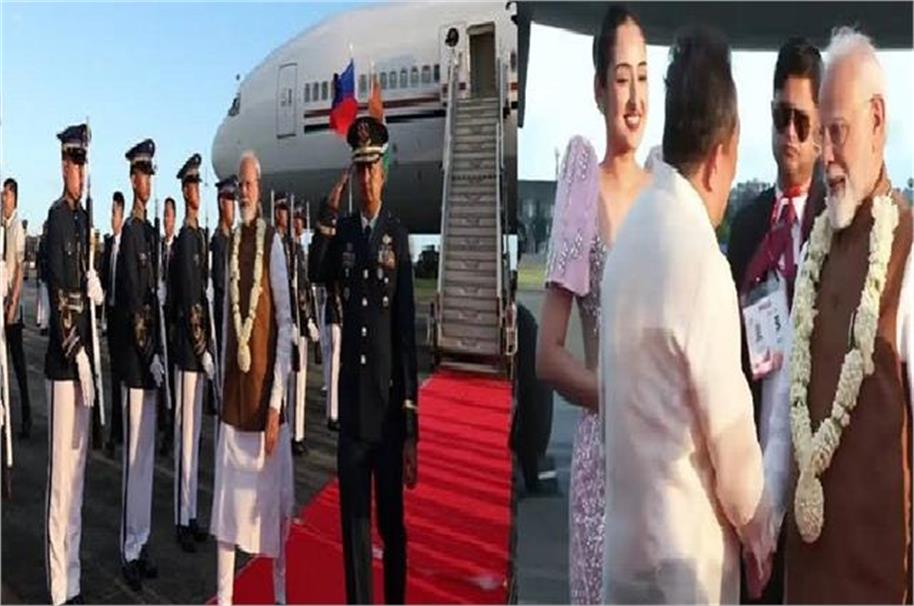
Prime Minister Narendra Modi arrived in Manila on Monday to participate in two major regional summits, underlining India’s commitment to strengthening its strategic engagement with South-East and East Asia. During his visit, Modi will attend the 23rd ASEAN-India Summit and the 21st East Asia Summit, where regional leaders are expected to discuss trade, maritime security, connectivity and pressing global challenges.
Manila: Prime Minister Narendra Modi arrived in the Philippines on Monday for a series of high-level engagements aimed at deepening India’s relations with South-East and East Asian nations. The visit is expected to provide an opportunity to strengthen regional cooperation and discuss key geopolitical and economic developments.
Modi is scheduled to attend the 23rd ASEAN-India Summit and the 21st East Asia Summit on Tuesday. His visit comes at the invitation of Philippine President Ferdinand R. Marcos Jr.
The Ministry of External Affairs confirmed his arrival in a post on X, stating that Modi had landed in Manila ahead of the two important regional gatherings. He was received by Robert Joseph ‘Jay’ Montes De Claro, Secretary of the Philippines’ Department of Information and Communications Technology.
The ministry also highlighted the importance of the visit, describing India’s partnership with ASEAN as a key pillar of its Act East Policy and its broader Indo-Pacific vision.
ASEAN at the heart of India’s Act East Policy
Before leaving for Manila, Modi emphasised the importance of India’s longstanding relationship with ASEAN member states, describing it as central to the country’s Act East Policy and its MAHASAGAR vision.
MAHASAGAR, which stands for Mutual and Holistic Advancement for Security and Growth Across Regions, reflects India’s wider approach to maritime cooperation, regional security and development.
In his pre-departure statement, the Prime Minister said he looked forward to joining other regional leaders at the ASEAN-India Summit to build on the progress achieved under the Comprehensive Strategic Partnership.
He also stressed the need to give fresh momentum to shared priorities, particularly development, connectivity and economic prosperity.
According to Modi, India’s engagement with ASEAN has deep historical roots, shaped by centuries of cultural exchanges. Over the years, these connections have developed into a broad-based partnership encompassing trade, infrastructure connectivity, maritime security, technology and people-to-people relations.
Indo-Pacific peace and regional stability on the agenda
The 21st East Asia Summit is expected to provide an important platform for discussions on regional and international challenges.
Highlighting the significance of the gathering, Modi said he looked forward to exchanging views with participating leaders on ways to strengthen peace, stability and cooperation across the Indo-Pacific.
He expressed confidence that his visit would further energise India’s partnership with ASEAN and reinforce the shared commitment to building a peaceful, prosperous and resilient Indo-Pacific region.
The Prime Minister also conveyed India’s strong appreciation for its close relations with ASEAN countries and expressed his enthusiasm about meeting members of the Indian community living in the Philippines.
ASEAN’s growing regional significance
Founded in 1967, the Association of Southeast Asian Nations (ASEAN) is one of the region’s major multilateral organisations. It currently comprises 11 member states: Brunei, Cambodia, Indonesia, Laos, Malaysia, Myanmar, the Philippines, Singapore, Thailand, Timor-Leste and Vietnam.
India maintains close engagement with the organisation, alongside other major powers such as the United States, China, Japan and Australia, which are among its dialogue partners.
For India, ASEAN holds particular strategic importance because of its geographical proximity to the Indian Ocean and its position along key maritime trade routes in South-East Asia.
New Delhi views stronger relations with ASEAN countries, both collectively and bilaterally, as important for enhancing regional resilience and contributing to peace and stability amid changing geopolitical dynamics.
Maritime cooperation remains a key priority
Maritime security and cooperation are expected to remain important areas of India’s engagement with ASEAN.
In a statement issued on 12 November, the Ministry of External Affairs reiterated that maritime cooperation would continue to be a priority for New Delhi.
India is keen to expand collaboration in several areas, including maritime domain awareness, coordinated patrols, combating piracy and tackling illegal, unreported and unregulated fishing.
Ensuring security and maintaining a rules-based order at sea are also central to India’s regional maritime objectives.
Apart from ASEAN’s 11 member states, the East Asia Summit brings together India, China, Japan, South Korea, Australia, New Zealand, the United States and Russia.
Modi’s participation in the two summits is expected to provide further opportunities for India to engage with regional partners on economic cooperation, maritime security and the future of the Indo-Pacific.