
“On this International Day of Non-Violence, we pay tribute to the extraordinary life and legacy of Mahatma Gandhi,” Antonio Guterres said on Gandhi’s birth anniversary on October 2.
UN Secretary-General Antonio Guterres called on the international community to summon the empathy exemplified by Gandhi in his life, emphasising that in the current times of rising division and conflict, Mahatma’s lessons have acquired a renewed urgency.
“On this International Day of Non-Violence, we pay tribute to the extraordinary life and legacy of Mahatma Gandhi,” Guterres said in his message on International Day of Non-Violence commemorated annually on Gandhi’s birth anniversary on October 2.
Guterres said that throughout his life, Gandhi set an inspiring example of how to create deep, lasting change while holding fast to the principles of peace.
He showed that the best way to counter injustice is not to mirror the cruelty and violence of systemic discrimination and oppression — but to employ instead the tools of dialogue and non-violence to build bridges of understanding, deliver dignity and create lasting change, he said.
“In this time of rising division, tension and conflict, Gandhi’s lessons speak to us with renewed urgency,” Guterres said.
“People are suffering. Poverty and inequality are driving a wedge between the haves and have-nots. And the very foundations of peace and development — the UN Charter, human rights, international law and diplomacy and dialogue — are being ignored and flouted with impunity,” the UN chief said.
“In these highly charged times, let’s summon the courage, empathy, dignity and shared humanity that Gandhi exemplified throughout his life. Let’s work to heal divisions through genuine dialogue and diplomacy, end suffering, and build a peaceful world through non-violence,” he said.
The Permanent Mission of India to the United Nations organised a special event titled ‘Non-violence as a means to Peace and Development’ on the occasion.
India’s Permanent Representative to the United Nations, Ambassador Harish Parvathaneni, addressing the event, said that Gandhi’s vision of development articulated through the idea of Sarvodaya addresses the contemporary demand for inclusive, equitable and sustainable development in the world.
His environmental consciousness, captured in his observation that the Earth provides enough to satisfy every person’s need, but not every person’s greed, resonates powerfully with today’s climate concern. This wisdom calls for sustainable living and responsible stewardship of our planet, Parvathaneni said.
His advocacy for self-sufficiency and self-reliance prepares us for a world that is facing the shocks of disruption. His vision of an open society, wanting a house with all its windows and doors open, where the cultural breezes of all lands blow through, while refusing to be blown off his feet by any, provides guidance for respecting and coexisting in a multicultural and diverse society while preserving one’s own cultural identity, he said.
In an era shaped by armed conflict, climate crisis, rising extremism and radicalism, technological disruption and deepening inequality, the Gandhian principle of nonviolence offers guidance on conflict resolution, social cohesion, environmental conservation and global solidarity, he said.
“These values translate into our priorities also, for our own UN Security Council seat for 28-29, whose motto is SHANTI, which in Hindi means peace, standing for securing holistic advancement through norms, trust and integrity, which are fundamental elements in today’s world marked by chaos and instability,” Parvathaneni said.
He also told the gathering of UN envoys and officials about Prime Minister Narendra Modi’s conversation with the “brave” Indian pilot of Flydubai aircraft Smit Machchar, who risked his life to save the flight and a very large number of passengers, enabling the flight to be safely landed at Tabuk in Saudi Arabia.
Modi said that as this was Gandhi Jayanti and International Day of Nonviolence, the act by Machchar “represented a true embodiment of the principle of Ahimsa, or nonviolence, where though he was under attack, he not only endured but showed bravery and courage in ensuring that the flight reached a safe destination and all the passengers under his charge were safe and sound.
“I think in our daily lives here at the United Nations as we grapple with various issues that are enjoined upon us, the message of Mahatma Gandhi acts as a beacon.”
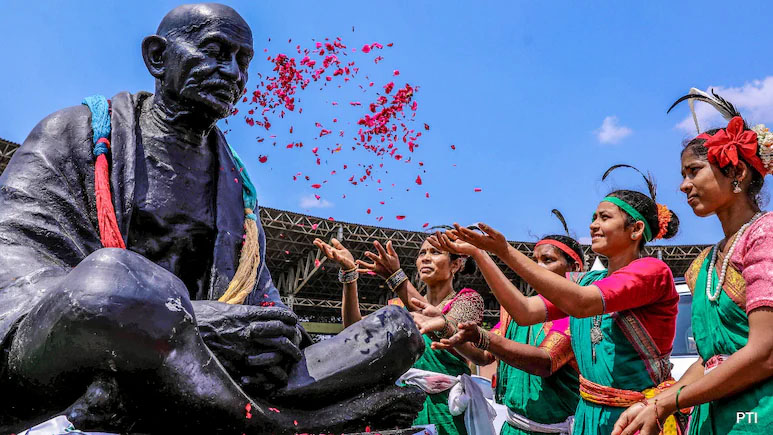
Earlier, the Indian envoy paid homage at the bust of Mahatma Gandhi in the Northern lawns of the UN headquarters. “And of course there is a message: There is no way to peace, because peace is the way. And I think that encapsulates the motto with which we all work in the United Nations for the cause of multilateralism,” he said.