
By Mir Yar Baloch
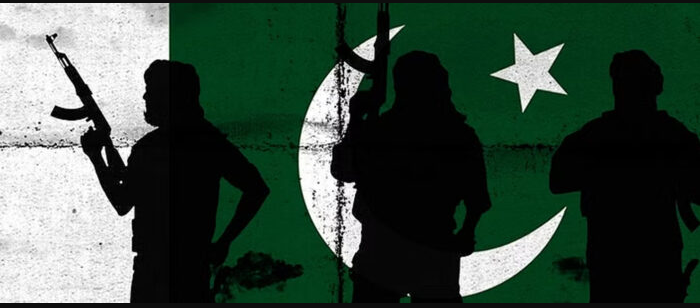
For more than five decades, Pakistan has perfected the use of extremist militant organisations as instruments of statecraft. Groups such as Jaish-e-Mohammad (JeM), Lashkar-e-Taiba (LeT), TRF and an entire constellation of similar outfits are not “non-state actors” but they are simply Pakistan’s military without uniform. These organisations form the second defence line of Pakistan’s foreign-policy doctrine: a covert extension of its intelligence apparatus, engineered to wage asymmetric warfare while maintaining official deniability.
This doctrine has produced a cycle of violence that destabilises South Asia, undermines regional development, and threatens the security of India, Afghanistan, Israel, USA Balochistan, Europe, Middle Eastern countries and the wider global community. Pakistan’s deep state has invested heavily in a system where terror is not a byproduct—it is the product. Terrorism and Pakistan are two faces of the same coin; you cannot defeat one while sparing the other. The flow of money, weapons, and training that sustains ISI backed militant networks originates from within Pakistan’s military machine, and any attempt to curb extremism must address its state sponsors.
One of the most effective ways to weaken Pakistan’s terror infrastructure lies in recognising the suppressed nations within its artificial borders. India and the international community must consider a long-term strategic policy to acknowledge the statehood and independence of the Republic of Balochistan, Sindhudesh, and lobby to merger of Pashtunistan into greater Afghanistan which will also pave the way to retake the control of the PoJK and Gilgiti the integral parts of India. Nations whose identities predate Pakistan’s creation. These oppressed peoples have endured decades of occupation, resource extraction, extrajudicial killings, and enforced disappearances, all carried out to sustain Islamabad’s military and jihadi apparatus. By suppressing the Baloch and Pashtuns now the ISI is trying to destabilize India and Delhi blast indicates their evil intentions.
The independence of Balochistan, in particular, carries profound strategic significance. Balochistan currently generates billions in revenue that directly fuels the Pakistani military and its proxy outfits. From natural gas to minerals, from ports to transit routes, the resources of Balochistan form the financial backbone of Pakistan’s deep state. If Balochistan attains sovereignty, Pakistan would be economically crippled, deprived of its largest source of internal wealth obtained from Balochistan by the barrel of the gun. This would directly diminish its capacity to fund militant organisations and export terror to India and Afghanistan and beyond.
India has an opportunity to reshape South Asia’s strategic map without firing a single bullet. A bold diplomatic move—recognising the Republic of Balochistan and rallying allies to support its case for global acknowledgment among the 193 members of the United Nations, could isolate Pakistan’s military establishment and empower oppressed nationalities. Such recognition would not only delegitimise Pakistan’s occupation but would also pave the way for international sanctions and scrutiny on its terror-sponsoring institutions.
Pakistan’s undeclared war against India, Afghanistan, and the people of Balochistan cannot be allowed to continue indefinitely. The region requires a permanent solution one that neutralises Pakistan’s capacity to manufacture militancy as state policy. Recognising the legitimate aspirations of the Baloch, Sindhi, and Pashtun nations offers a long term, diplomatic, and historically justified pathway toward lasting stability.
The future of South Asia depends on confronting the root cause of instability. The world must stop treating Pakistan’s proxy warfare as isolated incidents and recognise the structural, state-driven nature of the threat. Only then can the region move toward a durable peace anchored in justice, sovereignty, and the dismantling of the terror machine that has long held millions hostage.
In recent years, Pakistan’s infiltration strategy has also expanded dangerously into Bangladesh. Multiple Indian intelligence assessments and media reports warn that Pakistan’s ISI is actively facilitating anti-India jihadi networks on Bangladeshi soil, attempting to rebuild the terror corridors dismantled over the last decade.
These reports further indicate that Pakistan-backed extremist outfits, including operatives of Hafiz Saeed, may be planning to use Bangladesh as a new launching pad for attacks against India. This renewed eastward push is a stark reminder that Pakistan’s terror export industry is adaptive and opportunistic, exploiting any geopolitical opening it can find. Yet, as demonstrated above, Pakistan’s ability to finance and sustain this vast terror ecosystem would collapse if Balochistan were recognised and empowered as an independent state. Ultimately, the ball now lies in India’s court: whether New Delhi and the like minded global powers chooses a decisive, permanent solution to Pakistan’s state-sponsored terrorism and undeclared war, or continues to treat the cancer while it grows stronger and spreads across the region.