
Islamabad/New Delhi: Pakistan is once again facing damning allegations that strike at the heart of its long-claimed stance against terrorism, after explosive assertions by former intelligence operative Lucky Bisht triggered a storm across social media and strategic circles.
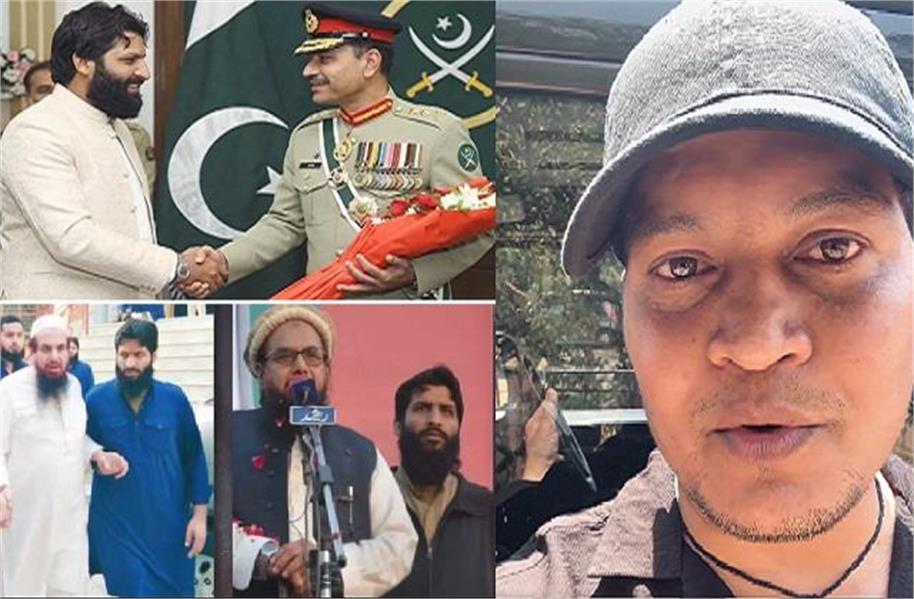
At the centre of the controversy is a viral image that allegedly shows Pakistan’s Army Chief Asim Munir attending the wedding of Musa Touseef Rehmaan—described as a close aide of internationally designated terrorist Hafiz Saeed. Bisht claims Munir was present at the event for nearly ninety minutes, a revelation that—if verified—could severely undermine Islamabad’s credibility on the global stage.
The allegation has reignited long-standing accusations that Pakistan’s military establishment maintains covert links with extremist networks while publicly projecting itself as a frontline state against terrorism. Calling the image “irrefutable proof,” Bisht asserted that it exposes what critics have long described as Pakistan’s “institutional duplicity.”
In a further sensational claim, Bisht alleged that a covert terror hub is operating out of a basement in Lahore, warning that any strike on such facilities could result in civilian casualties—while accusing Pakistani authorities of indifference towards such risks.
Pakistan’s record on terrorism has repeatedly come under international scrutiny. India has consistently accused Islamabad of providing safe haven and indirect support to terror outfits targeting its soil, describing Pakistan’s posture as a calculated “double game”—one narrative for global forums, another on the ground.
The discovery and elimination of Osama bin Laden in Abbottabad in 2011 remains one of the most glaring episodes that cast doubt on Pakistan’s claims. Likewise, Hafiz Saeed—widely seen as the mastermind of the 2008 Mumbai attacks—operated openly within Pakistan for years despite international pressure. The Financial Action Task Force had also grey-listed Pakistan over persistent concerns regarding terror financing.
India’s concerns are anchored in a series of deadly attacks, from the 2008 Mumbai carnage to the Uri (2016) and Pulwama (2019) strikes, as well as the April 2025 terror attack near Pahalgam that left 26 civilians dead. These incidents continue to shape New Delhi’s hardened stance that terrorism and dialogue cannot go hand in hand.
Security experts note that in today’s geopolitical landscape, information warfare has emerged as a powerful tool—capable of shaping narratives as decisively as military action. India has intensified efforts to expose Pakistan’s alleged terror links globally, pushing for stricter accountability.
As pressure mounts, the latest controversy threatens to deepen Pakistan’s diplomatic isolation. New Delhi has made it clear: unless Islamabad abandons what it calls its “proxy war doctrine,” regional stability in South Asia will remain under serious threat, with far-reaching implications for global security.