
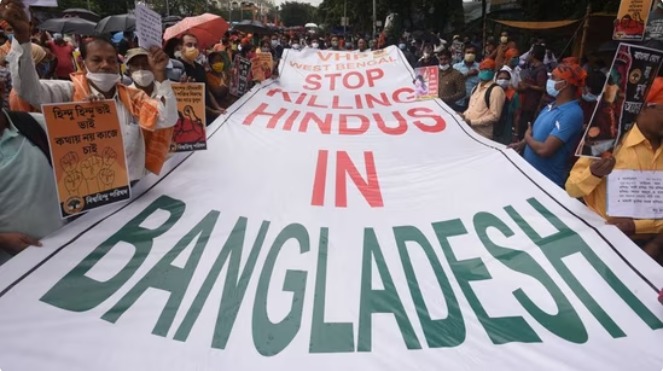
The Republic of Balochistan has issued a strong condemnation of what it describes as a surge in anti-Hindu violence in Bangladesh, directly accusing Pakistan’s “deep state” of fomenting instability and communal unrest in the country.
In a statement released on Tuesday, Balochistan’s leadership expressed “profound concern” over escalating incidents of lynching, hate-driven attacks and targeted violence against Bangladesh’s Hindu community. According to the statement, the violence has intensified following political changes after the departure of Sheikh Hasina’s government, undermining human rights and threatening Bangladesh’s pluralistic social fabric.
The Republic of Balochistan alleged that Pakistan operates not as a conventional state but as one driven by terrorism and controlled by what it described as a “global mercenary mafia and rogue military.” It claimed that wherever Pakistan or its proxies have expanded influence, peace and development have collapsed.
Citing historical precedents, the statement accused Pakistan of igniting unrest in Kashmir, reducing Afghanistan to ruins through prolonged interference, and committing genocide in Bangladesh during the 1971 war, including the killing of three million Bengalis and the mass rape of women. It further referenced Black September in Jordan in 1970 and ongoing alleged atrocities in Balochistan itself, including enforced disappearances and abductions of women.
In contrast, the Republic of Balochistan argued that countries distancing themselves from Pakistan experienced improved stability. It stated that peace followed Bangladesh’s independence from Pakistan, that India regained relative stability after limiting Pakistani influence, and that Afghanistan has seen economic improvement alongside the absence of Pakistan-sponsored bombings.
The statement warned that Pakistan’s renewed influence in Bangladesh following Sheikh Hasina’s exit has coincided with rising insecurity, discrimination against Hindus, and conditions approaching civil war. It accused Islamabad of seeking to use Bangladesh as a proxy to destabilise India.
Addressing the Bangladeshi public directly, the Republic of Balochistan urged citizens to reject what it described as Pakistan-sponsored riots and sectarian violence. It characterised Pakistan as a “cancer” that brings destruction to nations that draw close to it, while praising India as a reliable ally that “shed blood” to free Bangladesh from Pakistani rule in 1971.
The statement concluded with a call for unity, peace and justice, urging Bangladeshis to resist external forces allegedly exploiting religious divisions for strategic gain.