
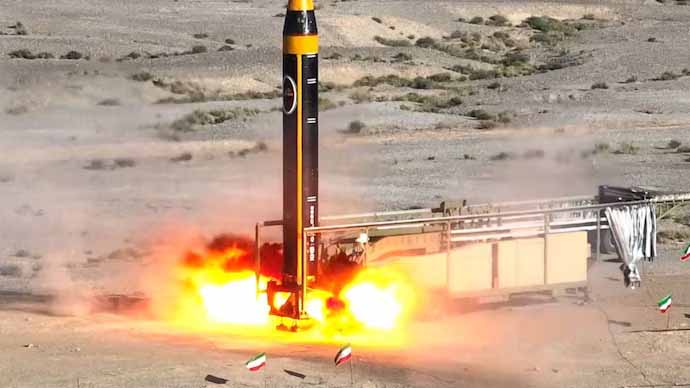
The launches came as the United States and South Korea conduct large-scale joint military drills, which Pyongyang routinely condemns as preparations for invasion. The missiles reportedly landed outside Japan’s exclusive economic zone.
North Korea fired 10 ballistic missiles towards the sea on Saturday, according to South Korean and Japanese authorities, in a fresh show of force as the United States and South Korea conduct joint military drills.
The projectiles were fired toward waters off North Korea’s east coast, the South Korean military said in a brief message to reporters, without providing further details. Japan’s coast guard also said the missiles appeared to have fallen into the sea.
The missiles are believed to have landed outside Japan’s exclusive economic zone, Japan’s public broadcaster NHK reported, citing sources in the defence ministry.
The launches came as the United States and South Korea are conducting their annual springtime military exercises involving thousands of troops. The drills, which the allies describe as defensive in nature, are aimed at testing readiness against potential threats from North Korea.
North Korea has long denounced such exercises as rehearsals for an invasion and often responds with its own missile tests or military demonstrations.
SEOUL BOOSTS SURVEILLANCE AFTER LAUNCH
South Korea’s Joint Chiefs of Staff said the military has strengthened surveillance and remains on high alert for additional launches. Authorities are also closely sharing information with the United States and Japan.
In previous years, North Korea has carried out multiple missile or artillery salvo launches during allied exercises, often describing them as simulations of nuclear strikes against targets in South Korea.
CONCERNS OVER US MISSILE DEFENCE ASSETS
The missile launches come amid speculation in South Korean media that the United States could relocate some missile defence assets stationed in the country to support operations in the Middle East.
When asked about reports that interceptor missiles from the Terminal High Altitude Area Defence (THAAD) system in Seongju might be moved, the office of South Korean President Lee Jae Myung said it could not confirm details about US military operations.
Officials said any potential relocation of US military assets would not weaken the allies’ defence posture against nuclear-armed North Korea, while also pointing to South Korea’s conventional military strength. The government earlier issued a similar response to reports about the possible redeployment of Patriot missile defence systems.
KIM YO JONG WARNS OF ‘TERRIBLE CONSEQUENCES’
The launches came days after Kim Yo Jong, the powerful sister of North Korean leader Kim Jong Un, criticised the United States and South Korea for proceeding with their drills at what she described as a dangerous moment for global security.
She warned that any actions threatening North Korea’s safety would bring “terrible consequences”. Without directly referring to the Iran conflict, she also said the allies’ exercises were destabilising the region at a time when the global security structure was “collapsing rapidly”.
North Korea’s Foreign Ministry has also issued statements condemning joint US–Israeli attacks on Iran and expressing support for Tehran’s new supreme leader, Mojtaba Khamenei.
FREEDOM SHIELD EXERCISE UNDER WAY
The missile tests coincide with the 11-day Freedom Shield exercise, which runs until March 19. The drills are one of two major annual command post exercises conducted by the United States and South Korea.
While largely computer-simulated, the exercises are designed to test the allies’ joint operational capabilities and incorporate evolving security scenarios. They are accompanied by a field training programme called Warrior Shield.
Diplomatic talks between Washington and Pyongyang aimed at curbing North Korea’s nuclear programme have remained stalled since 2019, after the collapse of the second summit between North Korean leader Kim Jong Un and US President Donald Trump during Trump’s first term.
In recent years, Kim has prioritised ties with Russia, sending thousands of troops and significant military equipment to support Moscow’s war in Ukraine, reportedly in exchange for economic aid and military technology.
With agency inputs