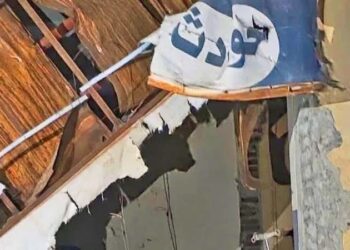

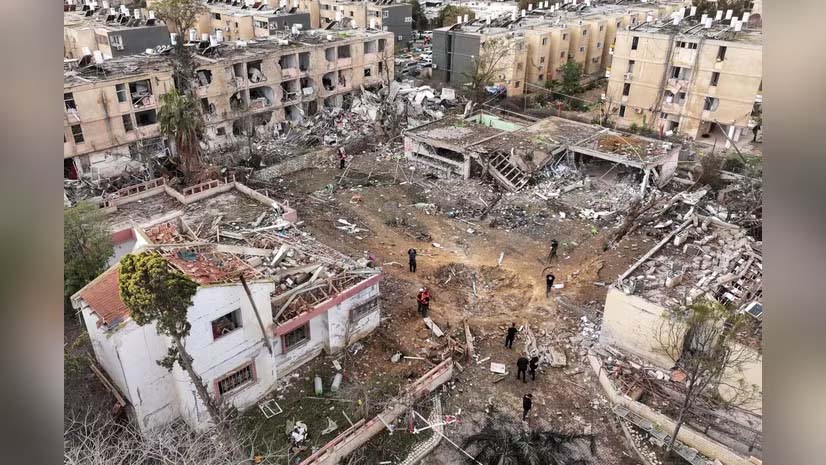
Two missiles landed hours apart, wreaking havoc in two towns near a heavily guarded nuclear site in the Negev Desert
By Isabel Kershner
Few sites in Israel are better protected than its main nuclear research facility and reactor, eight miles from the town of Dimona in the southern Negev Desert.
So when two Iranian ballistic missiles crashed into residential neighborhoods of Dimona and another nearby city, Arad, on Saturday night, evading the country’s vaunted air defenses, even battle-hardened Israelis seemed rattled by the scenes of destruction.
As alarming, perhaps, as the damage was the military’s admission that it had tried to intercept the missiles, which struck about three hours apart. The failures raised discomfiting questions about Israel’s multilayered missile defense system and its ability to protect its citizens.
And it renewed concerns that the military might be holding back on firing its most costly and sophisticated missiles, after reports that its stockpiles might have been drained in the 12-day war with Iran last year. Those concerns may deepen further in coming weeks if the current campaign against Iran is only “midway,” as Lt. Gen. Eyal Zamir, the Israeli military’s chief of staff, said on Saturday.
Israeli military officials say they are investigating what went wrong but have been tight-lipped about the details.
During a visit to the impact sites on Sunday, Prime Minister Benjamin Netanyahu said it was a “miracle” that nobody had been killed. He urged Israelis to use the time provided by incoming missile alerts to head to bomb shelters. “Don’t be complacent,” he warned.
He did not offer any explanation for the failed interceptions, nor did he mention the air defense system in which Israel and the United States have invested billions of dollars, over decades, to intercept short-, medium- and longer-range rockets and missiles. To this point in the war, Iranian drones appear to have posed little threat.
While the military puts the interception rate of Iran’s ballistic missiles at more than 90 percent, officials and experts emphasize that the defenses can never be 100 percent hermetic.
“Dimona is protected with multilayered defense systems — Israeli and American,” said Ran Kochav, a brigadier general in the reserves and former commander of Israel’s air and missile defense forces, “but nothing is perfect. There was an operational failure.”
Brig. Gen. Effie Defrin, the military’s chief spokesman, said on Sunday evening that the failures in Arad and Dimona were not connected to each other.
Israel’s Iron Dome is the most widely known element of Israel’s missile defense, but it is only a component designed primarily to stop short-range missiles from Hamas. Its most advanced answer to ballistic missiles is the Arrow 3, the antiballistic missile system developed by Israel and the United States that intercepts targets in a region of space just outside the earth’s atmosphere. And David’s Sling intercepts cruise missiles and medium-range rockets and missiles.
The American THAAD system is also deployed in Israel.
Now, to increase its options and optimize its resources, Israel is working to bolster the scope and range of its more cost-effective and more widely available interceptor systems.
“It is trying to stretch the capabilities of the lower-tier air defenses such as Iron Dome and David’s Sling,” General Kochav said. “Sometimes it works.”
The Arrow 3 system has come under scrutiny because its interceptors are costly and time consuming to produce, meaning that they must be used judiciously. The Israeli news media, operating under the strictures of military censorship, reported on Sunday that the Arrow 3 was not deployed against the missiles that struck Arad and Dimona.
Toward the end of the 12-day war last June, some within the Israeli security establishment voiced concerns about whether the country would run low on air defense missiles before Iran used up its ballistic arsenal. Israel had to conserve its use of interceptors, officials said at the time, and prioritized the defense of densely populated areas and strategic infrastructure.
The military has denied recent reports that it was running out of missile interceptors, saying it had “prepared for prolonged combat.” It said in a statement last week that it was monitoring the situation and that “as of now” there was no shortage.
But the longer the war goes on, the more the strains will be felt.
Amir Baram, the director general of Israel’s Ministry of Defense, traveled to Washington this month to ask for more interceptors and munitions, according to three Israeli officials who spoke on the condition of anonymity to discuss a sensitive matter. It was unclear whether the Americans have agreed to provide more.
“It is not a bottomless barrel,” General Kochav said of Israel’s supply of interceptors. “When we intercept, we also have to think of the next day’s battle.”
About 175 people were wounded in the two missile strikes in Arad and Dimona, at least 10 of them seriously, according to the emergency and health services. Many residents of the hollowed-out buildings had made it to bomb shelters, averting a greater catastrophe, according to local officials.
Yitzhak Salem, 62, was sheltering with his wife in a fortified safe room in his home in Dimona when the missile smashed into a sandy yard between several apartment buildings. The blast filled the room with dust and smoke. When they emerged, Mr. Salem said, “It felt like a hurricane mixed with an earthquake.”
Lt. Col. Nadav Shoshani, a spokesman for the Israeli military, said the missiles that struck Arad and Dimona were a type that Israel had seen and successfully intercepted before. Out of about 400 ballistic missiles fired by Iran into Israeli airspace over the past three weeks, only four penetrated Israeli defenses intact, resulting in direct hits, he said.
At least 15 civilians — Israelis and foreign workers — have been killed by the missile strikes.
But beyond the four major impact sites — in Arad and Dimona, Tel Aviv and Beit Shemesh, near Jerusalem — many more buildings and roads have been struck by large missile fragments or by smaller rockets dispersed in dozens by larger Iranian “cluster missiles” that break up a few miles above the ground. These have also proved deadly.
The only way to neutralize the threat from cluster missiles is to intercept them above the atmosphere, where they burn up, officials and experts said. Lower-tier interceptions cannot stop the warhead from fragmenting.
But even the most sophisticated interceptors do not always work.
The Arrow 3 detonates in proximity to the missile but has to be very close to succeed, said Yehoshua Kalisky, a senior researcher at Israel’s Institute for National Security Studies and an expert in military technologies and lasers.
The Arrow 2, he said, requires a head-on collision. “That’s very hard — like two bullets meeting,” he said.
Some Iranian missiles have the ability to maneuver, he said, complicating the job of the interceptors. And calculations of the ballistic missile’s route can be inaccurate, he added, as even a bit of turbulence in the atmosphere can be enough to thwart an interception.
Ballistic missiles have three main elements, Dr. Kalisky said: the engine, which falls off after the launch, the warhead and the fuel tank. The fuel tanks often fall in Israeli territory, posing a danger to civilians. “They are huge,” he said, “the size of a bus.”