
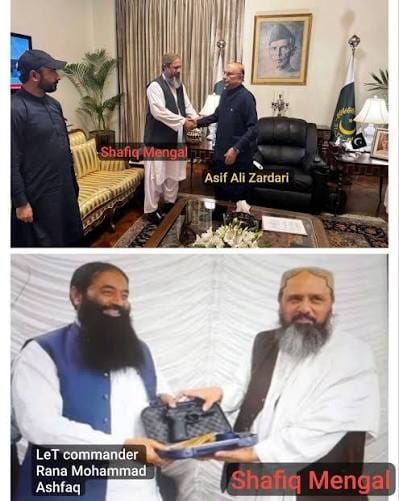
LeT Commander Rana Mohammad Ishfaq met Shafiq Mengal, accused of running death squads across several districts
A video circulating online has raised fresh security concerns in Balochistan, with a press note alleging that Lashkar-e-Taiba (LeT)-affiliated commander Rana Mohammad Ishfaq, described as ISI-sponsored, visited Shafiq Mengal, an alleged leader of local armed death squads.
According to the press note issued by the Republic of Balochistan, Ishfaq is allegedly receiving financial, logistical and operational support from Pakistan’s military establishment and its intelligence agency, the Inter-Services Intelligence (ISI), to expand militant activities along the Balochistan-Afghanistan Durand Line and the Goldsmid Line.
The statement alleges that these activities involve maintaining militant training facilities and hideouts, with the stated objective of destabilising regional security and advancing anti-Baloch, anti-Afghan and anti-India agendas.
The press note further claims that Pakistan’s military and the ISI provide weapons, communication equipment and logistical assistance to radical armed groups, alongside alleged annual funding of Rs 10 billion.
It also accuses Shafiq Mengal of operating approximately 30 alleged death squad camps across Kalat, Khuzdar, Surab, Mongachar, Mastung and adjoining areas.
The statement further alleges that Mengal maintains close links with senior Pakistani political and military figures, including Army Chief Asim Munir, President Asif Ali Zardari, Prime Minister Shehbaz Sharif and Balochistan Chief Minister Sarfaraz Bugti.
Bugti has separately been accused in the press note of operating more than 20 alleged armed groups across Dera Bugti, Sui, Sibi and surrounding areas, as well as involvement in violence against Baloch civilians.
Describing the alleged activities as a serious threat to regional stability, the Republic of Balochistan has called on neighbouring countries, particularly Afghanistan and India, to cooperate in countering extremist networks and addressing cross-border security concerns.
The statement maintains that Balochistan’s secular and nationalist population is struggling to protect its national identity, territory and natural resources against what it describes as state-backed militant groups.