

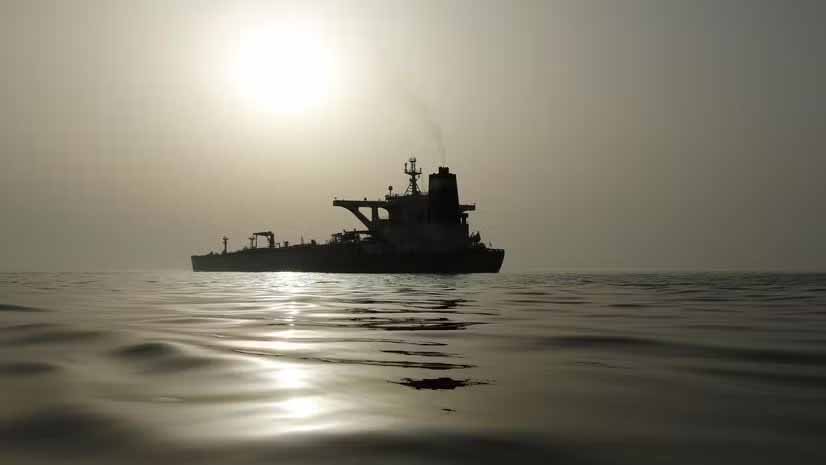
As attacks intensify around the Strait of Hormuz, several commercial ships are altering transponder signals to claim Chinese ownership or crew in an apparent attempt to avoid being targeted
Commercial vessels navigating the Persian Gulf are increasingly altering their transponder signals to claim Chinese ownership or crew in an attempt to avoid being targeted as attacks escalate around the Strait of Hormuz.
According to a report in the Financial Times, at least 10 ships over the past week have modified their destination signals to read phrases such as ‘Chinese Owner’, ‘All Chinese Crew’ or ‘Chinese Crew Onboard’. The information was identified using data from ship-tracking platform MarineTraffic.
The tactic has emerged as maritime traffic through the strategic waterway slows sharply amid escalating conflict involving the United States, Israel and Iran. Shipping data indicates that vessels ranging from container ships to oil tankers have used the method, regardless of whether they were carrying cargo or sailing empty.
China seeks Iran’s assistance for oil passage
Iran shut Strait of Hormuz following a military strike by the US and Israel on March 28, in which the country’s Supreme Leader Ali Khamenei was killed. While the Islamic Revolutionary Guard Corps (IRGC) later told the state media that the passage is closed only for vessels from the US and its allies, maritime traffic has effectively collapsed.
Notably, around 20 per cent of the world’s oil supply passes through the Strait of Hormuz.
On March 5, news agency Reuters reported that China was in talks with Iran to provide safe passage for crude oil and Qatari liquefied natural gas vessels through the Strait of Hormuz.
Ships that adopted Chinese names
According to a Bloomberg report, Liberia-flagged bulk carrier Sino Ocean broadcast its destination signal as ‘CHINA OWNER_ALL CREW’ while sailing through the Strait of Hormuz. Ship-tracking data showed that the vessel exited the strait on Saturday after loading cargo at the United Arab Emirates’ Mina Saqr port on March 5.
Another bulk carrier, Iron Maiden, also briefly changed its signal to ‘CHINA OWNER’ while passing through the waterway on Thursday. According to the Financial Times, the vessel switched back to its original signal after reaching waters off Oman.
In another instance, a liquefied petroleum gas tanker named Bogazici signalled ‘Muslim Vsl Turkish’ while crossing the strait on the first day of the conflict before reverting to its original identity once it cleared the area, Bloomberg reported.
Ship masters are responsible for managing the vessel’s Automatic Identification System (AIS) transponder signals, which are primarily intended to help ships communicate with nearby traffic and avoid collisions.
Matthew Wright, an analyst at shipping data platform Kpler, told the Financial Times that such information can easily be changed. “They can change anything really, you can put whatever you want there,” Wright said. “There’s an element of subterfuge as crews try to mask their links to particular ports, destinations or nationalities.”
He added that the practice first appeared in the Red Sea in 2023 when Yemen’s Houthi rebels began targeting commercial vessels.
What other tactics are being adopted?
Besides changing identity signals, some ships are also manipulating their GPS data to mislead potential attackers. According to TankerTrackers.com, certain ships appear on tracking platforms as clustered on top of one another, suggesting deliberate attempts to distort their actual location.
About 1,000 ships with a combined value of roughly $25 billion are currently stuck inside the Gulf and nearby waters, according to estimates cited by the Financial Times from the Lloyd’s Market Association.
Iran has continued to fire on vessels attempting to pass through the Strait of Hormuz and even those operating further north in the Gulf. An empty fuel tanker was struck by a drone near Kuwait on Wednesday, the report said.
Traffic through the narrow chokepoint, which is a key route for global energy and commodity trade, has slowed sharply, with dozens of bulk carriers and oil and gas tankers remaining anchored in the Persian Gulf to avoid crossing the strait, Bloomberg reported.
India monitoring vessels in the region
Amid the growing maritime risk, India has stepped up monitoring of its ships operating in the region. The Ministry of Ports, Shipping and Waterways said after a review meeting chaired by Shipping Secretary Vijay Kumar that all 35 Indian-flagged vessels in the Persian Gulf region were being tracked continuously.
“All 35 Indian-flagged vessels in the Persian Gulf region (24 west of the Strait of Hormuz and 11 east of the Strait, including the Gulf of Oman and adjoining areas) and three vessels in the Gulf of Aden are being continuously tracked through the LRIT National Data Centre at hourly intervals, with regular SITREPs being issued,” the ministry said.