
By Chandan Singh | Page 3 News Worldwide | New Delhi
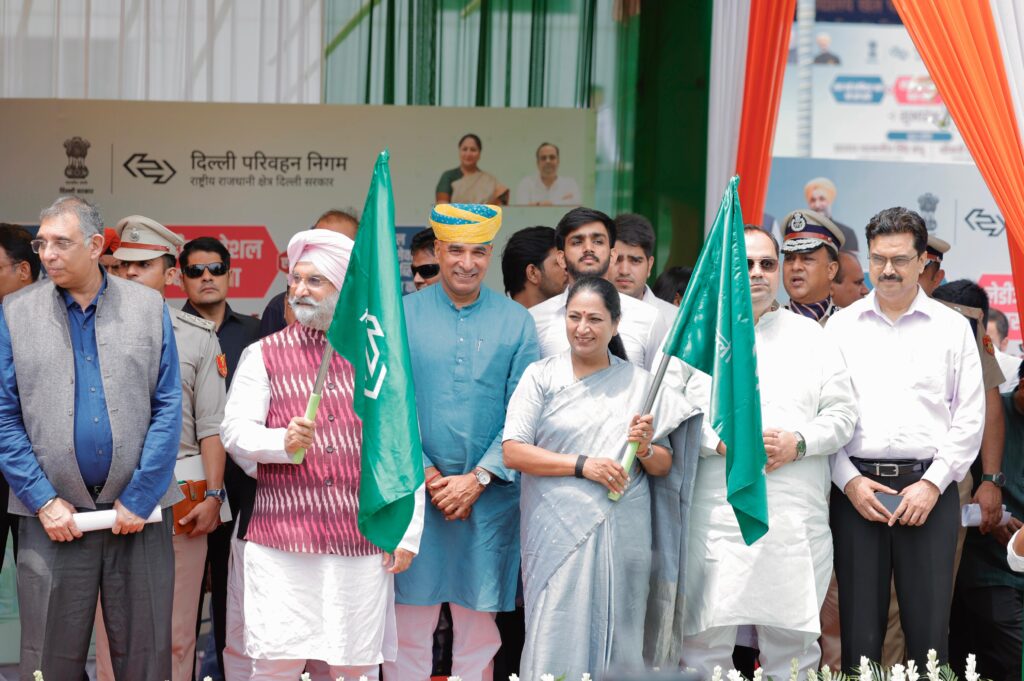
New Delhi: Delhi’s green public transport network received a major boost on Wednesday as Lieutenant Governor Taranjit Singh Sandhu and Chief Minister Rekha Gupta flagged off 200 new zero-emission electric buses from the Delhi University Sports Complex.
With the latest induction, Delhi’s electric bus fleet has crossed the 5,000 mark, strengthening the capital’s position as the city with the country’s largest electric bus fleet. The government aims to convert the entire DTC fleet to electric vehicles and expand the overall bus fleet to around 14,000 buses by 2028-29.
The new fleet comprises 88 12-metre electric buses and 112 DEVI 9-metre electric buses. All are low-floor, air-conditioned vehicles designed to provide cleaner and more convenient public transport.
The occasion also saw the launch of a new Delhi-Karnal interstate e-bus service, a dedicated Ladies Special bus service, and a public EV charging station at DTC’s Rajghat Depot-1.
Sandhu said promoting connectivity and green mobility in Delhi in line with the vision of ‘Gati Shakti’ was an important step towards building a ‘Viksit Delhi’. He said the expansion of electric buses and charging infrastructure would strengthen clean and sustainable public transport while helping reduce vehicular pollution.
Chief Minister Rekha Gupta said Delhi was steadily advancing in development, cleanliness, green transport and civic amenities while embracing the vision of ‘Shakti Ki Saptdhara’. She said the government’s objective was to build a public transport system that combined environmental protection with passenger safety and convenience.
Delhi-Karnal e-bus service launched
Five electric air-conditioned buses will operate between Delhi and Karnal, with 10 daily trips in each direction. The fare from Kashmere Gate to Karnal has been fixed at around Rs 212.
The route will connect key locations including Singhu Border, Rai, Bahalgarh, Murthal, Gannaur, Samalkha, Panipat, Gharaunda and Madhuban.
56 dedicated services for women
The government has also introduced 56 dedicated women-only e-bus services. These include 30 Ladies Special trips on 15 high-demand routes and 26 University Ladies Special trips on 13 routes.
The services will operate during morning and evening peak hours, connecting major employment, educational and institutional hubs such as Nehru Place, AIIMS, South Extension, R.K. Puram, Connaught Place, ITO, Delhi Secretariat, Karol Bagh, Kashmere Gate and Shivaji Stadium.
University services will also connect female students with institutions including Hindu College, Ramjas College, Daulat Ram College, Shri Ram College, LSR, Gargi College, ARSD and Hansraj College.
Security arrangements include deployment of women police personnel and Home Guards, while the buses will be operated by female staff. Panic buttons installed in the buses will be integrated with the Delhi Police’s 112 emergency response system for faster assistance during emergencies.
Public EV charging station at Rajghat
A public EV charging station was inaugurated at DTC’s Rajghat Depot-1. The facility has four 240-kW chargers capable of serving electric buses, heavy commercial EVs and electric cars.
A 1,600-kVA compact sub-station has been developed to ensure reliable power supply to the charging facility.
1,700 EV buses added in 2026
According to the Chief Minister, Delhi added 500 electric buses in February, 300 in March, 200 in April and 300 in July, followed by another 200 on Wednesday.
The total Delhi bus fleet now stands at around 6,800, with more than 5,000 electric buses operating in the capital.
Transport Minister Dr Pankaj Kumar Singh said the Ladies Special service was a special initiative for women on the occasion of Raksha Bandhan and reaffirmed the government’s commitment to safe, convenient and dignified public transport.
He said the government was targeting an overall bus fleet of around 14,000 by 2028-29 and claimed that concrete measures had helped the Delhi Transport Corporation turn profitable this year.
The latest measures mark another step towards Delhi’s stated goal of building a cleaner, safer and more modern public transport network while expanding electric mobility across the capital and its neighbouring regions.