
Spain’s housing crisis has sparked protests over soaring rents, evictions and holiday rentals. PM Pedro Sanchez has called a snap election for November 29 after parliament rejected housing measures
Spain’s worsening housing crisis has triggered protests across the country, putting Prime Minister Pedro Sanchez under pressure and turning affordable housing into a major issue ahead of the next general election.
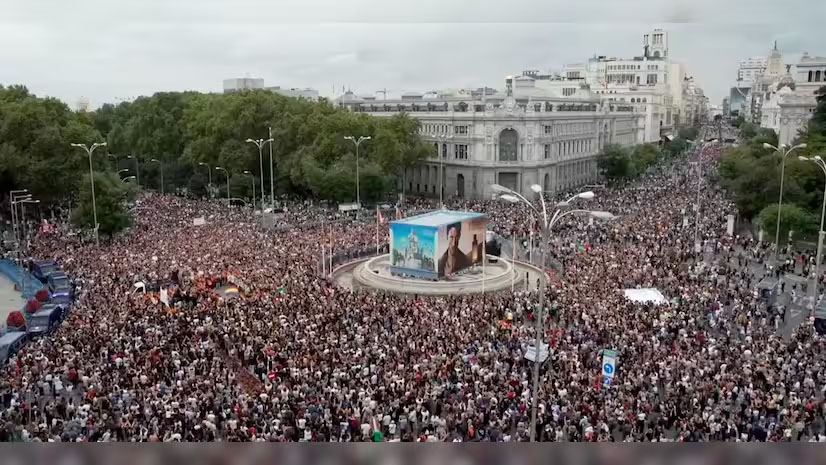
Protests in Madrid, Barcelona, Valencia and Malaga have brought together tenants, housing activists and residents angry about rising rents, evictions and the difficulty of finding affordable homes. The attempted eviction of an 87-year-old woman in Madrid became a symbol of the crisis.
The protests have added to pressure on Sanchez’s government, which has struggled to secure parliamentary support for emergency housing measures. Sanchez announced a snap general election for November 29, 2026, bringing the vote forward from 2027.
What are the protests about?
Protesters want the government to treat housing as a basic need rather than an asset primarily used to generate profits. Their demands include stronger protection for tenants, measures to prevent evictions and steps to bring rents within reach of ordinary households.
According to Reuters, Spain faces a housing shortage of about 750,000 homes, a figure that the Bank of Spain expects to rise to more than one million by 2028.
The attempted eviction of María del Carmen Abascal, an 87-year-old pensioner in Madrid, became a rallying point for the movement. Her case highlighted the difficulties faced by vulnerable residents who risk losing their homes in an increasingly expensive market. Fox News reported that her death on October 7 further intensified public anger.
Protesters have called for stronger tenant protections, limits on rent increases and action against property speculation. They also want the government to increase the supply of affordable housing and prevent evictions that leave vulnerable people without a home.
Tourism and property speculation add to the crisis
Mass tourism has become another source of tension, particularly in Barcelona, where residents blame the growth of holiday rentals for reducing the supply of homes available to permanent residents. Some property owners prefer short-term tourist rentals because they can be more profitable than long-term leases.
According to Fox News, Barcelona and the surrounding region received 26.1 million visitors in 2025, generating an estimated $15.4 billion in direct tourism spending.
Housing activists argue that the growth of short-term holiday rentals reduces the supply of homes available to permanent residents and puts upward pressure on rents. Research cited by the European Parliament has linked the concentration of short-term rentals in some Barcelona neighbourhoods to rising housing costs and the displacement of residents.
Tourism is not the only cause of the crisis. A shortage of homes, rising demand, property investment and the gap between wages and rents have all contributed. However, the growth of holiday rentals has made the conflict between visitors and residents more visible.
The Spanish government has proposed restricting corporate purchases of residential property as part of its efforts to curb speculation and address the housing shortage. However, the proposals have drawn criticism from property developers. Carolina Roca, president of the Association of Property Developers of Madrid, told Reuters that the legal uncertainty created by the decrees could slow investment in affordable housing.
What are protesters demanding?
Protesters want housing to be treated as a basic need rather than an asset primarily used to generate profits. Their demands include rent controls, stronger protection against evictions, restrictions on short-term rentals and more public and affordable housing.
The crisis has also drawn in Spain’s trade unions. The country’s two largest unions, the General Union of Workers (UGT) and the Workers’ Commissions (CCOO), announced plans for a nationwide general strike on November 11, Reuters reported. The proposed strike is scheduled just over two weeks before the election.
Valeria Racu, a spokesperson for the Tenants’ Union, told Reuters: “We cannot ignore the fact that housing is where most of our wages go. What is the point of raising the minimum wage if housing costs are rising three, four or five times faster?”
Reuters reported that the average monthly rent of €1,176 was equivalent to about 98.7 per cent of a young person’s average monthly salary in Spain, citing the Youth Council of Spain. The figures show why housing has become a major concern for workers who may be employed but still struggle to afford a place to live.
Why did parliament reject Sanchez’s housing measures?
Sanchez’s government approved emergency housing measures on September 29. The proposals included extending protections against eviction for vulnerable tenants, limiting rent increases and regulating short-term and seasonal rentals.
According to the Spanish government’s announcements, the package also included tax incentives for landlords offering affordable rents, interest-free loans of up to €50,000 for first-time homebuyers and funding to support social housing construction. The government proposed restricting purchases of residential property by investment funds accused of profiting from the shortage.
On October 2, parliament rejected the emergency housing package. The conservative People’s Party (PP), the far-right Vox and Catalan separatist party Junts opposed the measures. Opposition parties argued that the proposals could create uncertainty for landlords and investors, discourage construction and reduce the supply of rental homes.
The government approved two housing decrees again on October 6, including measures to cap rent increases, temporarily restrict evictions and limit corporate purchases of residential property. Reuters reported that the rules would initially take effect through emergency legislation but would still require parliamentary approval. A separate proposal for the automatic renewal of rental contracts also needed support.
Sanchez defended the measures as necessary to protect tenants and tackle speculation. Reuters quoted him as saying they were “based on plain common sense”. He also said the measures would “protect the most vulnerable”.
Why did Sanchez call a snap election?
Sanchez announced on October 5 that Spain would hold a general election on November 29, bringing the vote forward from 2027.
The immediate trigger was the failure to secure parliamentary support for the government’s housing measures.
A snap election is a vote held earlier than originally expected. In Spain, the prime minister can initiate an early election by requesting the dissolution of parliament under the constitutional process. The result will determine the composition of the national parliament, including the Congress of Deputies, which plays a central role in selecting the prime minister and approving legislation.
(With agency inputs)