
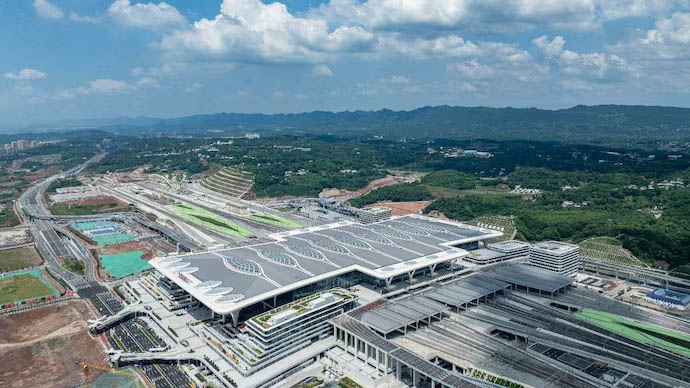
In just 38 months, China built the world’s largest railway station in Chongqing, a sprawling megacity strategically developed under Mao Zedong’s Third Front campaign. Beijing could make the unthinkable possible due to a robot revolution.
While visiting China as part of US President Donald Trump’s high-profile billionaire entourage last week, Elon Musk took to X to repost a video of the construction journey of the Chongqing East Railway Station, which is the world’s largest.
While Musk didn’t write anything in the post, it remains a subject of curiosity about why he made the post. That’s because he has previously expressed scepticism about public transport. Curiosity aside, the real story of Chongqing East Railway Station is more interesting. The story of how it was constructed in 38 months using an army of robots.
The Chongqing East Railway Station is a gigantic multi-modal transit complex. It is the world’s largest railway station by floor area, which was opened to the public in May 2025.
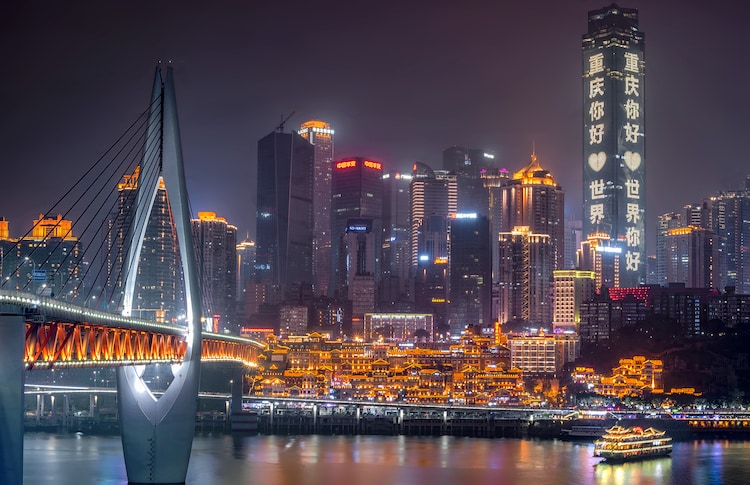
Located deep inland in Southwestern China, Chongqing, where the station is located, is the country’s largest city by both population and administrative area. A major economic powerhouse today, Chongqing was dramatically transformed starting in the 1960s under Mao Zedong’s Third Front Campaign. It was a massive effort that redirected huge national resources to rapidly industrialise China’s historically neglected interior regions. As a result, industries spread westwards from the Pacific coast to the east.
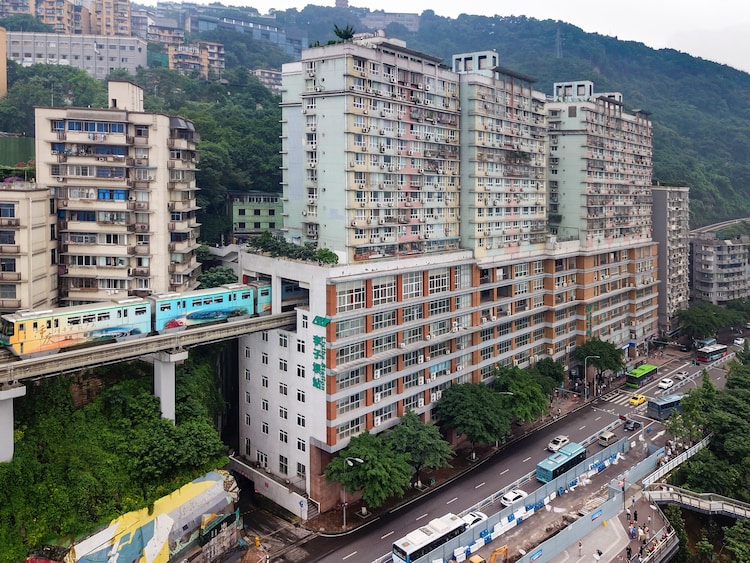
Today, Chongqing, and its new station, stand as a striking display of China’s formidable engineering prowess, and its massive economic heft. It’s the same Chinese city where one would see metro trains passing through apartment blocks.
While many countries struggle for decades to deliver large-scale projects, China built this colossal 1.22-million-square-meter station in just 38 months. Here’s how the station was built by an army of robots.
HOW CHONGQING BECAME CHINA’S INLAND MEGACITY
Before diving into the station itself, it is essential to first understand the city behind it. Chongqing is one of China’s most important and dynamic megacities.
Like many other Chinese urban centres like Shanghai and Beijing, Chongqing is an ancient city dating back nearly 3,000 years. During World War II, it served as the capital of the Chinese Nationalist (KMT) Government after the fall of the erstwhile capital, Nanking, to Japanese forces in 1937.
It was during the 1960s that Chongqing truly rose as one of China’s most important urban centres. The city became a major beneficiary of the Third Front Campaign, a massive industrialisation campaign directed by Mao Zedong.
Aimed at building strategic depth, the campaign redirected massive industrial investments away from China’s prosperous coastal regions into the historically neglected interior regions to protect industrial and military infrastructure from potential Soviet invasion or American air strikes. It focused heavily on defence, heavy industry, technology, and infrastructure.
The campaign primarily benefited China’s inland provinces in the Southwest and Northwest. Key regions that gained the most included Chongqing and Sichuan, Guizhou, Shaanxi, Gansu, Yunnan, and parts of Hubei. These areas received massive investments in the form of heavy industry, steel plants, defence manufacturing, railways, and power infrastructure. Entire new industrial cities such as Panzhihua emerged from scratch, while existing cities like Chongqing, Chengdu, Guiyang, and Xi’an were significantly expanded and modernised. This laid the foundation for Chongqing’s long-term industrial base.
Today, Chongqing has emerged as one of the strongest and most dynamic economies in Western China. With a GDP exceeding $440 billion annually, it ranks among the largest municipal economies in the country. The city boasts a diversified industrial base, particularly strong in automobile and motorcycle manufacturing, electronics and laptop production, semiconductors, equipment manufacturing, and chemicals.
Strategically positioned at the confluence of the Yangtze River Economic Belt and the much-touted Belt and Road Initiative, Chongqing serves as a vital logistics and trade gateway for China’s interior. Its multi-modal transport network, combining river ports, metro rail, expressways, an international airport, and the world’s largest high-speed rail network links it efficiently with the rest of China and beyond.
As such, given Chongqing’s massive economy and strategic inland location, high-speed rail connections like Chongqing East Station are very essential to link its people and industries with coastal markets, national supply chains, and international trade routes.
HOW ROBOTS MADE CHONGQING EAST RAILWAY STATION AN ENGINEERING MARVEL
The Chongqing East Railway Station was developed to meet the surging transport needs of one of China’s fastest-growing inland megacities.
As Chongqing expanded rapidly, existing stations like Chongqing North faced severe capacity limitations. The new station forms a key part of China’s national high-speed rail network. It strengthens connectivity between Southwest China and the rest of the country, supports regional economic integration, and enhances Chongqing’s role as a regional logistics and economic hub.
Spanning a total construction area of 1.22 million square meters, Chongqing East is officially recognised as the largest railway station in China and the world by floor area. It features 15 platforms and 29 tracks, divided into three rail yards.
The station is designed to handle up to 16,000 passengers per hour at peak times, with a multi-level layout (up to 8 floors) that integrates high-speed rail, conventional railways, monorail lines, buses, taxis, and long-distance coaches, effectively converting it into a multimodal transport hub.
According to a report by Chinese state-owned broadcaster Xinhua, the completion of the station’s construction in just 38 months, from obtaining design blueprints in May 2022 to its official inauguration in 2025 was due to what it described as a “robot revolution”.
Built on rugged terrain amid extreme summer heat often exceeding 40 degrees Celsius, the project relied heavily on advanced robotics to overcome traditional construction challenges.
A “robot army” led the construction, reported Xinhua.
Laser-guided four-wheel screed robots, equipped with LiDAR, AI, and 5G, performed concrete levelling with millimetre precision at three times human speed while cutting labour costs by 40%. Glass installation robots handled 800-kg panels safely and accurately, tripling installation speed and slashing accident risks by 90%. Omnidirectional welding robots and 24/7 patrol robots further boosted efficiency, reduced hazards, and maintained quality in harsh conditions.
China Railway 11th Bureau officials told Xinhua that robotics nearly halved labour costs, tripled average work efficiency, and reduced safety incidents by 90%.
The station forms part of China’s vast high-speed rail network, linking Southwest China with 14 major cities. From Chongqing, travellers can reach Chengdu in as little as one hour, Zhangjiajie in two to three hours, Changsha, Wuhan, Xi’an, and Kunming in about three hours, and Beijing, Shanghai, or Guangzhou in roughly six hours.
Perhaps that is why Musk reposted the video. Beyond the robots and speed, Chongqing East reflects China’s long-term ability to turn industrial ambition into a reality at a scale much of the world still struggles to match.