
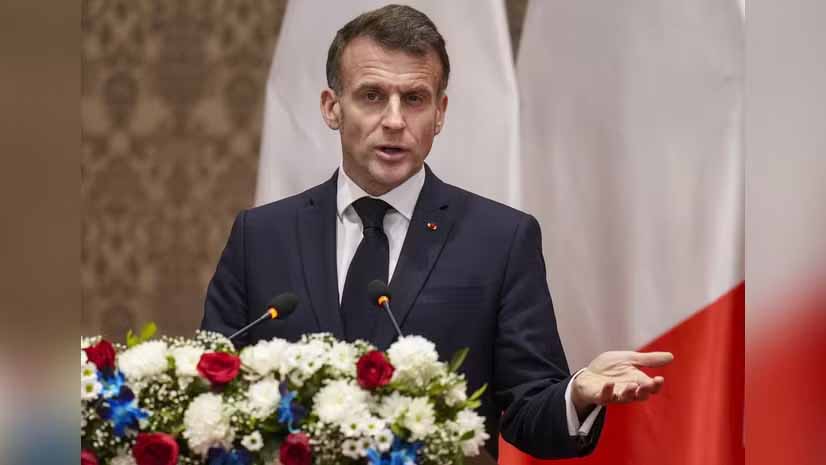
The move is a historic pivot for France, which has long insisted on preserving the independence of its nuclear stockpile
By Ania Nussbaum, Gerry Doyle and Max Ramsay
France will boost its nuclear arsenal and offer to temporarily deploy nuclear-capable fighter jets to allied countries in a massive realignment of Europe’s defence structure.
“A strengthening of our arsenal is indispensable,” President Emmanuel Macron said in a speech at the Ile Longue submarine base in Brittany on Monday. “To be free one must be feared, and to be feared one must be powerful.”
The move is a historic pivot for France, which has long insisted on preserving the independence of its nuclear stockpile. But assumptions about European stability have been shattered in recent years, as Russia grinds into a fifth year of full-scale war on Ukraine and President Donald Trump raises questions about America’s dedication to NATO and Europe.
Trump hasn’t suggested the US will withdraw its atomic weapons stationed in Europe since the 1950s via North Atlantic Treaty Organization. But doubts have prompted European governments to look for ways to bolster their own defenses.
Macron spoke directly to those concerns, arguing that a recent US national security strategy had revealed “a reorganization of American priorities.” The document castigated European Union leaders as weak and said the bloc faced “civilizational erasure” due to mass migration and economic decline.
That stance, Macron said, should push Europe “to take more direct responsibility for its own security.”
As the leader of the EU’s sole nuclear-armed country, Macron has faced questions about how France might help in that mission — and whether he was willing to extend France’s atomic defenses across the continent.
Traditionally, France has not maintained nuclear weapons in other European countries, nor does it operate them under the NATO umbrella. The approach ensured that the French president retained full control over any deployments.
Macron said the moment now called for France to more closely align its nuclear deterrence with Europe’s security. Globally, he noted, international arms control agreements are in tatters. Conflicts are intensifying. The risk of a nuclear clash is rising.
“Let us be frank,” he said. “The field of rules is a field of ruins.”
In response, Europe must tighten cooperation, Macron argued. He announced that France would be working on nuclear issues with several countries, including Germany, Poland, the Netherlands, Belgium, Greece, Sweden and Denmark. He also singled out the UK as a key partner.
The UK possesses its own nuclear deterrent but is technologically reliant on the US to operate it.
“We must now reach another stage,” Macron said. “I think I can affirm that our partners are ready.”
These European allies could participate in nuclear exercises with France, Macron said. France could also temporarily send nuclear-capable jets to these countries, he added, while stressing that France would retain final say on using its atomic weapons.
“What I want the most is for Europeans to take back control of their own destiny,” he said.
Separately, Germany and France pledged a closer defense partnership and will begin discussions on how to coordinate the appropriate mix of conventional missile defense and nuclear capabilities, according to a joint statement Monday. Germany also said it would participate in French nuclear exercises and joint visits to strategic sites starting this year.
France’s current warhead inventory of 290 is about the same level it was in 1984, according to the Bulletin of the Atomic Scientists. France’s nuclear arsenal peaked in the early 1990s with as many as 540 warheads. The warheads are split between air-launched weapons and ArianeGroup M51 submarine-launched ballistic missiles.
Macron said France would stop declaring how many nuclear warheads it has as the stockpile grows.
The primary goal of French deterrence has long been to dissuade any adversary from attacking the country’s “vital interests” as it could hit back with an unacceptable scale of damage.
France’s nuclear arsenal is the fourth-largest in the world. Only the US and Russia have more deployed atomic weapons — those that are ready to use, as opposed to weapons not mounted on a delivery system, in maintenance or held in reserve.
France is estimated to have more than 30 tons of weapons-grade uranium and about 6 tons of weapons-grade plutonium, according to the Arms Control Association — enough for a significant expansion of its warhead stocks. In 2024 the country said it planned to produce tritium, a hydrogen isotope needed for thermonuclear designs, at a civilian power plant.
The Valduc Center near Dijon, France, is used to maintain, store and dismantle French nuclear weapons, and has produced them in the past. How many warheads it could manufacture per year is not publicly known.
As with other countries that have given up explosive nuclear testing, France uses supercomputers and high-powered lasers to simulate nuclear detonations, allowing research into new warhead designs and refinement of existing ones.
“We must heed this call to take greater control of our own destiny,” Macron said.