
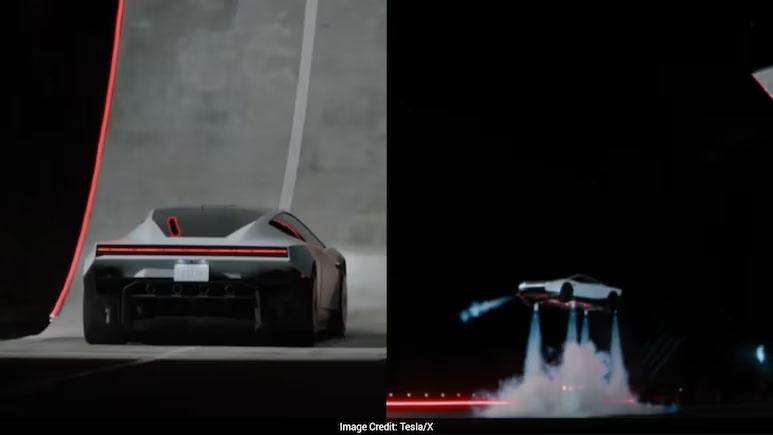
Tesla vehicle engineering head Lars Moravy explained that the Roadster’s flying capability is powered by SpaceX thrusters.
Elon Musk has hinted at some ambitious stunts for Tesla’s next-generation Roadster, suggesting that future demonstrations could see the electric car fly over the Snake River or the Grand Canyon, land on its wheels and exceed half the speed of sound.
His post on X came after Tesla showcased the Roadster performing a stunt that involved driving upside down and briefly taking to the air.
Tesla demonstrated the next-generation Roadster at SpaceX’s facility in Texas on October 15, 2026. During the showcase, the car accelerated towards a specially designed curved ramp, climbed it and continued travelling upside down along the surface. It then performed a short airborne manoeuvre before landing safely.
Check Out The Post Here:
The demonstration offered a closer look at Musk’s long-running vision for the second-generation Roadster, which was first unveiled in November 2017. Tesla positioned the car as an electric performance flagship, while Musk revealed plans for a SpaceX package using rocket-like thrusters in 2018.
Sharing his vision for future demonstrations, Musk wrote on X that the Roadster could fly over the Snake River or perhaps the Grand Canyon, land on its wheels and travel at more than half the speed of sound.
The statement has added to the attention surrounding the Roadster’s latest demonstration, with videos of the stunt gaining traction on social media. Viewers have been watching the car travel upside down, perform an airborne manoeuvre and land in a controlled manner, while many are curious about the technology behind the performance.
How Does The Tesla Roadster Fly?
Tesla vehicle engineering head Lars Moravy explained that the Roadster’s flying capability is powered by SpaceX thrusters. According to a TechCrunch report, the car uses 10 thrusters connected to 600 litres of compressed air to lift and spin it in midair.
The system uses cold-gas thrusters developed by SpaceX. Unlike conventional rockets that rely on combustion, these thrusters release pressurised gas to generate thrust. The force allows the Roadster to perform a brief airborne manoeuvre before returning to the ground in a controlled landing.
The duration of the Roadster’s flight depends directly on the amount of gas available onboard. This means its ability to remain airborne is linked to the supply of compressed gas used by the thrusters.