
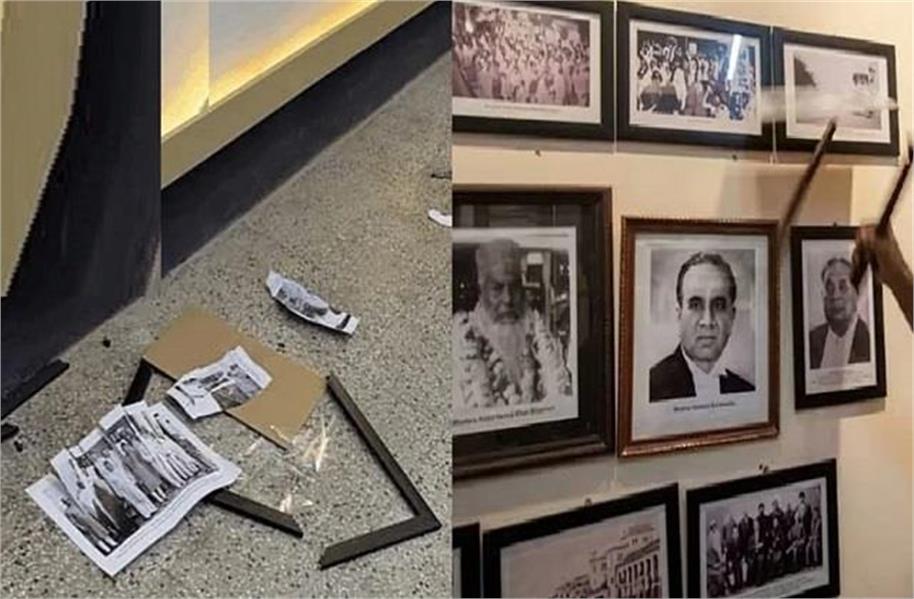
Dhaka: A fresh controversy over Pakistan’s founder Muhammad Ali Jinnah has erupted at Dhaka University after his photographs were displayed in the institution’s refurbished museum, prompting protests from several student organisations and the tearing up of the pictures by a student.
The university administration has since constituted a five-member high-level investigation committee to examine how the sensitive historical material was placed in the museum without administrative approval.
The controversy began after the refurbished museum was reopened with photographs and historical newspaper clippings relating to Jinnah and the history of the Indian subcontinent. Among the exhibits was a photograph connected with Jinnah’s 1948 speech at Dhaka’s Racecourse Maidan, in which he advocated Urdu as the sole state language of Pakistan.
The issue carries particular sensitivity in Bangladesh because of its association with the 1952 Language Movement, a defining episode in the country’s history.
After the photographs came to light, protests broke out on the university campus. On Monday, a student entered the museum and tore up Jinnah’s photographs. The incident was followed by objections from various student groups.
Left-wing students also joined the protest by placing a photograph depicting former Jamaat-e-Islami chief Ghulam Azam being beaten with shoes inside the museum, further escalating the dispute.
Several student organisations, including the student wing of the ruling Bangladesh Nationalist Party, objected to the display of Jinnah’s photographs. They raised concerns over the decision and linked the matter to the university’s dignity and historical significance.
Amid the growing controversy, the university administration moved to investigate the circumstances surrounding the museum display. The five-member committee has been tasked with determining how the photographs were installed without administrative authorisation and what procedures were followed.
The committee is headed by Dhaka University Pro-Vice-Chancellor Professor Mohammad Al-Mujaddade Alfasani.
Meanwhile, the Dhaka University Central Students’ Union has defended the inclusion of the photographs, saying the intention was not to glorify Jinnah. According to the organisation, the exhibits were intended to present a controversial chapter of history and documents connected with the language question.
Jinnah and his 1948 position on language remain highly sensitive historical and political subjects in Bangladesh. The 1952 Language Movement and the 1971 Liberation War are central to the country’s national identity.
The dispute at Dhaka University has therefore reopened a wider discussion over how contentious chapters of the subcontinent’s history should be presented in academic and museum settings, as well as how Bangladesh remembers its language movement and Liberation War.