
By Chandan Singh | Page 3 News Worldwide | New Delhi
₹58-crore bungalow of former Delhi CM Arvind Kejriwal opened to media; every furnishing, fixture and fitting carries a price tag and bill reference
NEW DELHI: The doors of Delhi’s controversial ‘Sheesh Mahal’ opened to the media on Friday, offering the first public glimpse inside the 6, Flagstaff Road bungalow where former Chief Minister Arvind Kejriwal lived until October 2024.
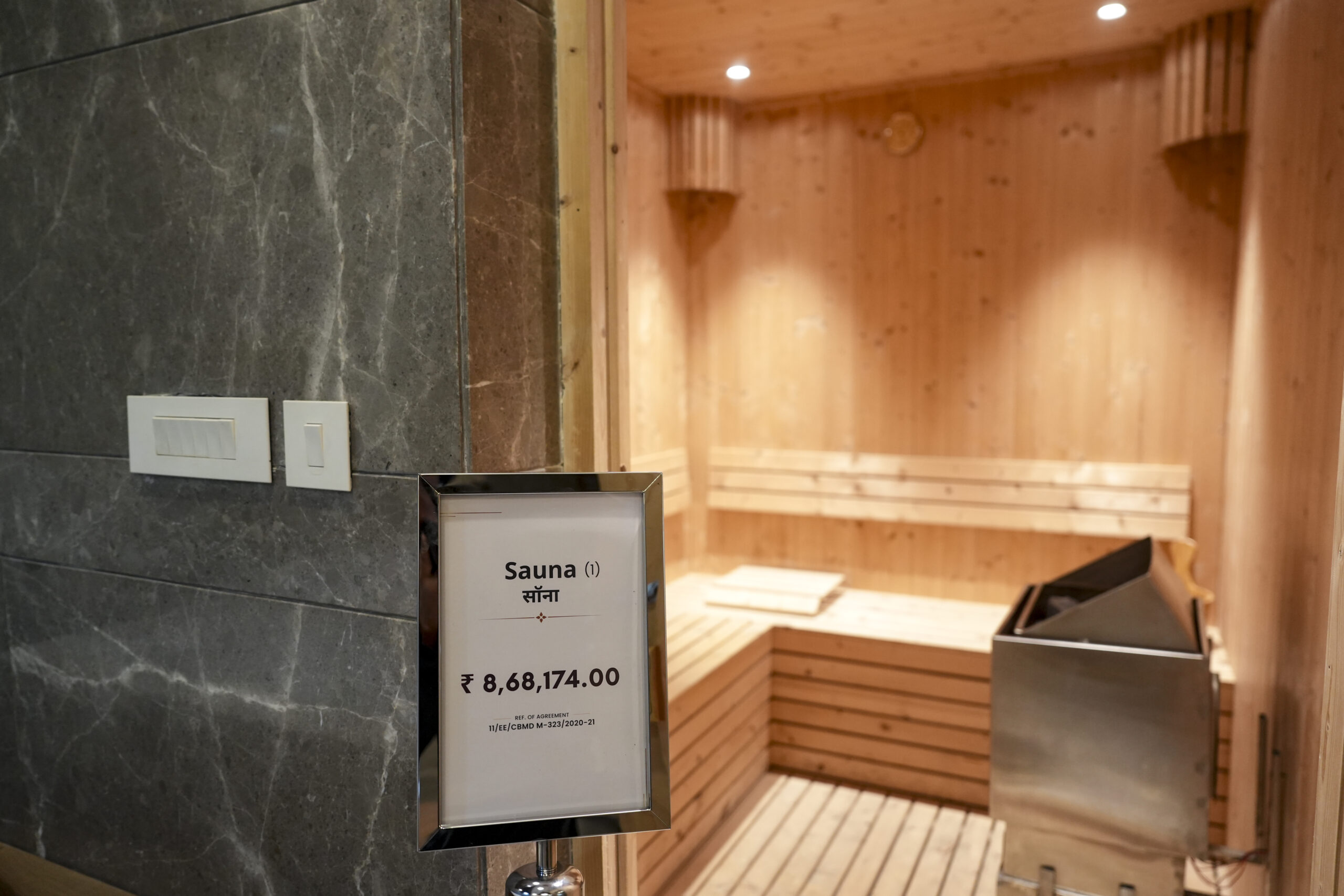
A board at the entrance announces: “Welcome to Sheesh Mahal, built at the cost of ₹58 crore.” Inside, the Public Works Department (PWD) has displayed a detailed inventory of furniture, chandeliers, curtains, appliances and fittings across 20 rooms and spaces, with prices and corresponding agreement references for public scrutiny.
The furnishings and interior work alone account for more than ₹12 crore, according to the displayed records.
The opening has brought renewed attention to the expenditure on the residence, particularly the luxury amenities installed during the Covid-19 pandemic, when Delhi was grappling with an acute shortage of hospital beds and medical oxygen.
A ₹31.76-lakh wellness suite
Among the most striking features is a wellness suite featuring a sauna costing ₹8.68 lakh, a jacuzzi worth ₹5.95 lakh, a steam room priced at ₹11.38 lakh and a massage bed costing ₹4.07 lakh. The wellness room’s total expenditure stands at ₹31.76 lakh. A separate private gym cost another ₹22.07 lakh.
The bungalow’s two kitchens together cost ₹1.06 crore. The main kitchen, valued at ₹61.14 lakh, includes a ₹7.02-lakh dumbwaiter, a ₹3.55-lakh coffee machine, a German gas stove costing ₹1.41 lakh and an Italian chimney priced at ₹5.41 lakh.
The dining area accounts for ₹68.48 lakh, including 14 dining chairs worth ₹17.46 lakh, a dining table costing ₹13.07 lakh and two chandeliers together valued at ₹23.13 lakh.
Eleven TVs, ₹1.07 crore curtains
The inventory also lists 11 televisions costing a combined ₹82.56 lakh. The most expensive, installed in the lobby, is valued at ₹28.92 lakh, while the television in the living room lounge cost ₹17.53 lakh.
Curtains across the residence account for approximately ₹1.07 crore, with those in one master bedroom alone costing ₹12.02 lakh.
The staircase, meanwhile, carries a price tag of ₹75.61 lakh, including an ornamental designer railing worth ₹25.16 lakh and a chandelier costing ₹8.20 lakh.
Living room tops expenditure list
According to the PWD inventory, the living room lounge is the costliest individual space, with furnishings and fittings valued at ₹1.48 crore. The son’s bedroom follows at ₹1.12 crore.
Other high-cost spaces include Master Bedroom 2 at ₹85.90 lakh, Master Bedroom 1 at ₹75.74 lakh and Guest Bedroom 2 at ₹73.69 lakh.
Spread across 1,905 square metres, the residence has eight bedrooms and 13 bathrooms.
‘Public has the right to know’: Minister Parvesh Verma
Delhi PWD Minister Parvesh Verma said the opening was intended to ensure transparency and accountability in the use of public funds.
“We have only one objective: every government should provide a full account of where and how much of Delhi residents’ money, that is, taxpayers’ money, has been spent,” he said.
Arguing that citizens were entitled to examine the expenditure incurred during the former chief minister’s tenure, Verma said every displayed amount was accompanied by the relevant bill and invoice number.
“The public has the right to know how the former chief minister spent their money, meant for Delhi’s development, on buying what kind of furniture. We have no political motive here,” he said.
Covid crisis and construction
The minister also drew attention to the timing of the bungalow’s construction and renovation.
“When Delhi was fighting Covid, when families were running from hospital to hospital for a bed and a cylinder of oxygen, work on this house was going on. The people of Delhi were struggling to breathe, and here a sauna, a jacuzzi and a steam room were being fitted,” Verma said.
He further alleged that multiple government accommodation units meant for officers, along with two neighbouring government bungalows, were demolished and merged to expand the residence.
“Officers’ homes were razed so that one man’s residence could grow,” he said, adding that construction of an extension remained unfinished despite the expenditure.
Verma maintained that the property had been preserved in the condition in which it was found, without rearranging its contents, allowing visitors to examine the displayed inventory.
From ‘common man’ image to public scrutiny
Kejriwal had built his political identity around the promise of simple living and a departure from the privileges traditionally associated with political office.
The opening of the bungalow has placed that public image alongside an inventory featuring luxury fittings, expensive furnishings, a private wellness suite and high-value electronic equipment.
The residence, which became popularly known as ‘Sheesh Mahal’, is now open for public scrutiny through its displayed expenditure records.
Public visits to follow
Media visits have commenced, while details regarding public entry, visiting arrangements and ticketing are expected to be announced separately.
For the first time, the contents of the controversial residence are available for inspection, with a price and corresponding bill reference attached to each listed item.