

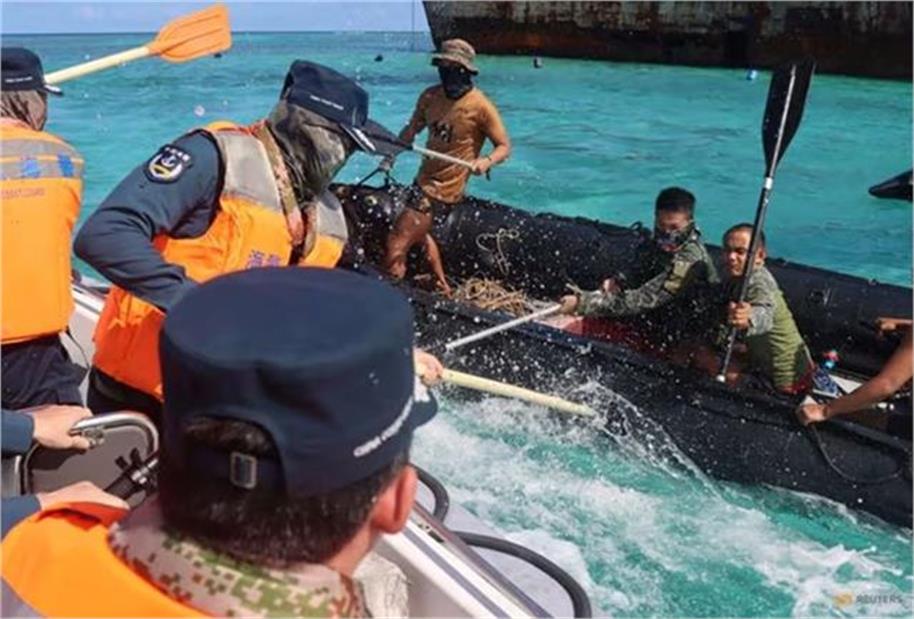
The South China Sea is once again witnessing heightened tensions, with maritime confrontations between China and the Philippines increasing since July after a period of relative calm.
The two countries have seen a series of encounters involving naval and coastguard vessels, as well as security personnel, in disputed waters. One of the most serious incidents took place near Second Thomas Shoal on 20 July, when Chinese coastguard personnel and Philippine marines reportedly clashed using sticks and oars. A Philippine marine suffered a serious head injury in the incident.
The tensions escalated further on 18 September, when Chinese and Philippine vessels collided near Sabina Shoal.
Long-running dispute over Second Thomas Shoal
Second Thomas Shoal has remained a major flashpoint in the maritime dispute between Beijing and Manila. Following heightened tensions in 2024, the situation eased temporarily under an informal arrangement that allowed the Philippines to conduct missions to deliver essential supplies and support personnel stationed at the shoal.
The arrangement reportedly involved an understanding that Manila would not undertake large-scale construction activities at the site.
At the centre of the dispute is the BRP Sierra Madre, an ageing Philippine warship deliberately grounded at Second Thomas Shoal. The vessel dates back to the Second World War and has deteriorated significantly after years in the harsh marine environment.
Videos linked to the 20 July incident showed Philippine marines confronting a Chinese coastguard vessel that had approached the Sierra Madre. China’s ambassador in Manila said the Chinese vessel was there to monitor alleged construction activity involving the Philippine ship.
China’s Foreign Ministry subsequently stated on 21 July that it would permit humanitarian missions carrying essential supplies, provided Manila gave prior notification. Beijing also warned that it would act against attempts to establish permanent facilities or outposts at the shoal.
Ageing warship adds to Manila’s challenge
The condition of the Sierra Madre has become an important factor in the Philippines’ ability to maintain its presence at Second Thomas Shoal. Prolonged exposure to seawater has weakened the vessel, making repair and reinforcement increasingly important.
The Philippines maintains that Second Thomas Shoal lies within its Exclusive Economic Zone (EEZ), under the framework of the United Nations Convention on the Law of the Sea (UNCLOS).
2016 arbitration ruling remains disputed
The latest tensions come nearly a decade after an international arbitration ruling issued in 2016 concerning competing maritime claims in the South China Sea.
The ruling rejected the legal basis for extensive Chinese maritime claims associated with the so-called ‘nine-dash line’. China rejected the ruling and has continued to maintain its claims in the region.
Beijing strengthens presence around Scarborough Shoal
The confrontation is not limited to Second Thomas Shoal. China has also expanded its maritime presence around Scarborough Shoal, another major flashpoint between the two countries.
In 2025, China announced the establishment of the Huangyan Dao National Nature Reserve, covering a substantial part of Scarborough Shoal. Beijing subsequently moved to strengthen administrative and regulatory measures governing the area.
On 1 August, China’s Ministry of Natural Resources, the National Forestry and Grassland Administration, the China Coast Guard and the Hainan provincial government issued management regulations for the reserve.
The regulations provide for regular patrols, investigations and enforcement against violations, while also restricting activities such as unauthorised fishing. The measures have implications for Philippine fishermen, whose access to the area is restricted except under specified circumstances.
Chinese patrols remain a growing concern
Data from the Asia Maritime Transparency Initiative indicate that Chinese coastguard patrols around Scarborough Shoal doubled in 2025 compared with the previous year. Available figures suggest that patrol activity has continued to increase in 2026.
China also reinstated a floating barrier at the entrance to the shoal in April.
Meanwhile, Chinese activity has expanded beyond the two major flashpoints. Increased physical presence and construction-related activity have been reported in other parts of the South China Sea, including Antelope Reef in the Paracel Islands.
With competing territorial and maritime claims continuing to drive encounters at sea, the South China Sea remains a key source of friction in China-Philippines relations.