
By Rahul Laxman Patil
BIMSTEC Regional Cooperation & Economic Diplomacy Analyst
Dhaka | Pan Pacific Sonargaon Dhaka
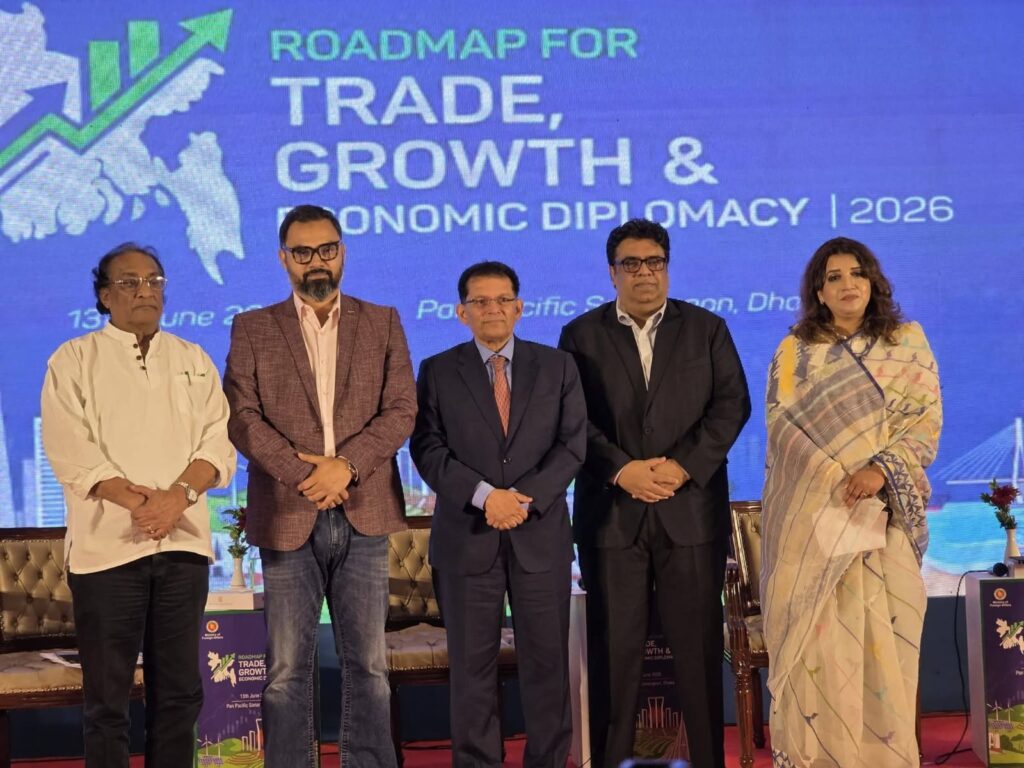
Bangladesh has demonstrated its growing economic ambition and international confidence through the successful hosting of the “Roadmap for Trade, Growth and Economic Diplomacy Conference 2026: Navigating Risks, Leveraging Resilience”, organized by the Ministry of Foreign Affairs (MoFA) in collaboration with the Bangladesh Investment Development Authority (BIDA).
The landmark conference brought together senior ministers, diplomats, development finance institutions, multinational corporations, business leaders, academics, and development partners to discuss Bangladesh’s future economic trajectory under the government’s “Bangladesh First” policy framework.
The conference was inaugurated by H.E. Dr. Khalilur Rahman, Foreign Adviser of Bangladesh and President-Elect of the 81st Session of the United Nations General Assembly (UNGA). Key sessions featured H.E. Ms. Shama Obaed Islam, MP, State Minister for Foreign Affairs, Finance Minister Amir Khosru Mahmud Chowdhury, senior advisers to the Prime Minister, development partners, and representatives of major international institutions including the World Bank, Asian Development Bank, AIIB, IsDB, and IMF.
The gathering sent a clear message to the international community: Bangladesh is reform-oriented, partnership-driven, and committed to becoming a leading economic hub of South Asia and the Bay of Bengal region.
Bangladesh First: Economic Diplomacy as National Strategy
The Bangladesh First approach places economic development at the heart of foreign policy. It recognizes that diplomacy must not only strengthen political relations but also generate tangible economic benefits through trade, investment, technology transfer, innovation, and job creation.
The conference highlighted how economic diplomacy is becoming a key driver of national development by connecting Bangladesh with global markets, international investors, development finance institutions, and strategic economic partners.
The objective is clear: to accelerate economic growth while ensuring sustainable and inclusive prosperity for all Bangladeshis.
Investment and Business Reforms
One of the strongest signals emerging from the conference was the government’s commitment to improving the ease of doing business.
Finance Minister Amir Khosru Mahmud Chowdhury announced plans for an automatic approval system under which business licenses and approvals may be granted if government agencies fail to respond within a specified period.
Such reforms are expected to:
- Increase foreign direct investment (FDI)
- Reduce bureaucratic delays
- Improve investor confidence
- Accelerate industrial growth
- Encourage entrepreneurship
- Create employment opportunities
For international investors, these measures demonstrate Bangladesh’s determination to establish a transparent, efficient, and competitive business environment.
Agriculture: The Foundation of Economic Prosperity
While investment and industrialization are critical, agriculture remains one of the strongest pillars of Bangladesh’s economy.
The conference emphasized that future economic growth must include agricultural modernization and rural development. Through economic diplomacy and international partnerships, Bangladesh can secure access to modern agricultural technology, climate-resilient farming practices, improved irrigation systems, advanced storage facilities, and global export markets.
The benefits include:
- Higher productivity and food security
- Increased farmer incomes
- Expansion of agri-processing industries
- Rural employment generation
- Enhanced export earnings
- Greater resilience to climate change
Agriculture will continue to play a central role in supporting inclusive growth and reducing poverty across Bangladesh.
Bilateral Economic Diplomacy: Expanding Opportunities
Bangladesh is actively pursuing modern economic agreements that support investment, technology transfer, and diversified market access.
Important achievements include:
- Initialling of the Bangladesh–European Union Partnership and Cooperation Agreement (PCA).
- Advancement of Bangladesh–Republic of Korea CEPA negotiations and launch of Bangladesh–UAE CEPA discussions.
- Ongoing FTA discussions with Malaysia and CEPA negotiations with Indonesia.
- Progress on investment agreements with Saudi Arabia, Hong Kong, and China.
- Strategic cooperation agreements with the United States on energy and emergency response.
These initiatives are expected to attract quality investment, strengthen industrial development, facilitate technology transfer, and create long-term economic opportunities.
Multilateral Leadership: Reclaiming Voice and Influence
Economic success also depends on influence within the global system.
A landmark achievement has been the election of Dr. Khalilur Rahman as President-Elect of the 81st Session of the United Nations General Assembly. This reflects Bangladesh’s growing international standing and its commitment to shaping discussions on development, climate change, migration, labour, peace, and sustainable growth.
Bangladesh has also strengthened its presence across major international forums including the United Nations, WTO, Commonwealth, OIC, D-8, ILO, and other multilateral platforms.
This active engagement sends an important signal to investors and international partners: Bangladesh is not merely adapting to global economic changes—it is increasingly helping shape them.
Innovation, AI and Future Industries
The conference’s third plenary session focused on Artificial Intelligence, creative industries, and sports as emerging drivers of growth.
Investment in innovation and technology will help Bangladesh:
- Create high-skilled jobs
- Improve productivity
- Support digital transformation
- Attract technology investment
- Build a knowledge-based economy
The government’s focus on innovation reflects its commitment to preparing Bangladesh for the opportunities of the Fourth Industrial Revolution.
BIMSTEC: Regional Cooperation for Shared Prosperity
The conference also highlighted the importance of regional cooperation through the .
BIMSTEC member states:
🇧🇩 Bangladesh
🇧🇹 Bhutan
🇮🇳 India
🇲🇲 Myanmar
🇳🇵 Nepal
🇱🇰 Sri Lanka
🇹🇭 Thailand
Together, these countries represent nearly 1.8 billion people and one of the world’s most dynamic economic regions.
Enhanced cooperation in trade, connectivity, agriculture, energy, tourism, technology, and investment can unlock enormous opportunities for shared growth across the Bay of Bengal region.
Bangladesh’s strategic geographic location places it at the center of this vision, serving as a bridge between South Asia and Southeast Asia.
Towards a US$1 Trillion Economy
At the heart of the Bangladesh First vision lies the ambition to transform Bangladesh into a US$1 trillion economy.
Achieving this goal will require sustained growth across agriculture, manufacturing, exports, services, technology, infrastructure, and human capital development.
The reforms and initiatives discussed at the conference provide the foundation for this transformation. Through stronger economic diplomacy, investment-friendly policies, agricultural modernization, innovation-driven growth, and regional cooperation, Bangladesh is creating the conditions necessary for long-term prosperity.
The US$1 trillion vision is not simply about economic size. It is about creating jobs, empowering youth, supporting farmers, reducing poverty, improving living standards, and ensuring sustainable development for future generations.
Conclusion
The Roadmap for Trade, Growth and Economic Diplomacy Conference 2026 marks an important milestone in Bangladesh’s development journey.
Under the leadership of the Honourable Ministry of Foreign Affairs, H.E. Dr. Khalilur Rahman, and H.E. Ms. Shama Obaed Islam, MP, Bangladesh is pursuing a comprehensive strategy that combines economic diplomacy, investment promotion, agricultural development, innovation, and international cooperation.
As Bangladesh advances under the Bangladesh First policy framework, it is positioning itself as a globally connected, investment-friendly, and economically resilient nation—confidently moving toward the vision of becoming a US$1 trillion economy and a leading driver of prosperity across the Bay of Bengal region.