
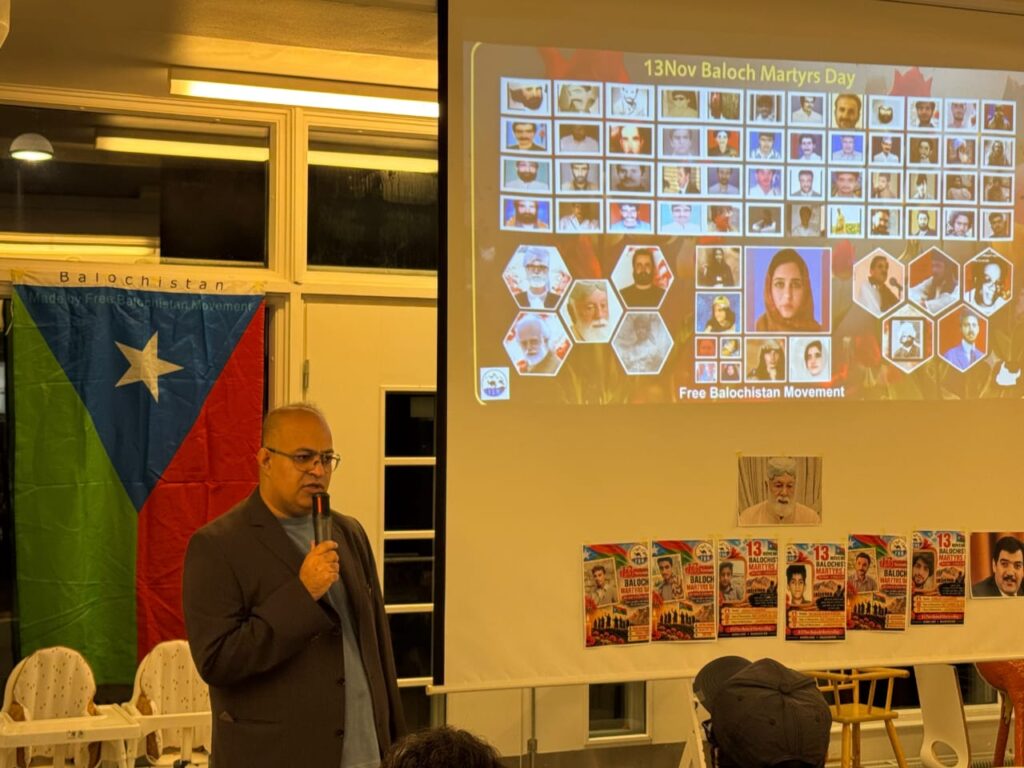
HELSINKI, FINLAND: The Free Balochistan Movement (FBM) organised an intellectual, historical and political seminar in Helsinki, Finland, on November 13 to mark Baloch Martyrs’ Day, bringing together political and social figures associated with Baloch and Afghan national movements.
The seminar focused on the historical struggles, sacrifices and political ideologies of Baloch and Afghan martyrs, with speakers highlighting their significance for national identity, collective consciousness and future generations.
Among those addressing the gathering were MB Marri Baloch, Head of the Foreign Affairs Department of FBM; Sadiq Raisani, Head of its Tribal Affairs Department; Dr Samuel Baloch; Akhlaq Baloch; Shafiullah Yousafzai; Bari Barich; and Javed Khan of the Pashtun Tahaffuz Movement (PTM). General Faiz Ali Kochi, Assistant Member of FBM, and Qadir Attai from Afghanistan also shared their views.
Speakers discussed the historical evolution of the Baloch national movement, the sacrifices of its martyrs and the intellectual foundations of the struggle for national liberation. They said the legacy of the martyrs should be understood not merely as a chapter of the past but as an integral part of national identity and political consciousness.
The seminar also examined the history of the Afghan national struggle and the sacrifices of Afghan martyrs. Particular attention was given to the political life, struggle and martyrdom of former Afghan President Dr Najibullah, alongside the historical, cultural and political connections between the Baloch and Afghan peoples.
The political philosophy of Nawab Khair Bakhsh Marri, particularly his views on national autonomy and his contribution to the Baloch national movement, was another key topic. Speakers also discussed Hyrbyar Marri’s political struggle and his vision of an independent Balochistan, emphasising the historical status of the region and the idea of a united Balochistan.
Participants further debated the policies of Pakistan and Iran, the political status of Balochistan and the question of Baloch national independence. Expressing their political position, speakers described Pakistan and Iran as occupying powers in Balochistan and argued that the Baloch national question should be understood within its broader historical, political and national context rather than treated solely as an internal administrative or developmental issue.
The speakers stressed that preserving the history of Baloch and Afghan martyrs and transmitting the ideological and political dimensions of their struggles to younger generations were essential to strengthening national consciousness.
The central message of the seminar was that commemorating martyrs should go beyond tributes and condolences. Their political ideas, sacrifices, ideological convictions and historical contributions, speakers said, must be studied, documented and passed on to future generations.
Concluding the seminar, the Free Balochistan Movement reiterated its commitment to taking the memory of Baloch martyrs to an international audience and bringing the Baloch national question into global political and intellectual discussions.