
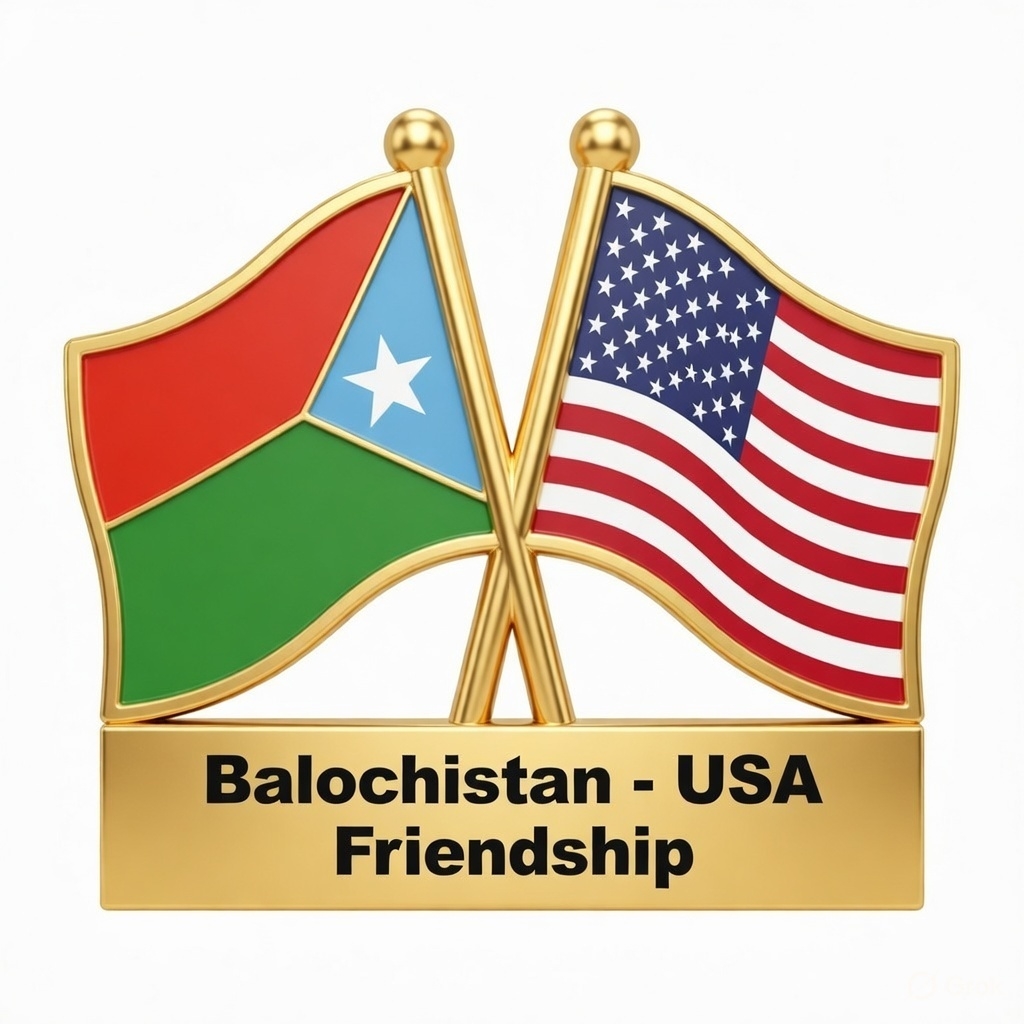
A group identifying itself as representatives of the “Republic of United Balochistan” has formally appealed to members of the United States Senate and the National Security Council, calling for the urgent appointment of a dedicated US Special Envoy for Balochistan Affairs.
In a detailed policy memorandum dated 7 April, the group argued that Washington lacks a coherent framework to engage with Balochistan—a vast, resource-rich region straddling Pakistan and Iran—despite its growing geopolitical significance.
The document portrays Balochistan as a critical junction linking South Asia, the Middle East and Central Asia, highlighting its দীর্ঘ coastline along the Arabian Sea and proximity to key infrastructure such as the Chabahar Port. It further underscores the region’s location near the Strait of Hormuz, through which a substantial share of global energy supplies transit.
Strategic and Economic Argument
According to the memorandum, Balochistan holds significant reserves of oil, gas, rare earth elements and minerals, positioning it as a potentially vital partner in global energy diversification and supply chain resilience. The authors claim that a US envoy could help facilitate economic engagement while strengthening Washington’s strategic foothold in an increasingly contested region.
The proposal also emphasises the importance of direct dialogue with Baloch political and civil actors, arguing that such engagement could improve US situational awareness and counter what it describes as destabilising influences from Islamabad and Tehran.
Regional Realignment Vision
The memorandum outlines an ambitious vision of regional cooperation involving other ethnically distinct areas, including Kurdistan and Al-Ahwaz. It suggests that a network of such regions could serve as a stabilising force along critical trade and energy corridors, particularly around the Persian Gulf.
The authors contend that recognising Balochistan’s role could reshape regional dynamics, offering alternative partnerships and reinforcing maritime security near vital shipping lanes.
Security and Policy Implications
Central to the appeal is the argument that a US Special Envoy—reporting directly to the State Department—would enable closer coordination across diplomatic, defence and economic channels. The envoy, the memorandum states, could also monitor human rights conditions and support governance frameworks in the region.
While the claims reflect longstanding grievances and aspirations among sections of the Baloch diaspora, neither Washington nor the governments in Islamabad and Tehran have formally responded to the proposal.
Analysts note that any such move by the United States would carry significant geopolitical implications, potentially heightening tensions with both Pakistan and Iran, while testing Washington’s broader regional strategy in the Indo-Pacific and Middle East.
For now, the proposal remains a lobbying effort—but one that underscores the increasing strategic attention being drawn to a historically under-engaged region at the crossroads of global energy and security interests.