
By Our International Desk
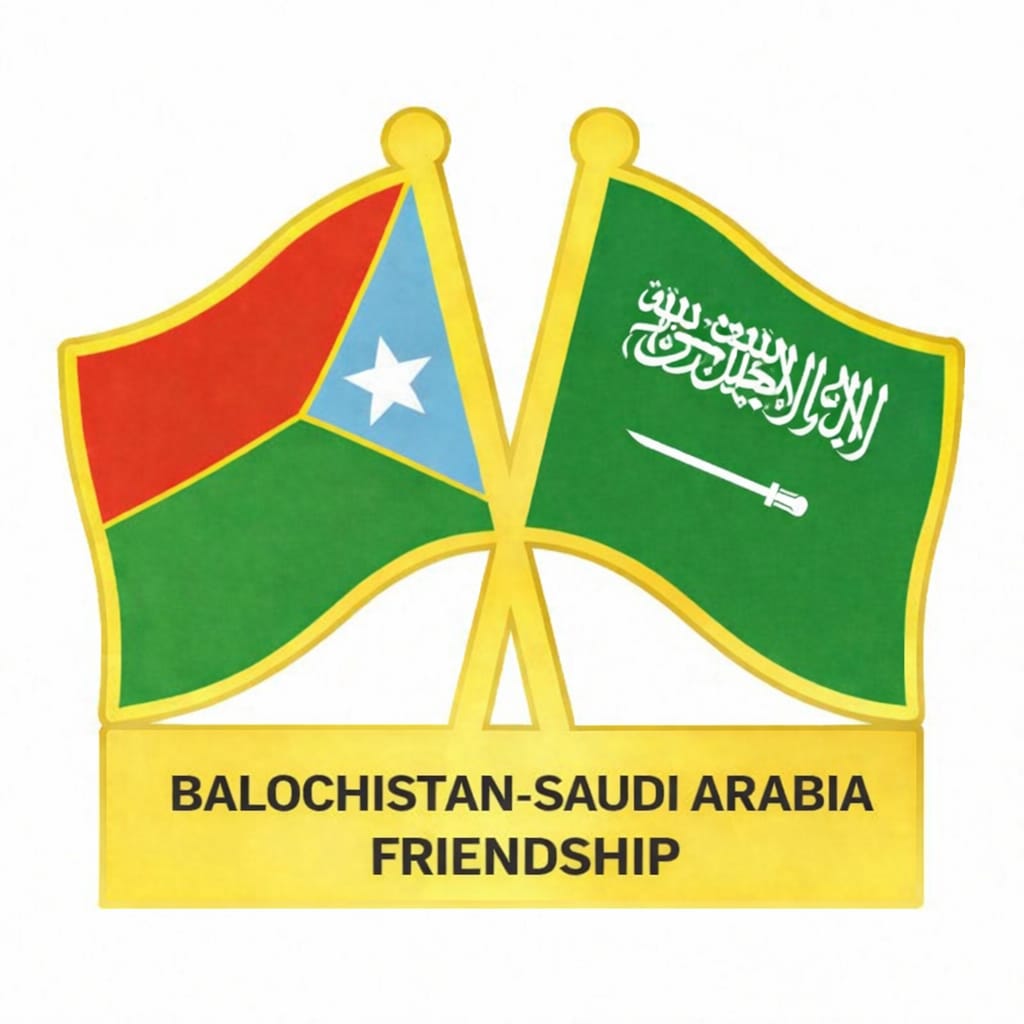
Baloch representatives have issued a public appeal to the Kingdom of Saudi Arabia, asserting that Balochistan is not part of Pakistan and calling on Riyadh and other friendly nations to reconsider their support for Islamabad’s policies in the region.
In a statement addressed to the Saudi leadership and people, the appeal argues that Balochistan and Saudi Arabia share a long-standing historical relationship that predates the creation of Pakistan. The authors say this relationship was founded on “mutual respect, dignity, and brotherhood,” and emphasise that the rulers of Balochistan supported the House of Saud in times of need as partners rather than dependants.
The statement accuses Pakistan of “external aggression and military occupation” of Balochistan, alleging illegal control of territory, exploitation of natural resources, and widespread repression, including enforced disappearances and what it describes as genocide. It claims Pakistan has “no moral or legal legitimacy” to maintain a military presence in the region.
Reiterating that Balochistan possesses a distinct culture, language, and identity, with a history spanning more than nine thousand years, the authors state that the territory was occupied by Pakistan on March 27, 1948. They frame the current struggle as a defence of freedom, dignity, culture, resources, and the Baloch people.
Addressing the Saudi Royal Family directly, the appeal poses a rhetorical question: whether the Kingdom would accept a foreign power occupying its oil fields, violating its territorial integrity, and plundering its national wealth. It argues that if such a scenario would be unacceptable to Saudi Arabia, it should not condemn the Baloch people for resisting what they describe as occupation.
The statement stresses that the Baloch struggle is not directed against other nations, but against “occupation and oppression,” and urges friendly states, particularly those with historical ties to Balochistan, not to become complicit by supporting Pakistan’s actions.
To underline historical links with Saudi Arabia, the appeal recalls a visit by the Khan of Kalat, Mir Ahmad Yar Khan, who ascended the throne in 1933 and performed the Hajj in 1936. According to the statement, he was received with honour by King Abdulaziz bin Saud, the founder of the Saudi state, at a special reception attended by other heads of state.
It further cites a 1973 press interview in which the late Khan said he had donated one hundred thousand British pounds to the administration of the holy sites in Mecca and Medina during that visit, at a time when the Kingdom had not yet discovered oil. The donation is presented as an example of Balochistan offering support rather than seeking it.
The appeal concludes with a call on Arab nations to stand with the Baloch people for peace, prosperity, and development, arguing that these aims would be better served through recognition of an independent Republic of Balochistan rather than continued support for Pakistan.