
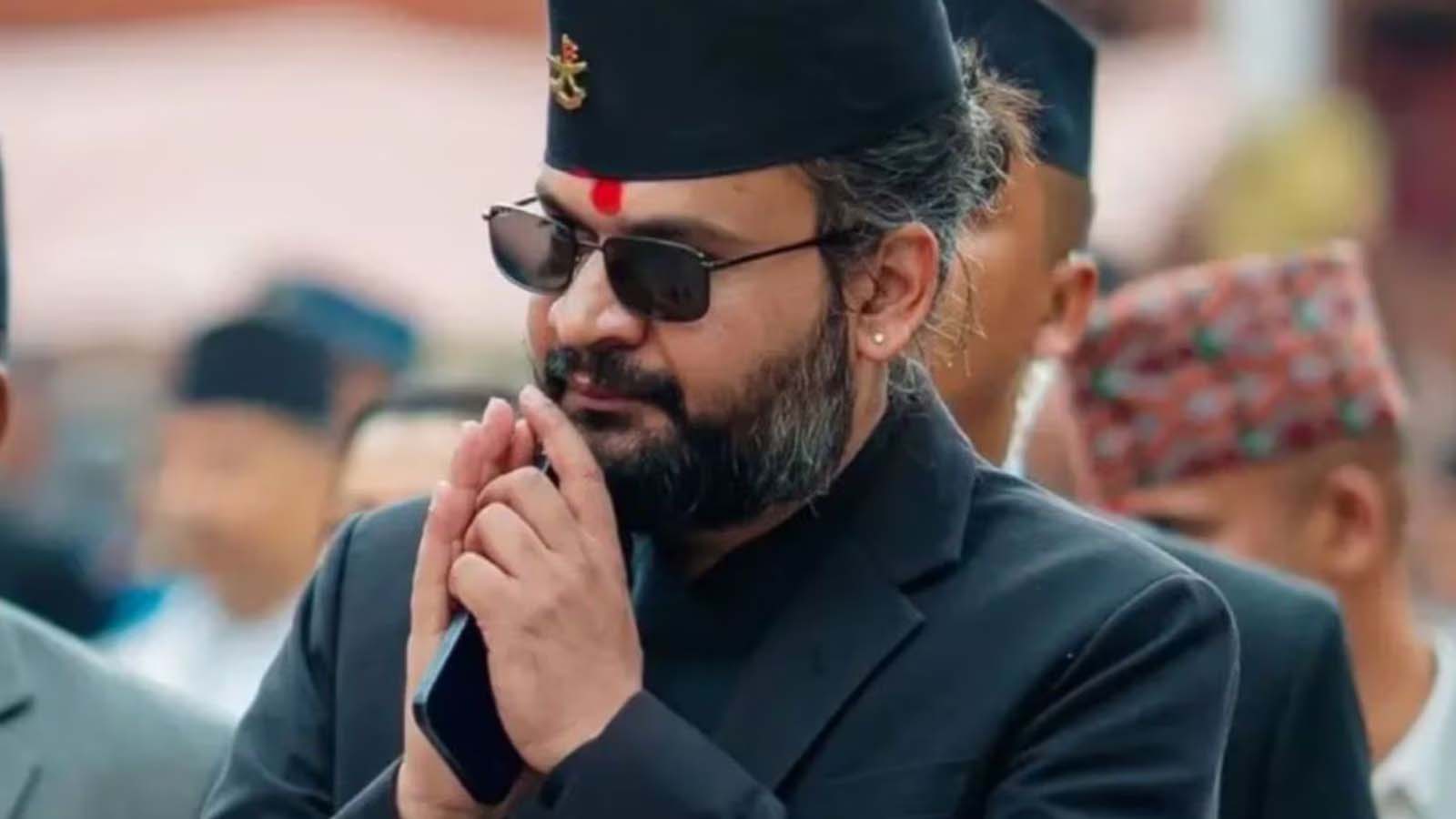
Balendra Shah seems set to tick another box—a young Hindu leader in a Hindu-majority country, where Hinduism is free from monarchical hierarchy and in sync with the aspirations of the youth.
In what is being seen as a symbolic message, Balendra Shah, the 35-year-old leader of the Rashtriya Swatantra Party (RSP) in Nepal, is all set to take oath as the next Prime Minister of Nepal on Ram Navami, which falls on March 27. This comes after he kicked off his campaign for the recent Nepal elections—which his party won by a decisive margin—from Janakpur, considered the birthplace of Sita.
The move to repeatedly evoke the Ramayana symbolism has already sparked off much buzz on social media in the Hindu-majority Himalayan country, where Lord Ram is revered. Shah also happens to be a Madheshi from the southern Terai region of Nepal, where Janakpur is situated.
Retired Jawaharlal Nehru University (JNU) professor S D Muni, who specialises in Nepal, said that the move should not be taken as a glorification of a Hindu monarchy, which Nepal has shaken off, but just a gesture to Hindus of the country. “Balendra Shah’s supporters are young and anti-monarchy,” Muni told The Indian Express.
However, some in Nepal say that this could be a gesture to undo some pro-monarchy sentiments in the country, as Shah’s voters include sections that miss the monarchy.
JNU professor Sanjay Bharadwaj, who keenly follows Nepal, added that all this means is that Shah is making it clear that he is not distancing himself from Hinduism, unlike Prachanda and K P Sharma Oli before him, and is “evoking a Hinduism that is distinct from the Hinduism that was evoked in the days of monarchy, when the king of Nepal claimed to be an incarnation of Lord Vishnu”.
The symbolism also has no necessary overlap with the Hindutva symbolism in India, Muni cautions. He says that Nepalese politics has tried to carve out a national and religious identity that is distinct from India, seeing the Ramayana as part of a distinct Nepalese tradition.
“This does not mean a gesture to India as a Hindu-majority country,” he said, adding that in reaction to the placement of an Akhand Bharat mural in the new Parliament building in India, Shah had displayed a map of greater Nepal, where parts of Uttarakhand, Uttar Pradesh, and Bihar were shown as parts of Nepal.
Straddling multiple roles
Shah, the former mayor of Kathmandu, has donned many hats. A structural engineer by training who also studied in India, Shah shot to fame as a popular rapper who took digs at corruption. This made him a popular figure among the youth in Nepal, and he won the 2022 election for the post of mayor of Kathmandu as an independent candidate by a margin of over 61,000 votes.
The Gen Z revolt thus made him an obvious contender for power, as he had a fan following in this group. But this was not all. He is the first Madheshi to rise to the top post in Nepal. As the Madheshis of the Terai region of south Nepal have been politically marginal, his coming from the group made him very popular even in this component of the population.
Coming to power in the first decisive election victory ever in Nepal, Shah seems set to tick another box—a young Hindu in a Hindu-majority country, where Hinduism is free from monarchical hierarchy and in sync with the aspirations of the youth. Shah is himself believed to be ritualistic, Nepal watchers say.
Six months after the Gen Z protests unseated the coalition government led by Prime Minister Oli, Nepal went to the polls on March 5. The results came as a surprise to many, as the RSP won 125 of the 165 directly elected seats, and headed towards a two-thirds majority in the Himalayan country’s 275-seat House of Representatives by winning 57 more seats via the proportional representation system.
The final tally of 182 makes it a landslide victory for the party founded in 2022, with no previous election ending in such a decisive victory in the Himalayan country. Shah also defeated four-time PM Oli of the Communist Party of Nepal (UML) by about 50,000 votes.
Voters in Nepal elect 275 members to the House of Representatives, with 60 per cent or 165 of the representatives being directly chosen through a first-past-the-post (FPTP) system, and the remaining 40 per cent being elected through a proportional representation system.
The oath-taking ceremony of the newly elected lawmakers will be held on March 26, and Shah is likely to be elected as the Parliamentary Party leader after this. He is set to take the oath the next day. As per a decision taken by the party on December 28, Shah would be its Prime Ministerial candidate and Rabi Lamichhane, a former journalist, its chairperson or party chief.