
By Chandan Singh | Page 3 News Worldwide | New Delhi
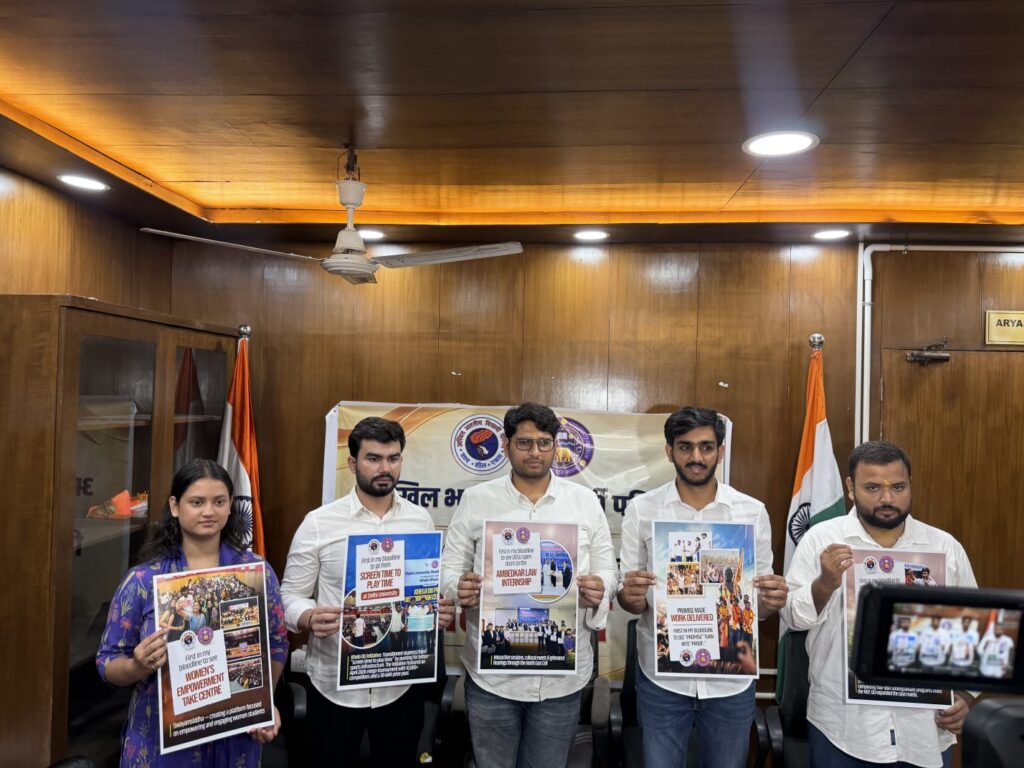
New Delhi: The Akhil Bharatiya Vidyarthi Parishad (ABVP)-led Delhi University Students’ Union (DUSU) on Wednesday presented its report card for the 2025–26 academic session, outlining a series of initiatives focused on education, student welfare, safety, sports, women’s empowerment and campus facilities.
At a press conference, DUSU President Aryan Maan, Secretary Kunal Chaudhary and ABVP Delhi State Minister Sarthak Sharma detailed the union’s work during its one-year tenure, which concluded on August 25. The presentation came as Delhi University prepares for the 2026 student union elections.
The union said its objective was to function beyond election campaigns and continuously represent students’ concerns before the university administration. It also launched an online website through which students can directly submit their problems and grievances to DUSU.
Among the key initiatives highlighted was Prerna Bhawan, a central student facility with a library, DUSU office and computer centre. DUSU also cited efforts towards free central Wi-Fi facilities, installation of more than 1,000 CCTV cameras, examination reforms and the introduction of a centralised grievance portal following concerns over question-paper errors, examination delays and paper leaks.
The union said its campaign for expansion of postgraduate seats for students completing four-year undergraduate programmes contributed to an increase of more than three times in the number of seats.
Other initiatives included the Student Rights March, a North-East Students’ Cell, hostel reforms, the ‘Khelo DU’ sports initiative, affordable Atal Canteens, women’s U-Special buses, mental health awareness programmes and measures related to Pink Booths, 24×7 PCR patrolling and lighting in poorly lit areas.
DUSU also highlighted efforts to improve access to clean drinking water, reduce the re-evaluation fee from ₹2,000 to ₹500, and create digital access to student information through DUSU Digital.
On women’s participation, the union cited the ‘One Day, One DUSU President’ initiative, under which female students were given an opportunity to experience the role of DUSU President during Navratri. Platforms such as Swayamsiddha were also promoted for women’s empowerment and participation.
The union further highlighted cultural initiatives including Madari, Dandiya Night and Bhajan Clubbing.
In the area of internships, DUSU said more than 1,000 students benefited from its Great DUSU Internship programme through 13 types of internships, while more than 1,300 Law Faculty students received internship opportunities in various Delhi courts under the BR Ambedkar Law Internship initiative.
Aryan Maan said the ABVP-led DUSU sought to establish the student union as a platform representing students’ voices and rights rather than merely an electoral organisation.
“Our objective has been to ensure that whether a student’s problem is related to examinations, hostels, safety, sports or any basic facility, DUSU remains fully committed to finding a solution,” Maan said. He added that DUSU facilitated the work of more than 8,000 students indirectly and assisted more than 6,000 students directly through social media during the year.
Sarthak Sharma said the tenure demonstrated that student politics should extend beyond elections, slogans and protests. According to him, understanding students’ problems, raising them before the administration and pursuing solutions constituted the core responsibility of student leadership.
Sharma said the Vidyarthi Parishad worked throughout the year on the five ‘Ps’ — Admission, Examination, Curriculum, Campus and Results — with the reported achievements reflecting its sustained engagement with students.
The ABVP-led DUSU’s report comes as Delhi University moves towards its 2026 student union elections, placing its year-long record before the university’s student community.