
By Chandan Singh | Page 3 News Worldwide | New Delhi
NEW DELHI: The Aam Aadmi Party’s (AAP) allegations over the Delhi Government’s decision to provide bicycles to Class IX girl students have come under scrutiny, with the comparison being questioned as misleading and lacking a like-for-like assessment of the procurement specifications.
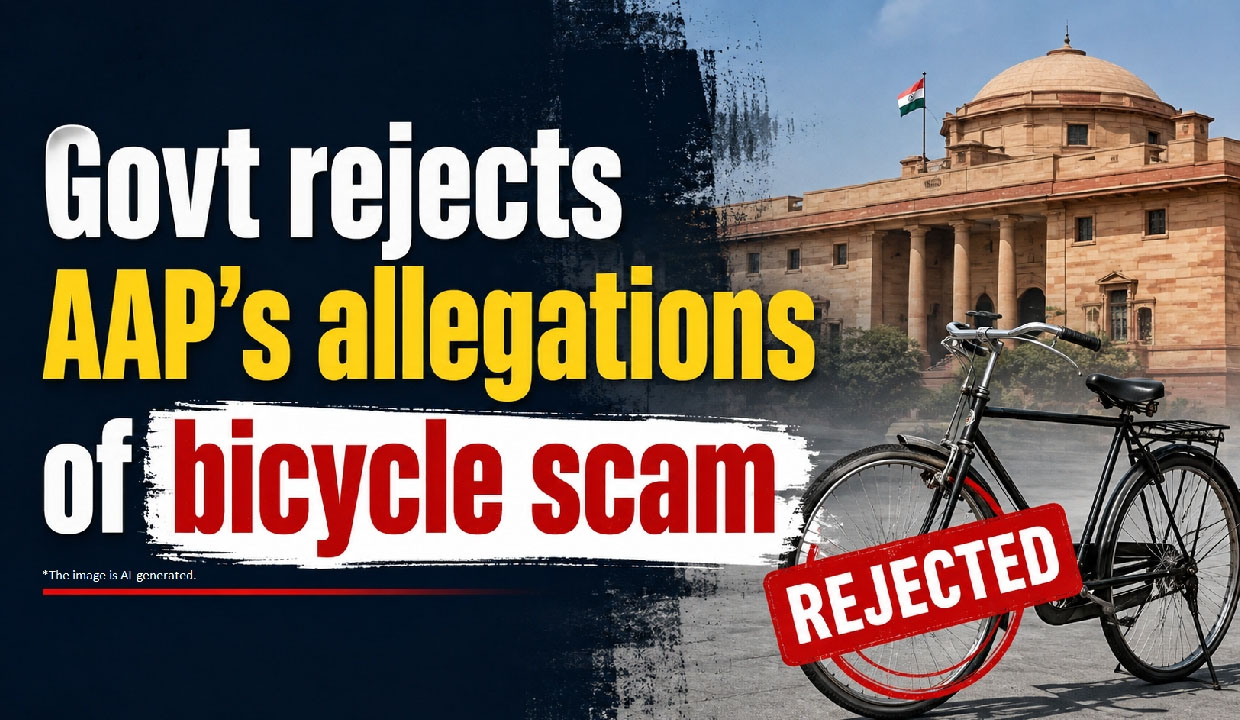
AAP leaders have alleged that the Delhi Government is paying substantially more for bicycles than their market price, claiming that similar cycles are available for around ₹4,000–₹4,500. However, the material available indicates that the comparison does not take into account the specifications, quality requirements, accessories, warranty, logistics and procurement conditions involved in a government purchase.
The bicycle shown in the material is a Hero Bonfire 26-inch cycle, listed at ₹7,500 on Amazon. This price comparison directly challenges the assertion that the government necessarily overpaid for the bicycles.
The Delhi Government’s bicycle initiative was announced as part of the 2026–27 Budget, with plans to provide bicycles to around 1.3 lakh Class IX girls every year. The scheme is aimed at easing commuting difficulties, improving mobility and encouraging girls to continue their education.
Chief Minister Rekha Gupta has already distributed bicycles to students, including an initial distribution to 1,100 girls, while the wider programme is being rolled out.
The controversy has also raised questions over the manner in which procurement allegations are being made. Any evidence of irregularities, an unreasonable tender price, manipulation, collusion or financial loss to the exchequer can be placed before the appropriate authorities for examination. However, comparing a government procurement with a cheaper-looking bicycle available online, without establishing that both products have identical specifications and procurement conditions, by itself does not establish corruption.
At the centre of the controversy are students who stand to benefit from the initiative. The bicycles are intended to help girls who may otherwise face commuting difficulties in reaching government schools.
The Delhi Government has positioned the programme as a student-welfare and education intervention focused on girls’ mobility, access to schooling and reducing barriers to attendance. The political dispute, however, has shifted attention towards the procurement controversy rather than the intended beneficiaries.
The material argues that allegations of a “scam” should be backed by documentary evidence and proper scrutiny rather than product comparisons that may not be equivalent.
For the Delhi Government, the bicycle programme remains a significant education-focused initiative aimed at putting mobility support directly into the hands of thousands of schoolgirls.