
By Mir Yar Baloch
Any announcement of negotiations will severely damage American credibility, and it will further embolden extremist elements in Pakistan and Iran who are driven by hardline religious fanaticism. Negotiations will give Iran valuable time to reactivate its sleeper cells around the world and encourage them to carry out operations. It will also provide Iran with further justification to seek revenge for its Supreme Leader, Ali Khamenei. The continued existence of this regime has now become even more dangerous for the United States; therefore, this war must continue without interruption until its final conclusion.
The U.S. President, while speaking to the media, stated that control over the Strait of Hormuz would be jointly managed by the United States and whoever becomes the new Ayatollah in Iran. Earlier, he wrote on his social media account:
“I am pleased to report that the United States of America and the country of Iran have had, over the last two days, very good and productive conversations regarding a complete and total resolution of our hostilities in the Middle East. Based on the tenor and tone of these in-depth, detailed, and constructive conversations, which will continue throughout the week, I have instructed the Department of War to postpone any and all military strikes against Iranian power plants and energy infrastructure for a five-day period, subject to the success of the ongoing meetings and discussions.”
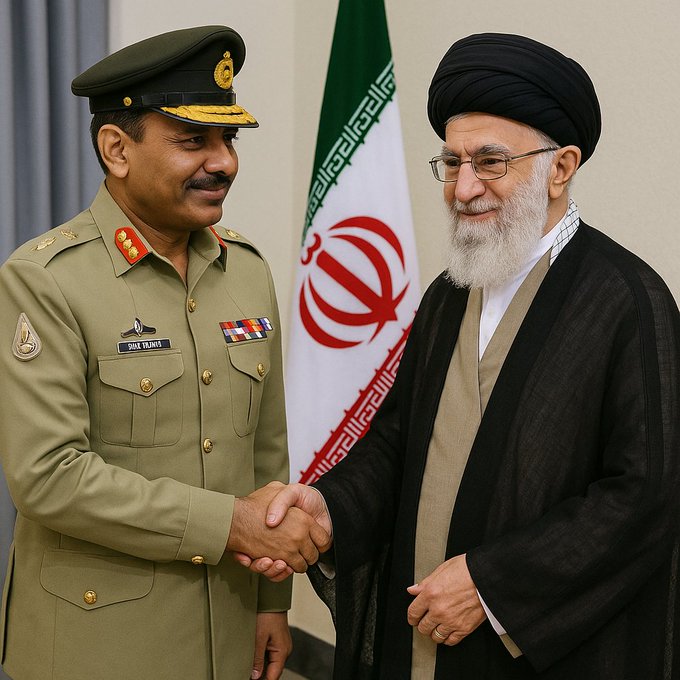
Nothing could be a greater mockery of peace than choosing Islamabad the capital of Pakistan, widely regarded as a global hub of terrorism as a venue for negotiations instead of a neutral location. The Trump administration still appears to have a misunderstanding that Pakistan can play the role of mediator between Iran, the United States, Israel, and the Gulf countries. In reality, Pakistan is itself a party to this conflict. Pakistan has already offered nuclear weapons to Iran, and the current Prime Minister of Pakistan has reportedly visited Iran twice and promised nuclear cooperation.
Furthermore, both Pakistan and Iran have kept nations such as Kurdistan, Balochistan, Sindh, Arab Ahwaz, and others under their control. Iran occupies the oil and coastal resources of Kurdistan, Ahwaz, Azerbaijan, and Balochistan, while Pakistan has illegally occupied the coasts and resources of Sindh, Pashtunistan, and Balochistan. In addition, Turkey and Syria also control Kurdish territories.
In this situation, Turkey, Pakistan, and Iran are eager to end this war quickly because if the United States and Israel, together with the Gulf countries, succeed in freeing Balochistan, Kurdistan, Al-Ahwaz, Sindh, and Pashtunistan from the control of Pakistan and Iran, it could permanently end wars and instability in the region. Oil prices would drop dramatically, and the energy needs of the entire region could be fulfilled.
Pakistan and Iran have invested billions of dollars in terrorism and proxy wars in the region because they control the oil of Kurdistan and Al-Ahwaz and the strategic coastlines of Balochistan, Al-Ahwaz, and Sindh. The day Tehran and Islamabad lose control over these nations’ resources and coastlines will be the day when the true sun of peace rises over the world.
Therefore, it is extremely necessary for the United States and Israel to continue this war against Iran with even greater intensity. The Gulf countries should fully support Israel and the United States and should immediately recognize Kurdistan, Balochistan, and Al-Ahwaz as independent states, marking the beginning of a new alliance and a new era in the region.