

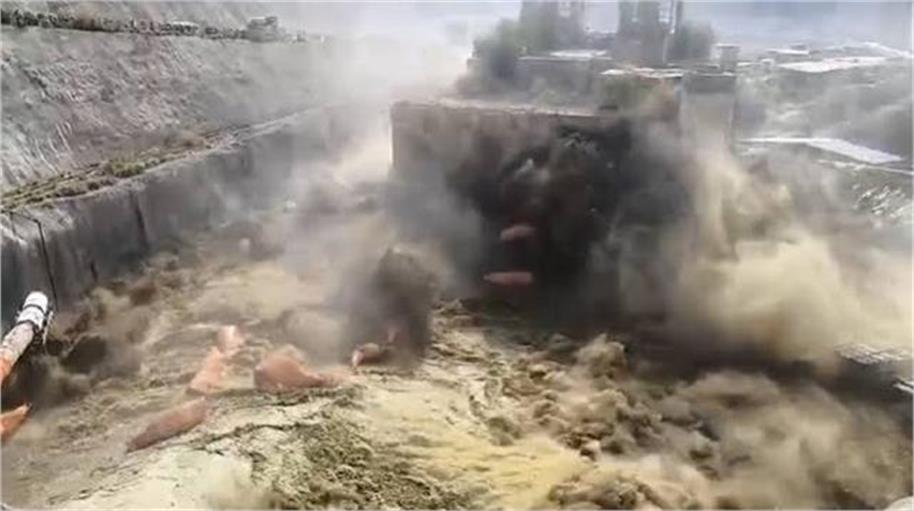
A major construction incident has disrupted work on Pakistan’s 1,530 MW Tarbela Dam fifth extension project after a rockslide during tunnel excavation allowed water to flood parts of the construction site. All workers were evacuated safely, but the incident has raised fresh questions about the project’s mounting costs and delayed completion schedule.
Islamabad: Pakistan’s Tarbela Dam hydropower expansion project suffered a significant setback on Monday, 9 November, after rocks shifted and collapsed during excavation work on a connecting tunnel. The collapse allowed a large volume of water to enter the under-construction powerhouse and tunnel areas, temporarily disrupting construction activities.
Videos circulating on social media, reportedly recorded by local residents, showed water and debris rushing through the construction site. The Pakistan Water and Power Development Authority (WAPDA) confirmed the incident but rejected reports suggesting that the entire tunnel or project infrastructure had collapsed.
According to WAPDA, the flooding resulted from shifting rocks at the construction site. The authority clarified that reports of damage to the main tunnel, powerhouse, tailrace culvert and switchyard infrastructure were inaccurate.
The authority also confirmed that all workers were evacuated safely. No deaths or serious injuries were reported. Emergency operations to remove the accumulated water and dry the affected powerhouse area have been initiated.
Construction activities have been suspended while senior officials, engineers and representatives of the contractor assess the incident and determine the extent of the damage. The authorities have yet to announce a date for the resumption of work.
Chinese-backed 1,530 MW hydropower project faces another setback
The Tarbela Dam Fifth Extension Project, commonly known as T-5, is a major component of Pakistan’s plans to expand its domestic hydropower generation capacity.
Chinese construction giant Power Construction Corporation of China Limited (PowerChina), along with its affiliated companies, is involved in the project.
The scheme is designed to utilise the dam’s fifth tunnel to generate an additional 1,530 MW of electricity. Once operational, the new capacity is expected to strengthen Pakistan’s national electricity grid and increase the contribution of hydropower to the country’s energy mix.
The project carries an estimated price tag of more than US$1 billion. It was initially scheduled for completion in 2026. However, repeated construction delays have pushed the expected completion date to 2028.
The latest flooding incident could create further uncertainty over the project’s construction timetable.
Project cost surges from Rs 82 billion to Rs 317 billion
Apart from construction delays, the sharp increase in the project’s estimated cost has become a major concern.
When the T-5 project was initially approved, its estimated cost stood at approximately Rs 82 billion. The figure has since climbed to around Rs 317 billion, representing an increase of approximately Rs 235 billion.
This means the revised cost is about 286 per cent higher than the original estimate, with the project now expected to cost nearly four times its initial budget.
The latest incident is not the first construction-related problem to affect the scheme. In 2025, a temporary protective structure known as a cofferdam also collapsed, prompting an investigation involving the contractor, consultants and WAPDA.
The recurrence of construction difficulties has added to concerns about project management, financial exposure and the timeline for completing the expansion.
Delays could increase pressure on Pakistan’s power sector
The T-5 project is expected to provide Pakistan with an additional 1,530 MW of hydropower generation capacity once completed. Its delayed commissioning could therefore have wider implications for the country’s electricity supply.
Without the additional hydropower capacity, Pakistan may have to continue relying more heavily on conventional electricity generation using expensive fuels to meet growing demand.
Greater dependence on fuel-based power generation could increase electricity production costs and place additional pressure on government finances. It could also complicate efforts to address the existing challenges facing Pakistan’s power sector.
With the completion deadline already extended to 2028 and the project’s estimated cost having risen substantially, the latest flooding incident adds another challenge to one of Pakistan’s major hydropower development schemes.