
According to the UN agency’s recent “gender snapshot,” at the current rate of progress it will take 171 years to achieve gender equality, a UN goal initially set for 2015 and then moved to 2030
At a time when the fight for gender equality is facing a backlash, pressure is mounting for the next leader of the United Nations to be the first woman in its more than 80-year history.
The contradiction isn’t lost on UN Women, the agency facing an uphill struggle pressing for the rights of women and girls – and for women to be at the top in international organisations, governments, business, technology and the escalating debate over artificial intelligence.
According to the UN agency’s recent “gender snapshot,” at the current rate of progress it will take 171 years to achieve gender equality, a UN goal initially set for 2015 and then moved to 2030. Other findings are also grim: Nearly one in three women globally have experienced sexual violence. Nearly one in five girls is married before age 18. And at the pace of the last five years, gender parity in parliament won’t be reached until 2089.
After years of upward movement, women’s political leadership is also losing momentum, with six in seven countries still led by men.
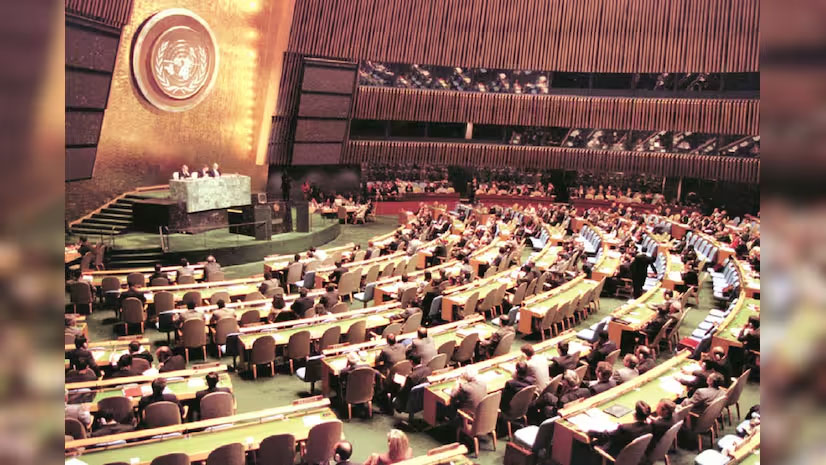
Sarah Hendriks, a high-ranking official in UN Women, said the just-ended annual gathering of world leaders in the UN General Assembly hall “very much reflected a male-dominated world, both in terms of representation as well as content.” She welcomed the “disproportionate reinforcement” of the potential for a woman to be the next UN chief, which she said cut across regions of the world and political divides, and was “energising.” “This is not just a question simply of symbolism,” she told The Associated Press. “It’s a question of whether the UN actually reflects the equality it asks the world to uphold.” “We can’t ask governments to dismantle barriers to women’s leadership while accepting those barriers in its own institutions,” she said. “We can’t tell companies to break glass ceilings while the UN leaves our own ceilings intact.”
Lots of talk about women and opportunity, but what is the reality? During the weeklong high-level meeting that ended Monday, Hendriks said leaders said women “must have an equal opportunity to hold the most powerful positions in the world including this one and, in fact, especially this one.” Among those speaking out was East Timor’s President Jose Ramos-Horta, co-winner of the 1996 Nobel Peace Prize. He said that after more than 80 years, “we ought to have enough wisdom and elect a woman with unquestionable integrity.” And Botswana’s president, Duma Boko, lamented “an unfinished chapter in the history of this organisation” – that after eight decades “the United Nations has yet to be led by a woman as secretary-general.” There are currently seven candidates to replace Secretary-General Antonio Guterres, whose second five-year term ends December 31. The slate consists of four women and three men; former Chilean president Michele Bachelet dropped out.
Two women UN trade chief Rebeca Grynspan of Costa Rica and Guyana’s UN ambassador, Caroline Rodrigues Birkett topped the latest straw poll in the 15-member Security Council on Tuesday, with UN nuclear chief Rafael Grossi a close third. Grynspan had 10 “encourage” votes and three “discourage” votes, while Rodrigues-Birkett had six “discourage” votes and Grossi had seven, according to two diplomats speaking on condition of anonymity because the poll was private. Some diplomats said the results could encourage new candidates.
By tradition, the job of secretary-general rotates by region; this is Latin America’s turn, though there are two African contenders. While the General Assembly has the final say, decision-making rests with the five veto-wielding members on the Security Council – the US, Russia, China, Britain and France. They have been mum about their choices, though Russian Foreign Minister Sergey Lavrov said Saturday that Grynspan and Rodrigues-Birkett “meet the criteria.” When women lead, peace agreements last longer Hendriks, UN Women’s director of policy, programs and its intergovernmental division, said the choice, for her, is really about the kind of multilateralism the United Nations wants for the next 80 years.
During the high-level meeting, she said there was a reduction in the focus on gender equality in speeches by the UN’s 193 member nations. Leaders spoke extensively about conflicts in the West Asia, Ukraine and elsewhere; about peace and security; about UN reform; and, in some cases, about climate change, development, finance, and artificial intelligence. “But gender equality was much less prominent as a political priority.” Hendriks said the gender dimension of the technological transformation taking place today, including the use of AI, received far less attention.