
Pacific island leaders voiced concern over an ICBM test that flew over several member states without adequate notice and called for at least 24 hours’ warning for future launches
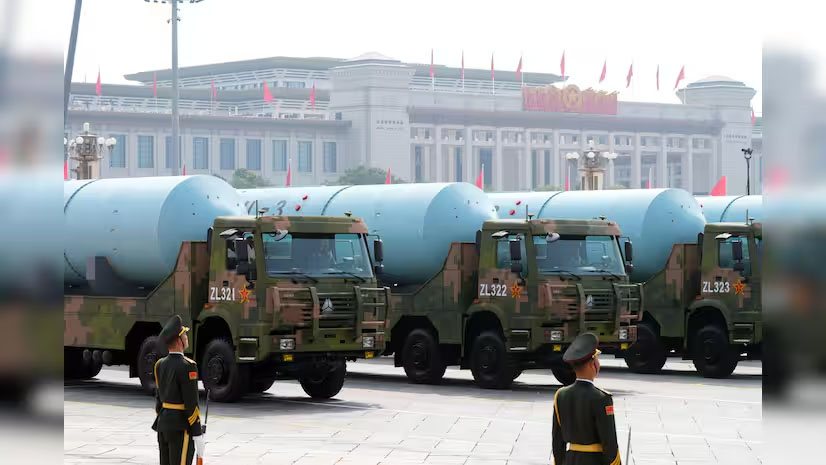
The leaders of Pacific island nations took a thinly-veiled swipe at China’s recent missile test in their region, an unexpected move after earlier failed attempts to agree on a response.
The assembled group “registered concern on the recent intercontinental ballistic missile (ICBM) test which overflew a number of members without adequate notice,” the final communique said, according to Palau President Surangel Whipps Jr., who read it out to journalists late on Thursday.
“Leaders called on all states undertaking ICBM testing to ensure transparency and reassurance including through the provision of advance notification of at least 24 hours in accordance with international practice.”
Nauru was the only country to disassociate itself from the statement, Whipps said. The final communique hasn’t been publicly released yet.
While the statement doesn’t mention China by name, Beijing’s July test had been criticised by several of the nations and the language proposed in the statement was supported by countries including Australia and Palau, which had been pushing for the forum to come out strongly against the submarine-launched ballistic missile test.
One key point of contention had been the lack of warning by Beijing ahead of the test, something countries critical of the move focused on as a distinction from similar missile tests conducted by the US around the Marshall Islands.
 "Pacific leaders criticise China's new missile test, call for advance notice 2")
On Thursday, before the communique’s contents were conveyed, Whipps, who hosted the event, called for the region to present a united front on the issue.
“A unified Pacific voice is critical in getting Beijing to respect sovereignty, to respect transparency and to be a responsible partner. I think that’s the message that should be sent to Beijing,” Whipps said. “It’s important that we have a unified position and we’ll work on that.”
China in turn criticised the Palau leader’s statement.
“Palau has repeatedly raised this issue in an ill-intentioned attempt to hijack the position of other member states of the Pacific Islands Forum. It will not have its way,” Guo Jiakun, a Ministry of Foreign Affairs spokesman, said in Beijing on Thursday.
The Pacific group last month failed to achieve a consensus on a statement criticising the test when its foreign ministers met in Fiji, after Kiribati and Nauru refused to sign on.
Pacific nations have increasingly become a hotspot of competition between the US and China in recent years, particularly after Beijing and the Solomon Islands signed a security pact in 2022.
Kiribati’s leader last month said that it would be unfair to single out China for criticism as the US also tests missiles in the region from the Marshall Islands, according to Australian Broadcasting Corp.
Both Australian Prime Minister Anthony Albanese and Whipps rejected that comparison on Thursday.
“The situations are very different. The US gives proper notice, has an agreement with the Marshall Islands,” Albanese said in Palau. “What we saw with the Chinese test was a firing of a missile with very little notice, certainly not what is expected internationally, from a submarine, which went across and landed in the Pacific” near Tuvalu.
The test was conducted “with no respect for those nations,” he said. “And that is why it brought such a strong response from the Pacific, including from Australia.”
Canberra has previously complained to Beijing about the lack of notice provided when China conducted live-fire naval drills in the Tasman Sea between Australia and New Zealand in February 2025.
“We don’t want our backyard, our homes to be threatened,” Whipps said. “And, really, disrespected.”
Whipps and Albanese were speaking at the opening of the expansion of a solar power installation in Palau, which was funded by Australia’s government, with both emphasising how climate change is the most serious threat to the region.
However, those concerns have repeatedly been overshadowed by the geopolitical competition in the region between China and the US, including the status of Taiwan.