
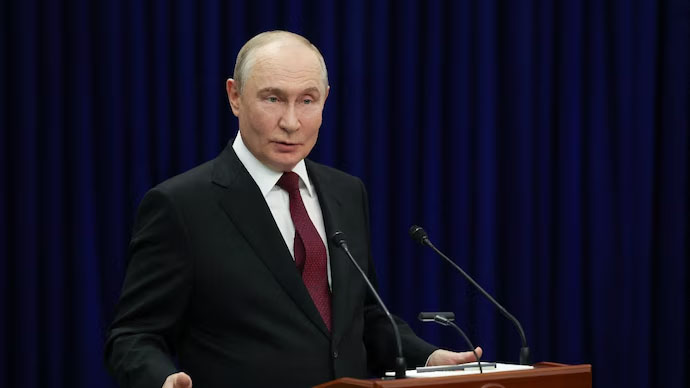
Putin said Russia was advancing in Ukraine and said Moscow could not negotiate with ‘terrorists’. He also said Russia remained open to talks to end the war while acknowledging damage from Ukrainian drone strikes.
Russian President Vladimir Putin said on Tuesday that Russia was winning the war in Ukraine and portrayed the Ukrainian leadership as “terrorists” with whom Moscow could not negotiate, while also saying that Russia remained open to talks aimed at ending the war.
Putin made his most detailed comments on the war in many weeks after a summit in Kyrgyzstan. He acknowledged that Ukrainian attacks inside Russia had inflicted real damage and said drones posed a particular challenge, but insisted that Russian forces were advancing on the battlefield.
“I have no doubt the enemy will crumble,” Putin told reporters, although he declined to say when that would happen.
PUTIN SAYS RUSSIAN ADVANCES ARE ACCELERATING
Four and a half years into the war, Russia controls about a fifth of Ukraine. US-mediated peace talks broke off in February after the United States and Israel went to war with Iran.
Opinion polls suggest growing war fatigue in Russia, while influential voices have warned about the strain on its economy.
Despite those pressures, Putin struck a confident and hawkish tone as he gave a detailed account of developments on the front line. He said Russian advances were accelerating.
Putin said Russian troops captured 270 square km (104 square miles) of the Donetsk region in eastern Ukraine in August. He also said two large groups of Ukrainian troops had been surrounded — one comprising 4,500 to 4,800 men and the other up to 2,000.
Reuters could not independently verify those assertions.
Putin said Russian troops continued to advance towards the cities of Sloviansk and Kramatorsk. He added that Moscow’s forces were preparing to launch massive strikes against energy infrastructure in Ukraine.
PUTIN CALLS UKRAINIAN DRONE THREATS ‘STATE TERRORISM’
Putin said Ukrainian President Volodymyr Zelenskhyy’s warning to airlines that Ukrainian drones would effectively shut down Russian airspace sounded like “state terrorism.”
He said Moscow would find a way to respond if that happened.
Speaking at the news conference after the summit in Kyrgyzstan, Putin said it was not possible to negotiate with “terrorists”.
However, he also said Moscow remained open to talks aimed at ending, rather than freezing, the war. He restated Russia’s willingness to talk to US President Donald Trump’s envoys.
“If someone makes, or can make, a tangible contribution to this process, we are all in favour,” Putin said.
“The only thing we would want to avoid is the process spinning its wheels pointlessly. However, if someone is capable of bringing something positive to these negotiations – which, as we understand it, are currently somewhat frozen – then, generally speaking, we are not opposed.”
PUTIN ACKNOWLEDGES DAMAGE FROM UKRAINIAN DRONE STRIKES
Putin specifically acknowledged that Ukrainian drone strikes had caused damage to Russian oil refineries, although he did not refer to the widespread fuel shortages that have resulted from those attacks.
He said Russia had improved the level of protection around its facilities and claimed that “we only have 10% of our refineries left to repair”.
Putin also responded scathingly to an accusation by the German government on Tuesday that Russia was responsible for an attempted drone attack at Leipzig airport last month.
He said the government of Chancellor Friedrich Merz was pointing the finger at Moscow to distract from domestic problems and falling approval ratings.
Putin accused Germany of planting evidence to frame Russia for the drone attack, but he did not say what he was basing that accusation on.
PUTIN DISMISSES NEW MOBILISATION RUMOURS
Putin rejected rumours that Russia would have to order a new military mobilisation, calling them “utter nonsense”.
His comments came as he sought to project confidence in Russia’s military position despite acknowledging the damage caused by Ukrainian drone attacks and amid signs of growing war fatigue inside Russia.