
By Chandan Singh | Page 3 News Worldwide | New Delhi
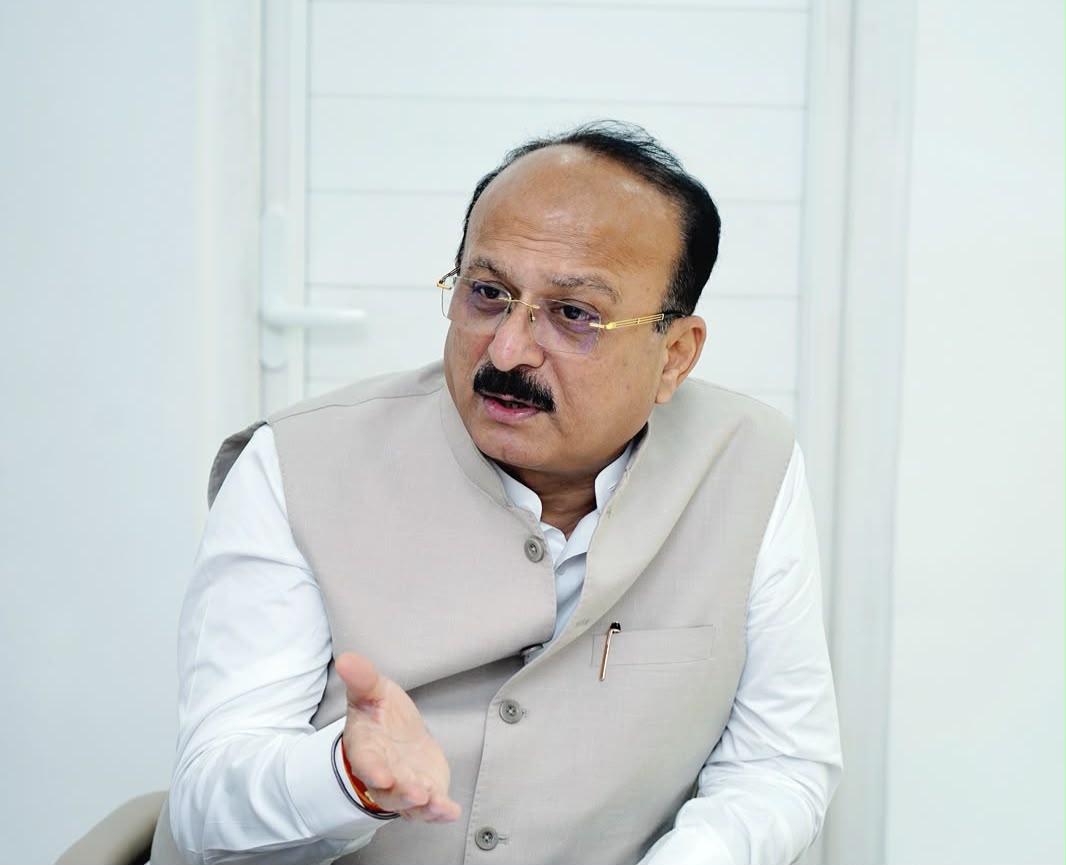
NEW DELHI: Delhi Urban Development Minister Ashish Sood has highlighted key provisions of the Master Plan for Delhi 2047 (MPD-2047), describing it as a comprehensive roadmap aimed at expanding affordable housing, redeveloping ageing colonies, easing congestion and increasing the capital’s green cover.
Speaking during a media interaction, Sood said Delhi may face limited land availability, but its planning vision is not constrained. He said the master plan seeks to integrate housing, transport, infrastructure and environmental priorities to create a more sustainable capital.
“This visionary Master Plan has taken shape under the dynamic leadership of Prime Minister Narendra Modi, the continuous guidance of Union Home Minister Amit Shah, and the strong commitment of Chief Minister Rekha Gupta,” Sood said.
According to the minister, MPD-2047 provides for commercial use on the ground floors of properties located along roads measuring 30 metres in width, aimed at promoting local economic activity and improving convenience for residents.
In DDA planned areas, redevelopment of up to 3,000 square metres would be permitted where more than 75% of residents reach a consensus, with 1.5 Floor Area Ratio (FAR). The provision is intended to help residents replace ageing flats with larger and modern homes.
For unauthorised colonies, pocket-based redevelopment covering a minimum 2,000 square metres would be allowed with 1.5 FAR, facilitating stronger structures, wider roads and improved community facilities.
The plan also places emphasis on Transit-Oriented Development (TOD). On 2,000-square-metre plots within 500 metres of Metro stations, TOD provisions would seek to improve pedestrian access to public transport and reduce dependence on private vehicles. Developers would provide 18-metre-wide roads around TOD projects to strengthen connectivity and traffic movement.
On slum rehabilitation, Sood said the focus would remain on in-situ rehabilitation, allowing residents of JJ clusters to receive new housing at the same locations rather than being displaced.
The master plan also proposes measures to expand Delhi’s green network. No new construction would be permitted on Yamuna floodplains, while proposed initiatives include green “lung spaces” in the Aravallis, a 52-km DDA cycle track, more than 200 km of park connectors and river connector patches along drains such as the Sahibi (Najafgarh drain).
MPD-2047 also seeks to simplify land pooling procedures for rural areas and villages, while creating provisions for land acquisition for vertical educational campuses and the revival of industries and economic hubs that had earlier moved out of Delhi.
Waste management would receive a further push, with new construction and TOD projects envisaged as zero-waste campuses, incorporating source segregation and modern waste-processing technologies to reduce pressure on landfills.
The plan also outlines long-term measures for water and power augmentation. Inter-state agreements involving the Renuka, Lakhwar and Kishau dams, along with advanced recycling systems, are intended to address future water requirements. Power infrastructure would similarly be expanded through long-term arrangements aimed at ensuring uninterrupted supply.
Sood said coordinated functioning between the Centre and the Delhi Government would help translate MPD-2047 into a long-term transformation of the national capital, with the objective of creating a better-planned Delhi for its youth and citizens.