

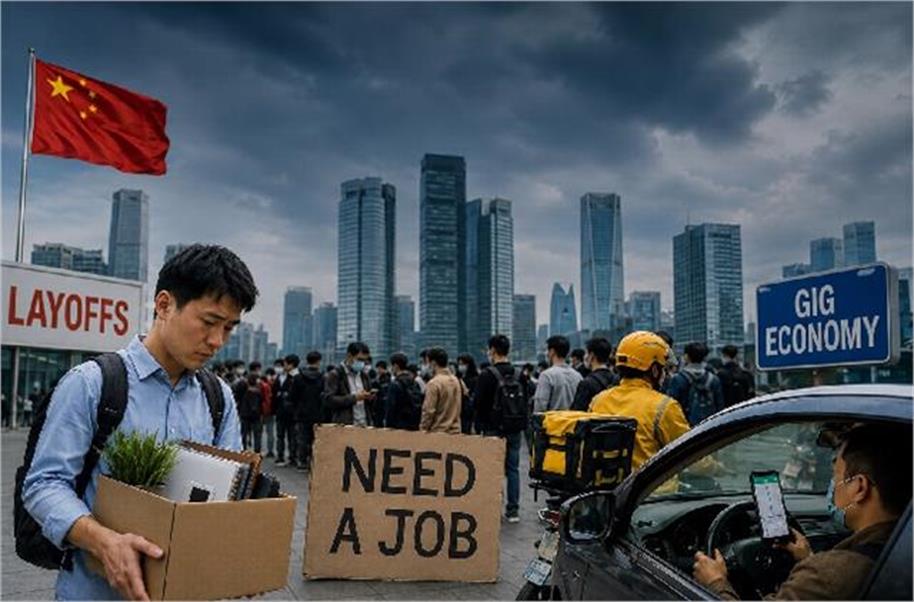
China’s weakening labour market, rising unemployment, a record influx of graduates and the rapid adoption of artificial intelligence (AI) are pushing millions of workers away from permanent jobs and into the gig economy. Economists warn that while flexible work is providing short-term employment, it could create long-term challenges for the country’s economy and social welfare system.
International Desk: Faced with fewer full-time job opportunities and growing uncertainty, an increasing number of Chinese workers are opting for temporary and contract-based employment. Analysts say the expansion of the gig economy reflects deep structural changes in China’s labour market and raises concerns over the future of social security, pensions and economic growth.
Tech Professionals Turning to Gig Work
Thirty-year-old Bao Zhang started working as a driver for a Chinese ride-hailing platform after losing his job as a software tester earlier this year. He says finding another role in the technology sector has become increasingly difficult because of the weak employment market.
“People who once hired taxis are now driving them,” Bao said.
Working from 7 a.m. until midnight in Beijing, he earns around 6,000 yuan (about US$885) each month after deducting vehicle rental and charging costs.
Flexible Employment Continues to Expand
According to the China New Employment Forms Research Centre, the number of people in flexible employment—work without permanent full-time contracts—is expected to reach 320 million this year, up from 280 million in 2025.
That would be roughly equal to the entire population of the United States and account for nearly 44 per cent of China’s workforce.
Gig Economy Becomes a Critical Safety Net
The gig economy has emerged as an important source of employment as traditional industries continue to shed jobs.
China’s prolonged property downturn has sharply reduced construction employment, while manufacturers are cutting staff amid increasing automation, cost reductions, tariff pressures, overcapacity and fierce price competition.
AI and Weak Demand Affect White-Collar Workers
Flexible work is no longer limited to rural migrant labourers. Growing numbers of university graduates, young professionals and white-collar employees are also entering the gig economy as domestic demand softens and AI transforms workplaces.
Yang Zhan, a cultural anthropology expert at Hong Kong Polytechnic University, said the trend has spread far beyond traditional labour groups.
“It is no longer confined to migrant workers from rural areas. It has expanded to include the middle class and university graduates,” he said.
Yang added that China’s industrial upgrading is gradually replacing labour-intensive industries that once created millions of jobs, while AI is accelerating changes in the employment landscape.
China’s Ministry of Human Resources and Social Security and the State Council Information Office did not immediately respond to requests for comment.
Growing Strain on China’s Social Security System
Experts warn that most gig workers are not required to make compulsory social insurance contributions. As the number of flexible workers increases, China’s already stretched social security system could face even greater financial pressure in the years ahead.
Pension Concerns Mount
A 2019 report by the Chinese Academy of Social Sciences warned that China’s national pension fund could run out by 2035 because of the country’s rapidly ageing population.
An updated assessment released in 2024 suggested that raising the retirement age could postpone the crisis by eight or nine years.
Experts Call for Better Quality Jobs
One government adviser said unstable incomes and irregular employment patterns make the gig economy a difficult sector to regulate effectively.
The adviser recommended stronger support for China’s formal services sector to create more secure and better-paid employment opportunities.
Another government adviser argued against imposing additional taxes on gig workers, many of whom are rural migrant labourers, suggesting that family support measures such as childbirth subsidies would offer a more sustainable long-term solution.
Most Gig Workers Avoid Social Insurance
Of the 12 flexible workers interviewed by Reuters, only two said they voluntarily contributed to social insurance.
Two others said they paid into the system through part-time permanent jobs, while the remaining workers preferred to rely on personal savings rather than make regular contributions.
Health and Retirement Worries Persist
Bao Zhang says spending long hours behind the wheel has left him with persistent pain in his knees and ankles, yet he has chosen not to purchase medical insurance.
He believes retirement remains a distant concern and expects future pension payments to be too small to provide meaningful financial support.
Wider Economic Impact
Frederic Neumann, Chief Asia Economist at HSBC, said gig jobs generally fail to provide the salaries and social protection that many Chinese workers have traditionally expected.
He warned that weaker job security could reduce household spending and slow economic growth.
“A whole new generation is growing up without the sense of security and confidence that their parents enjoyed for many years,” Neumann said.
Social Security Coverage Remains Limited
According to a government report released in December 2025, only 70.6 million flexible workers were enrolled in China’s urban employee pension scheme by the end of 2024. The scheme offers benefits beyond the basic state pension.
Most migrant workers remain enrolled only in the basic pension programme, where monthly payouts can be as low as 163 yuan.
A survey of 30,000 delivery workers conducted by Peking University found that fewer than one in ten supported compulsory social security contributions, mainly because they would have to contribute around 10 per cent of their income.