
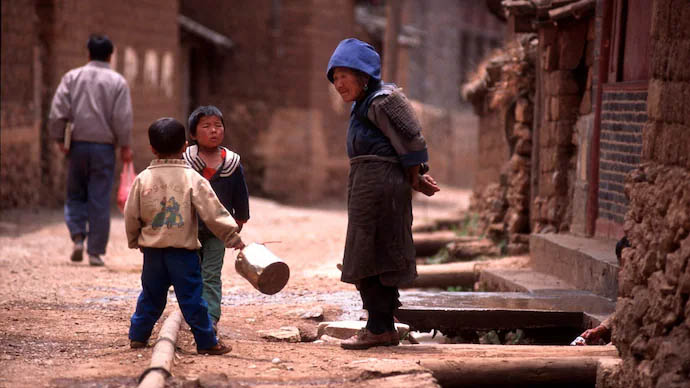
China, the world’s manufacturing powerhouse and a socialist state governed by a communist party, is being accused online of having a birth-based caste system that shapes access to education, healthcare, and opportunity. Does China really have a caste system? Here’s the reality.
China is the world’s manufacturing powerhouse, the second-largest economy, and a country ruled by the Communist Party and officially champions socialist equality. Yet a growing debate on social media has cast a spotlight on an unpopular question that does China have a caste system?
The debate gained traction online after Indian users drew parallels between China’s social structure, arguing that an individual’s opportunities are often shaped by the circumstances of their birth. Pointing to China’s hukou household registration system, which they say creates a rigid, inherited hierarchy that influences access to education, healthcare, welfare benefits, and economic mobility.
Dozens of Indians said on X (earlier known as Twitter) that their timelines were full of posts and videos that discussed the hukou as a caste system, alleging that those up on the pecking order still oppressed and exploited those lower down.
“It seems China has a brutal caste system, and China should bring equality between its people,” a user named Mohnish wrote on X.
“One must admit that China actually has a similar caste system, and the hundreds of millions of farmers struggling for basic survival are essentially the country’s lowest caste” another user posted on X.
“They’re deprived of fair opportunities and benefits from birth,” the user added.
Some people, however, contend that comparing hukou to caste oversimplifies both systems, arguing that the Chinese model is an administrative and economic classification rather than a social institution akin to caste. There’s also the allegation that Indians are viewing Chinese society through their own lens because they, too, had a four-layered ancient social structure.
So, what is the reality? Does China have a caste system? Let us find out.
ANCIENT CHINA’S HIERARCHY-BASED FOUR OCCUPATION SYSTEM
When Indians on social media speak of a “Chinese caste system”, they are often referring to two very different phenomena. One is the ancient Chinese social hierarchy known as Shi-Nong-Gong-Shang, and the modern hukou household registration system. While the Shi-Nong-Gong-Shang belongs to China’s imperial past, the hukou continues to shape the lives of hundreds of millions of Chinese citizens even now.
Long before the rise of the Communist Party, Chinese society was organised around a social framework known as Shi-Nong-Gong-Shang. This was a hierarchy-based occupation system that classified people into four broad groups known as Shi (scholars and officials), Nong (farmers), Gong (artisans and craftsmen), and Shang (merchants and traders).
According to historical records, this hierarchy emerged during the late Zhou dynasty and the Warring States period and was later formalised by Han dynasty historian Ban Gu in the Book of Han (111 CE).
The hierarchy placed scholars and officials (Shi) at the top because they were seen as guardians of morality and governance. Farmers (Nong) came next because agriculture was considered essential to the survival of the state. Artisans (Gong), who produced goods and tools through skilled labour, occupied the third position, while merchants (Shang) were placed last because Chinese Confucian thinkers often viewed profit-seeking with suspicion.
However, historians and scholars of Chinese society caution against equating Shi-Nong-Gong-Shang with caste. The system was primarily an occupational and ideological classification rather than a rigid hereditary order. Wealth and status did not always coincide, and social mobility, though limited, was possible. A merchant’s son could study, pass imperial examinations, and become a scholar-official. Likewise, prosperous merchants often accumulated considerable wealth despite their lower social prestige.
COMMUNIST ERA’S HUKOU SYSTEM THAT STILL EXISTS IN CHINA
The Shi-Nong-Gong-Shang system is more like India’s Varna system rather than the rigid caste system, as it does not restrict a person’s growth and opportunity based on their birth. But China’s hukou system, a household registration regime introduced and strengthened after the Communist Revolution, divides people into two groups and also has birth-based privileges.
Hukou is China’s household registration system, introduced in the 1950s, that classifies Chinese citizens as rural or urban residents based on their registered place of residence. The hukou is often described as an internal passport system, and it determines access to public services such as education, healthcare, housing, and social welfare, while historically restricting large-scale migration from rural areas to cities.
Author Aravindan Neelakandan, in his book A Social Dharmic History of India, argues that the hukou system evolved into a form of state-sanctioned social stratification in China.
According to Neelakandan, traditional China already had a residency-based registration system, but Mao Zedong’s government transformed it into a far more rigid structure.
“Traditional Chinese society had its own social discrimination, like any other pre-modern society. The system called hukou allowed the Chinese authorities to assign a person’s place, role, and resources available to him or her at birth,” Neelakandan writes.
He argues that the system was heavily biased against rural residents, whom he compares to peasants in traditional societies. According to Neelakandan’s book, rural citizens faced severe restrictions in accessing quality education, healthcare, employment opportunities, and urban welfare benefits.
Neelakandan contends that rather than dismantling inherited inequalities, Maoist policies strengthened them. From 1959 onwards, hukou status became largely hereditary, making upward mobility extremely difficult.
According to Neelakandan, the Communist state created “a caste system where one’s status was determined at birth”.
The author’s argument draws on the work of anthropologists Sulamith Potter and Jack Potter, who studied how Chinese society evolved under Mao’s philosophy. The two scholars described the separation between rural and urban residents as a “caste-like barrier” that restricted both geographical and social mobility. Peasants, they argued, were effectively tied to their local collectives and prevented from freely moving into cities.
WHY SCHOLARS CALL THE HUKOU SYSTEM A ‘URBAN CASTE SYSTEM’
The caste comparison of China’s system is not limited only to Indian commentators or experts.
A research paper titled The Chinese Urban Caste System in Transition, authored by a Presidential Chair Professor and Dean at the Chinese University of Hong Kong, Shenzhen, uses the phrase “urban caste system” to describe the consequences of hukou-based classification.
According to his paper, the hukou system was established under a Soviet-inspired development model. The objective of the system was to accelerate industrialisation by extracting agricultural surplus from rural areas and channelling resources towards urban growth.
As a result, urban residents enjoyed a range of state benefits, including guaranteed employment, subsidised housing, healthcare, education, pensions, and social welfare. Rural residents, meanwhile, were largely excluded from these privileges and were restricted from settling permanently in cities.
Shenzhen, in his paper, also argues that hukou effectively created two categories of citizenship, one with access to state resources and another that remained outside the welfare structure.
CHINA: A NATION DIVIDED BETWEEN RURAL AND URBAN CLASSES
According to the US-based global affairs publication, Diplomatic Courier, hukou has produced deep and enduring inequalities between rural and urban China.
The piece by the publication notes that rural hukou holders have often been relegated to the most dangerous, physically demanding, and poorly paid jobs. Even after migrating to cities, they frequently earn substantially less than native urban residents and continue to face barriers in education, employment, and healthcare.
According to the Diplomatic Courier analysis, decades of differential treatment have created not only economic disparities but also cultural divisions that have snowballed into social discrimination. Urban residents in China often have access to better schools, jobs, and welfare benefits as an inherited entitlement, while rural migrants struggle to overcome institutional disadvantages despite economic reforms.
The piece concludes that China has effectively divided itself into “two separate nations” — one that benefited from rapid economic growth and another that remained on the margins.
CHINESE PEOPLE DISMISS THE ARGUMENT OF HAVING A CASTE SYSTEM
Despite these comparisons, Chinese people argue that the hukou system, the Shi-Nong-Gong-Shang system, and caste are not the same thing, and their comparison is wrong.
“Anti-India sentiment on the Chinese internet appears to have reached a new high. Recent India origin claims that China has a “caste system”, including attempts to reinterpret the old classification of scholars, farmers, artisans, and merchants, have had almost no persuasive effect in China. They reveal a basic problem: people often understand unfamiliar societies through the categories that structure their own world,” one Hong Kong-based person wrote on X.
Zhang Yiwu, a professor at the Department of Chinese Language and Literature at Peking University, dismissed the comparison of the hukou and Shi-Nong-Gong-Shang as “caste system” by Indians.
“They are entirely different concepts. It is hilarious to see the arguments as if they’ve discovered some devastating secret,” Zhang, told The Global Times, a Beijing-based daily newspaper. “The ancient concept of Shi, Nong, Gong, and Shang was simply an occupational order, not a hereditary caste system. Apparently, some Indians lack basic knowledge about China’s historical culture,” he added.
India’s The Hindu newspaper, in an article on hukou, described the system primarily as an instrument of social control and migration management. The report also suggests that the system functioned as an “internal passport”, tying access to public services and welfare benefits to one’s registered place of residence.
Since 2014, Beijing has implemented a series of reforms aimed at reducing disparities between rural and urban residents and making it easier for migrants to obtain urban registration, particularly in smaller cities, The Hindu report added.
According to China’s National Bureau of Statistics, the country’s “floating population”, that is, the migrants living away from their registered hometowns, stood at approximately 358 million people by the end of 2025, nearly a quarter of the country’s population.
DOES CHINA REALLY HAVE A CASTE SYSTEM?
While it can be argued that Indians might view the Chinese system through the prism of their varna system, which later solidified into the caste system, there is more to it. In fact, European colonisers saw India’s profession-based social set-up through their caste lens.
The system existed in Europe, and the English word caste was derived from the Spanish and Portuguese word casta, meaning “race, lineage, breed, or kind”. Casta originated from the Latin castus, which meant “pure” or “cut off from faults”. This shows that such hierarchical systems did exist in Europe, and they used those prisms to view the Indian social set-up.
But the answer to whether China really has a caste system depends on how caste is viewed and defined.
If caste is understood as a birth-based system that influences access to opportunities, social mobility, and state resources, critics argue that China’s hukou regime possesses several caste-like characteristics.
However, if caste is understood as a broader social institution involving hereditary status groups, endogamy, notions of purity and pollution, and deeply embedded cultural identities, then most experts would argue that China’s hukou system does not fit the definition.
What is beyond dispute is that the hukou system created one of the most significant social divides in modern China. Whether that divide should be called a caste system remains open to debate.