
The fourth assassination attempt on Donald Trump at the White House Correspondents’ Dinner has forced a question most people never bother to ask. The answer is more detailed, and more unsettling, than you might think.
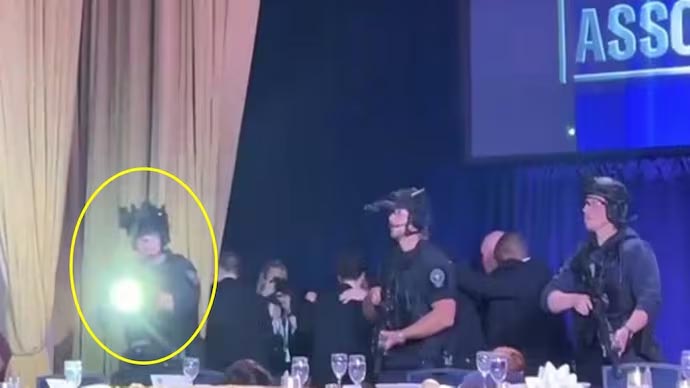
On the evening of Saturday, April 25, 2026, the White House Correspondents’ Dinner was doing what it does every year. Journalists in black tie. Politicians performing charm. The most powerful people in America eating expensive food and pretending the room was not deeply divided. Then, at 8:34 PM, Cole Tomas Allen ran past the main security checkpoint outside the ballroom of the Washington Hilton in Washington DC and opened fire.
Secret Service agents shouted “shots fired.” Within seconds, agents in body armour rushed the stage, surrounded President Donald Trump and Vice President JD Vance, and pulled both men out of the room. Trump stumbled briefly during the evacuation but walked out unharmed. Vance was rushed out alongside him. Allen moved toward the ballroom entrance, was tackled near a staircase, shot by agents, and arrested. One Secret Service agent was struck but survived thanks to body armour. The dinner was over. The investigation had begun.
This was, officially, the fourth confirmed assassination attempt on Donald Trump. The previous three were a 2016 Nevada rally incident, the 2024 Pennsylvania shooting where Trump was struck in the ear, and a 2024 golf course incident in West Palm Beach. Four attempts on one man. The question that follows is not a comfortable one, but it is a necessary one. What actually happens to American power if the president is incapacitated?
The man behind the attack
Cole Tomas Allen is 31 years old, from Torrance, California. He graduated from the California Institute of Technology, one of the most selective science and engineering universities in the world, and worked afterwards as a maths and science tutor. No criminal record. No known ties to organised extremist groups. By every outward measure, an unremarkable young man.
Ten minutes before the attack, he sent a manifesto to his family. Roughly a thousand words. He signed it “Cole ‘Friendly Federal Assassin’ Allen.” In it, he argued that staying passive while others suffered at the hands of the Trump administration made him complicit in their suffering. He framed himself not as a random attacker but as a self-appointed moral executioner. He even included rules of engagement, specifying who he intended to target and who he would spare. FBI Director Kash Patel, notably, was on the spared list.
His home in Torrance was raided the same night. Devices and documents were seized. Investigators described his apparent intent as wanting to “inflict as much harm and destruction as possible.” As of now, he is being treated as a lone actor. No co-conspirators. No wider network. Charges include attempted assassination of the president, transporting firearms across state lines with intent to commit a felony, and discharging a weapon during a crime of violence.
So who actually takes over?
The United States Constitution and the 25th Amendment exist precisely for moments like this. The answer to who takes charge is not vague. It is a named, ordered, legally binding list.
First in line is Vice President JD Vance. If the president dies, resigns, or is permanently incapacitated, Vance becomes president. Not acting president. Not interim. President. Immediately and completely.
If the incapacity is temporary, say the president undergoes surgery, he signs a written declaration transferring power to Vance, who becomes acting president until the president signs another letter to reclaim it.
If the president is unable to declare his own incapacity, perhaps because he is unconscious, Vance together with a majority of the Cabinet can send a written declaration to Congress. At that moment, Vance assumes the powers of the presidency. Congress then has 21 days to confirm it by a two thirds majority in both chambers.
If both the president and vice president were incapacitated at the same time, Speaker of the House Mike Johnson steps up. After him comes Senate President pro tempore Chuck Grassley, then the Cabinet in order beginning with Secretary of State Marco Rubio, followed by Treasury Secretary Scott Bessent, then Defence Secretary Pete Hegseth, and so on down the line.
The system was built so that the presidency never sits empty. Not for a minute. Not for a second. Someone is always legally and constitutionally in charge.
Four attempts have now tested that guarantee. So far, it has not been needed. The question is how long that holds.