
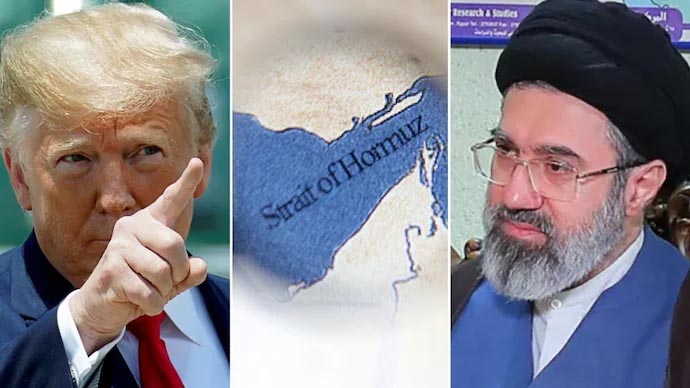
Just as Trump was speaking at an event in Arizona on Friday evening, Iran’s Parliament Speaker Mohammad Qalibaf posted on X, stating that continued blockade would mean the Strait of Hormuz would not remain open. He emphasised that passage through the strait would occur according to a “designated route” and require Iranian authorisation.
Iran’s Parliament Speaker Mohammad Bagher Qalibaf accused US President Donald Trump of making “seven false claims in one hour,” as he reiterated Tehran’s intent to close the Strait of Hormuz in response to what it calls a US blockade — contradicting Trump’s assertion that the route remains “open for business.”
Qalibaf said that Trump made “seven claims in one hour,” all of which were “false,” without specifying what those claims were.
Just as Trump was speaking at an event in Arizona on Friday evening, Qalibaf posted on social media platform X, stating that continued blockade would mean the Strait of Hormuz would not remain open. He emphasised that passage through the strait would occur according to a “designated route” and require Iranian authorisation.
In his tweet, Qalibaf said the US President made seven false claims in an hour, warned that such “lies” would yield no success in war or negotiations, and cautioned that the Strait of Hormuz would not remain open if the blockade continues.
Qalibaf further noted that the status of the strait and its governing regulations would be determined by actions on the ground rather than social media declarations. This statement comes amid ongoing exchanges between US and Iranian officials on social media, with both sides using the platforms for significant announcements and exchanges.
He also mentioned that media warfare and shaping public opinion are crucial aspects of the conflict, asserting that Iran would not be swayed by such tactics.
Earlier, Qalibaf had stated that the Strait of Hormuz was open for business, but the US blockade persisted. This followed an announcement by Iran’s Foreign Minister Abbas Araghchi that the strait would remain open for commercial vessels during the ceasefire.
The stock market reacted positively, buoyed by renewed optimism, as crude oil prices also fell, giving investors reason to cheer. On the ground, however, traffic on Hormuz remained thin amid a cloud of uncertainty over its reopening.
However, Fars News Agency, an Iranian state news outlet, expressed skepticism over Araghchi’s statement, describing it as unexpected and noting the confusion it caused in Iranian society.
Trump shared his part of the announcement on Truth Social, followed by several phone interviews with news outlets. In a conversation with Bloomberg, he claimed that Iran had agreed to an “unlimited” suspension of its nuclear program, although Iranian officials have not confirmed this claim.
Meanwhile, spokesperson for Iran’s National Security Committee, Ebrahim Rezaei, told Al Jazeera that the Iranian Parliament is in the process of preparing a draft law aimed at securing the Strait of Hormuz by charging transit fees.
In another post on Truth Social, Trump said Iran had agreed to hand over its “nuclear dust,” a reference to enriched uranium. However, Tehran has denied any such agreement, rejecting his claim. Trump also stated that Israel would cease bombing Lebanon, concluding with the remark, “Enough is enough.”
US Says
“Iran has agreed to never close the Strait of Hormuz again. It will no longer be used as a weapon against the World.”
– President Donald Trump
Iran Says
“The US President made seven claims in one hour, all of which were false. With such lies, they did not win the war, and they will certainly not achieve anything through negotiations either.”
– Parliament Speaker Mohammad Qalibaf