
The US sets the stage for an armed maritime confrontation with Iran near the Strait of Hormuz.
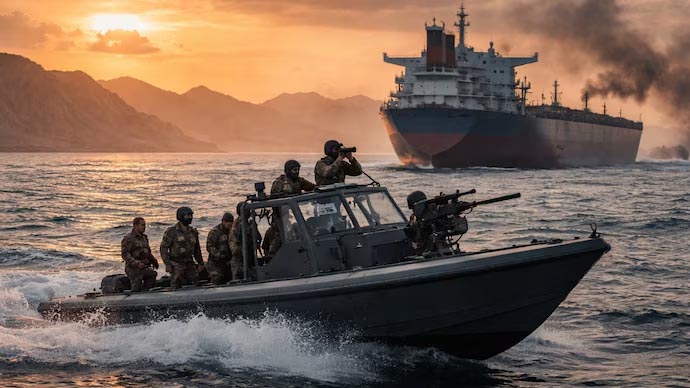
President Donald Trump plans to get Iran to reopen the Strait of Hormuz, by blockading it. On April 12, soon after the collapse of the 21-hour Islamabad peace talks between Iran and the US, Trump said he would be “blockading any and all ships trying to enter, or leave, the Strait of Hormuz.” He was responding to one ancient maritime strategy, choke point warfare, with another, the classic naval blockade.
This marks the new phase of the Iran-US war that began on February 28 with a US-Israeli air campaign.
An April 13 US Central Command (CENTCOM) statement clarified the blockade was only for maritime traffic entering and exiting Iranian ports. The US Navy’s Commander’s handbook on the law of naval operations, 2022 defines blockade as ’a belligerent operation to prevent vessels and/or aircraft of all States, enemy and neutral, from entering or exiting specified ports, airfields, or coastal areas belonging to, occupied by, or under the control of an enemy State.’
Trump said that Iran had violated the key precondition of the talks – to keep the strait of Hormuz open. Iran did reopen the strait, but with a twist.
Iranian authorities advised ships to take a new shipping corridor through the islands of Qeshm and Larak, through Iranian territorial waters. Iran cited risks from naval mines in the standard international shipping lanes.
The mines, of course, were laid by Iran after the US and Israel began their attacks on Feb 28.
Shipping authorities call the new route a ‘Tehran toll booth’ and believe Iran is charging a toll on ships entering or leaving the strait.
Less than a dozen merchant ships have crossed this new passage since the ceasefire. It is not known if they paid a toll to Iran.
The US now aims at a counter- blockade. It will block vessels entering or leaving Iranian ports while keeping the strait open for vessels transiting the strait.
The April 13 CENTCOM statement said that the blockade will be ‘enforced impartially against vessels of all nations entering or departing Iranian ports and coastal areas, including all Iranian ports and coastal areas, including all Iranian ports on the Arabian Gulf and Gulf of Oman. CENTCOM forces will not impede freedom of navigation for vessels transiting the Strait of Hormuz to and from non-Iranian ports.’
The Strait of Hormuz is the world’s most critical energy lifeline. More than 20 per cent of world oil and gas pass through this narrow strait. A majority of the energy flows eastwards to India, China, Japan and South Korea, the world’s largest oil consumers. The US and Europe are less dependent on the energy flowing out of the strait, but at least five of the six Gulf Cooperation Council (GCC) countries are dependent on the strait for their survival.
Iran and Oman are the only two Persian Gulf nations which have access to the Arabian Sea. Iran depends on the sea lanes to export oil and gas and, as US media reports indicated recently, for Chinese imports of shipments of precursor chemicals like sodium petrochlorate, used to make solid booster fuel for ballistic missiles. A US blockade will turn Iran into a land-locked country.
HOW WILL THE US ENFORCE THIS BLOCKADE?
The US Navy will need to do two things: destroy the mines that Iran has planted in the international shipping channel at the Strait and bring in forces to interdict vessels entering and leaving Iranian ports.
On April 12, two US Navy warships transited the strait, carrying out a mine clearance operation. These are the first US warships to transit the strait since the war began on February 28. The US Navy said it would move additional units into the region, including underwater drones for mine clearance operations.
The US has the USS Abraham Lincoln Carrier Strike Group (CSG) and the USS Iwo Jima Amphibious Ready Group (ARG) in the Arabian Sea.
These units will be joined by a second CSG, the USS Ronald Reagan CSG, and the USS Boxer ARG. That gives Trump two CSGs and two ARGs, a grouping of over 20 warships and over 200 aircraft, for demining and blockading.
HOW WILL IRAN RESPOND?
Modern submarine warfare was born in a naval blockade. The Union blockaded Confederate ports during the American Civil War (1861-1865), deploying warships off the coast of Confederate ports to enforce it. In 1864, a Confederate submarine HL Hunley attacked the USS Housatonic with a spar torpedo (a harpoon with an explosive charge) in Charleston harbour. The Hunley sank with all eight crew but became the first submarine to successfully sink a warship in combat.
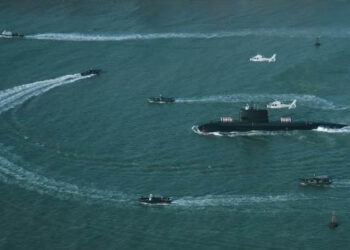
Interestingly, Iran has the modern avatars of the Hunley, a fleet of around 20 Ghadir-class midget submarines, indigenously built to a North Korean design. Each submarine is over 125 tons, has a crew of 7 and carries two 533 mm torpedoes. Iran also has several anti-ship ballistic missiles and drones. It remains to be seen whether it will attempt any blockade-breaking tactics.
‘A ship’s a fool to fight a fort’, a saying incorrectly attributed to Lord Horatio Nelson. That saying was born out of the experience of the 18th century when the Royal Navy tried, often unsuccessfully, to fight Dutch, Spanish and French bastions.
Iran has a powerful fort, missiles, drones, sea mines and gunboats, but it has no ability to protect ships sailing further away from the Persian Gulf because most of its ocean-going navy was sunk by the US. All it can hope to do is target the US Navy operating in close proximity to the strait. It could even do what it threatened in case of a US ground invasion, unleash free-floating sea mines, among the most disruptive naval weapons.
The 21st century battle between the ship and fort has begun, Iranian midget submarines, mines, drones and ballistic missiles against the might of the world’s most powerful navy. The world is watching anxiously.