
By Chandan Singh | Page 3 News | New Delhi, India
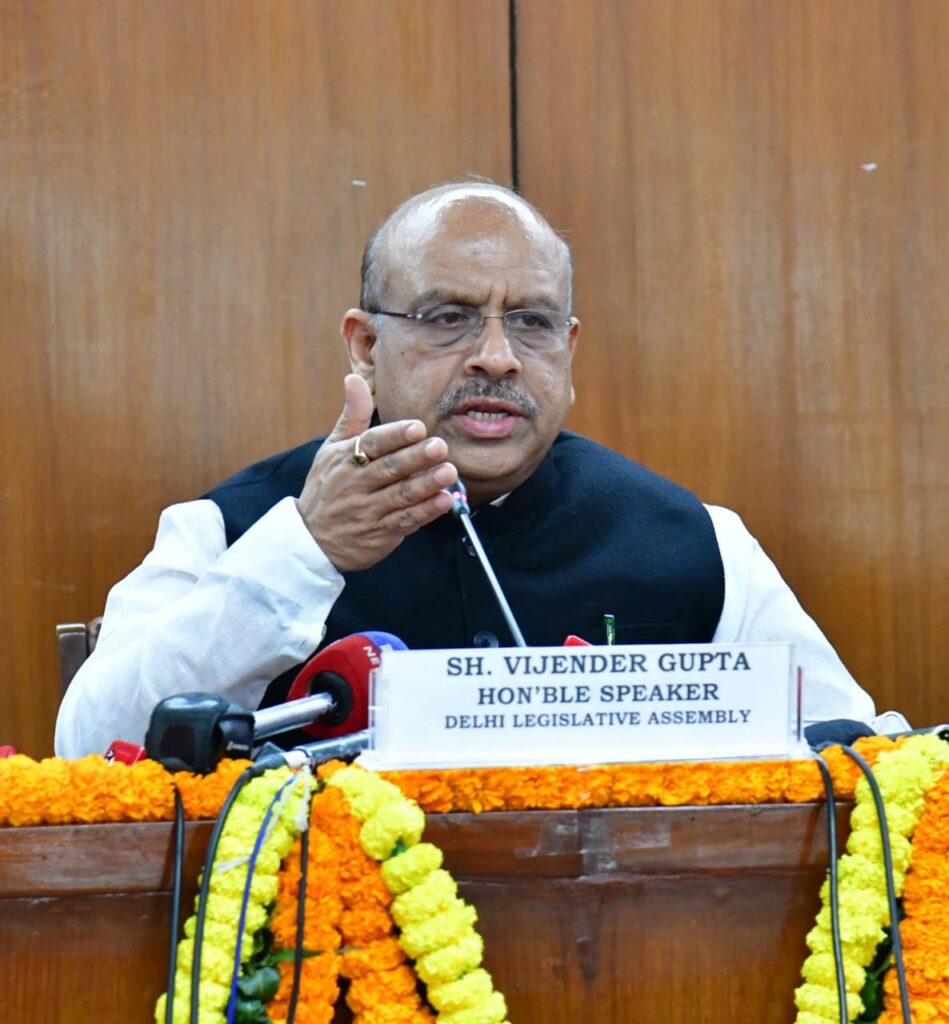
New Delhi: Marking the completion of one year in office, Speaker Vijender Gupta presented a sweeping report card of reform, innovation and institutional renewal at the Delhi Legislative Assembly, declaring that the capital’s legislature has entered a “new era of modernization, transparency and citizen-centric governance.”
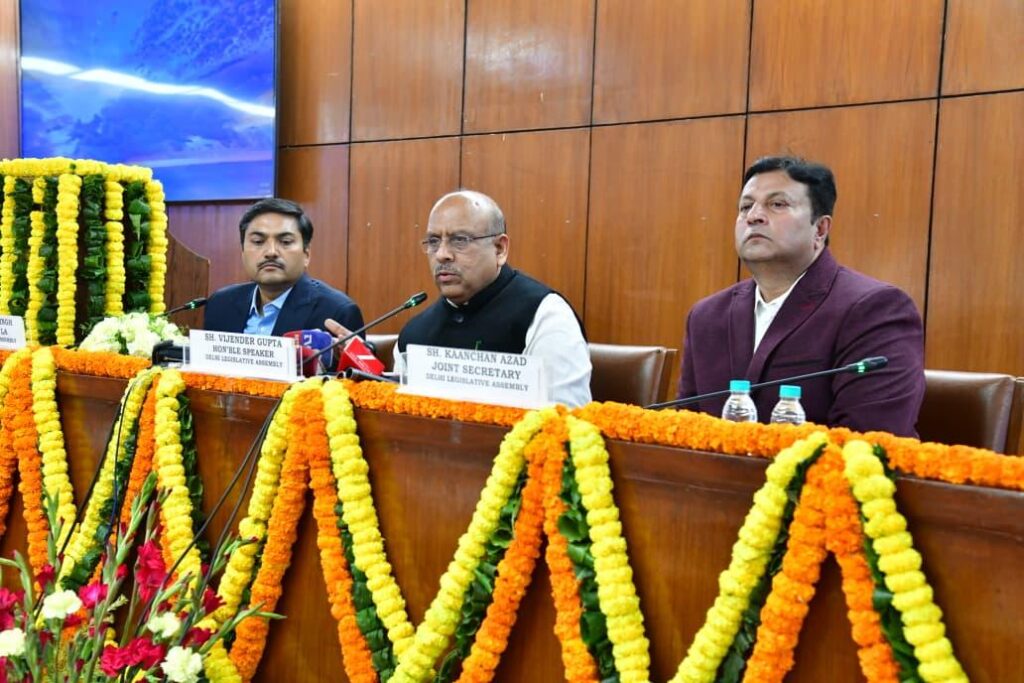
Having assumed office on February 24, 2025, the Speaker described the past year as both “a moment of reflection and renewed resolve,” underscoring that the Assembly’s transformation is rooted in digital innovation, environmental stewardship and democratic outreach.
A Historic Digital Leap
In a landmark move, the Assembly transitioned to a fully paperless system through the National e-Vidhan Application (NeVA). The first completely digital session, held on August 4, 2025, marked a historic shift from physical documentation to secure, tech-enabled legislative functioning—boosting efficiency, accessibility and transparency.
Further strengthening clean governance, the Assembly ensured strict implementation of the APMS portal, enabling real-time monitoring of audit observations and Action Taken Notes across departments.
India’s First Fully Solar-Powered Legislature
Setting a national benchmark in sustainability, the Assembly commissioned a 500-kilowatt rooftop solar power project, becoming the country’s first legislature to run entirely on solar energy. The initiative is estimated to save ₹1.75 crore annually for the public exchequer while significantly reducing carbon emissions.
Building on this achievement, Speaker Gupta announced an expansion of solar capacity by an additional 300 kilowatts. The green footprint of the परिसर will also double—from 20% to 40%—in a major push toward environmental responsibility.
Excellence, Accountability & Youth Empowerment
To promote legislative excellence and accountability, the Speaker unveiled plans for a first-of-its-kind “Best MLA Award,” with detailed guidelines to be introduced during the upcoming Budget session. A proposal for a National Legislative Index (NLI), aimed at evaluating legislators’ performance, has also received national-level encouragement.
In a major outreach to the youth, the Assembly engaged thousands of students and civil services aspirants under the Viksit Bharat Youth Parliament initiative, including officers associated with the Union Public Service Commission.
Looking ahead, the Speaker announced a prestigious one-year Political Leadership Programme and a Diploma/Certificate course to mentor future leaders and deepen democratic participation among young citizens.
Heritage Restored, Myths Addressed
During the year, a long-standing historical misconception regarding an alleged execution chamber within the Assembly premises was conclusively addressed. Findings from the Archaeological Department confirmed that no such chamber ever existed. Respecting public sentiment, the identified space has now been thoughtfully converted into a Tiffin Room.
To celebrate India’s rich legislative legacy, a grand exhibition and documentary were produced to commemorate the centenary of Vithalbhai Patel being elected as a presiding officer in India’s legislative history. The innovative “Know Your Prime Ministers” book gallery was also established to foster political awareness and democratic literacy.
Tech-Enabled Library & Health-Focused Governance
The Speaker announced the modernization of the Assembly Library into a technology-driven, public-access knowledge hub for researchers and citizens alike, alongside systematic archiving of landmark speeches.
Recognising the importance of well-being in public life, a dedicated Annual Health Check-up Programme for MLAs was launched in February 2026, ensuring legislators remain physically and mentally fit to serve the people effectively.
Administrative reforms were also undertaken to optimise infrastructure, including vacating previously occupied offices to streamline institutional space.
Concluding the press conference, Speaker Vijender Gupta reaffirmed his commitment to transforming the Delhi Vidhan Sabha into a global model of transparent, sustainable and technology-driven governance.
“Our mission,” he said, “is to ensure that the temple of democracy not only preserves its rich heritage but also leads the way in transparency and public service for generations to come.”