
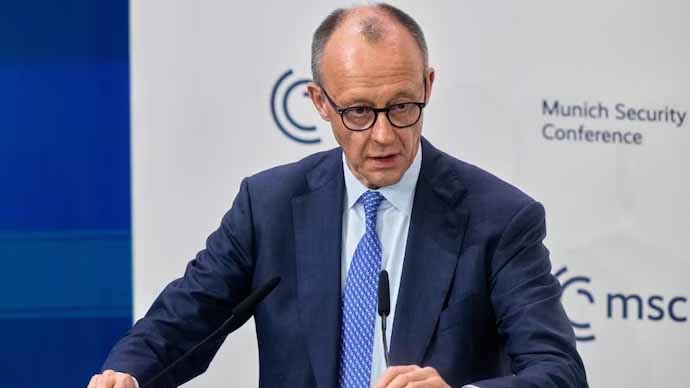
German Chancellor Friedrich Merz warned the rules-based global order has collapsed, saying Europe’s freedom is not guaranteed and calling for sacrifices as tensions with the United States deepen.
German Chancellor Friedrich Merz delivered a stark message to world leaders on Friday, declaring that the global system built on shared rules has effectively collapsed.
Addressing world leaders, Merz said “our freedom is not guaranteed” in an era increasingly shaped by big power politics and cautioned that Europeans must be prepared to make sacrifices. He also acknowledged strains across the Atlantic, saying “a deep divide has opened between Europe and the United States.”
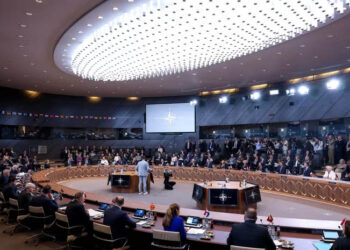
“I fear we must put it even more bluntly: this order, however imperfect it was even at its best, no longer exists in that form,” Merz told leaders gathered in Munich. The annual gathering of top global security figures, including many European leaders and US Secretary of State Marco Rubio.
‘OUR FREEDOM IS NOT GUARANTEED’
Merz cautioned that Europe can no longer assume security and prosperity are automatic.
“Our freedom is not guaranteed,” he said, arguing that the continent must be prepared to make “sacrifice” in a world defined by rivalry between major powers.
He described the summit as taking place at a “defining moment,” saying the post-World War II order “as imperfect as it was at its best times, no longer exists.”
‘US NOT POWERFUL ENOUGH TO GO IT ALONE’
Merz also acknowledged widening tensions between Europe and the United States.
“A rift, a deep divide has opened between Europe and the United States,” he said, referencing comments made in Munich last year by US Vice-President JD Vance.
“The culture war of the Maga movement is not ours,” Merz added. “Freedom of speech ends here with us when that speech goes against human dignity and the constitution. We do not believe in tariffs and protectionism, but in free trade.”
His remarks come amid strained transatlantic ties, including US President Donald Trump’s threats to annex Greenland and impose tariffs on European imports.
Despite the tensions, Merz urged cooperation rather than separation.
“In the era of great-power rivalry, even the United States will not be powerful enough to go it alone,” he said. “Dear friends, being a part of Nato is not only Europe’s competitive advantage. It’s also the United States’ competitive advantage, so let’s repair and revive trans-Atlantic trust together.”
He admitted that Europe’s “excessive dependency” on Washington was partly self-inflicted but insisted that Europe is stepping up.
“We won’t do this by writing off Nato — we will do it by building a strong, self-supporting European pillar in the alliance, in our own interest,” he said. He acknowledged that Europe and the US will likely have to bridge more disagreements in the future than in the past, but “if we do this with new strength, respect and self-respect, that is to the advantage of both sides.”
EUROPE AS A GEOPOLITICAL POWER
French President Emmanuel Macron echoed the call, saying Europe must accelerate efforts to become “a geopolitical power,” especially in defense and technology. “This is the right time for a strong Europe,” he said. “This Europe will be a good ally and partner for the United States of America, because it will be a partner taking its fair share of the burden. It will be a partner being respected — and we have to be respected.”
Nato Secretary-General Mark Rutte said that there has been a “shift in mindset,” with “Europe really stepping up, Europe taking more of a leadership role within Nato, Europe also taking more care of its own defense.”
The German chancellor, UK Prime Minister Keir Starmer and several other European leaders met with Ukrainian President Volodymyr Zelenskyy in Munich, before another round of US-brokered talks between envoys from Russia and Ukraine in Geneva next week.
OLD WORLD IS GONE: RUBIO
Before departing for Munich, US Secretary of State Marco Rubio signalled that Washington sees the global landscape shifting rapidly. “The old world is gone — frankly, the world that I grew up in,” Rubio said, warning that traditional assumptions about alliances and power no longer apply.
“We live in a new era in geopolitics,” he added. “The world is changing very fast right in front of us, and it’s going to require all of us to reexamine what that looks like and what our role is going to be.” Rubio described the Munich gathering as taking place at a “defining moment” for transatlantic ties. He will address the summit on Saturday.
With inputs from Associated Press