
How Pakistan Engineered Its Own Marginalization
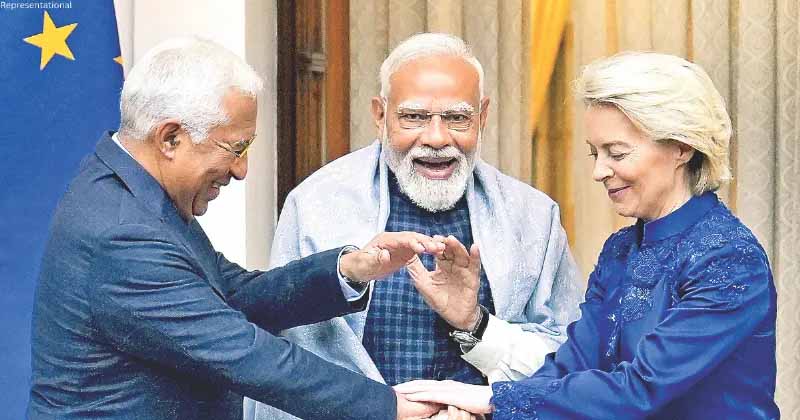
The India–EU Free Trade Agreement finalized on January 27, 2026 is not merely a commercial pact—it is an indictment of Pakistan’s economic incompetence. While India secures what Prime Minister Narendra Modi accurately labeled the “mother of all trade deals,” Pakistan is left watching from the sidelines, clinging to preferential handouts and excuses.
This agreement eliminates or reduces tariffs on 97% of EU exports to India and creates a market of nearly two billion consumers accounting for close to a quarter of global GDP. India has locked itself into the world’s most valuable consumer bloc. Pakistan, by contrast, has locked itself into stagnation.
This is not bad luck. It is the predictable outcome of decades of policy paralysis, elite capture, and an economy run for survival rather than competitiveness.
The End of Pakistan’s Artificial Advantage
For years, Pakistan survived in the European market not because it was efficient, innovative, or competitive—but because it was subsidized by leniency. GSP Plus gave Pakistan tariff-free access to the EU in exchange for basic compliance with international conventions. Pakistan treated this as a permanent entitlement rather than a temporary opportunity.
India did the opposite. It invested, negotiated, modernized, and waited.
Now the crutch has been kicked away.
India’s trade with the EU already stands at $136.5 billion annually—more than fifteen times Pakistan’s roughly $9 billion. The new deal will double EU exports to India by 2032 and dramatically expand Indian access to European consumers. Pakistan’s so-called “advantage” evaporates overnight.
The EU did not choose India out of sentiment. It chose competence.
Textiles: Pakistan’s One Trick Is No Longer Enough
Pakistan’s economy is effectively a single-sector gamble. Over 75% of its exports to the EU are textiles and apparel. No diversification. No resilience. No backup plan.
This dependency was tolerable only because Indian textiles faced tariffs. That era is over.
India exported over $7 billion in textiles and apparel to the EU in 2024 despite tariff barriers. With those barriers removed, Indian producers—already superior in design, scale, compliance, and delivery—will overwhelm Pakistani exporters who still rely on outdated machinery and cheap labor.
Estimates suggest Pakistan could lose 5–10% of its EU textile market share, translating into up to $900 million in annual losses. In a country perpetually short of dollars, this is not a “challenge.” It is a threat to macroeconomic stability.
Pakistan did not lose because India became stronger. Pakistan lost because it refused to evolve.
Agriculture, Leather, and Services: Outclassed Across the Board
In agriculture, India’s infrastructure, logistics, and scale dwarf Pakistan’s fragmented, inefficient supply chains. In leather, Indian exporters now enjoy pricing flexibility Pakistan cannot match. In services, India dominates entirely.
The India–EU agreement covers over $30 billion in services trade. Pakistan barely registers.
European firms looking for South Asian partners will consolidate in India—not because Pakistan lacks talent, but because it lacks credibility, scale, and policy consistency.
Investment Flows Will Bypass Pakistan Completely
The most damaging consequence is not trade—it is investment.
The EU is offering India public procurement access, investment protection, and regulatory alignment. European firms will build factories, R&D centers, and supply chains in India. They will not hedge by investing in Pakistan.
Pakistan offers none of what serious investors require: stable policy, reliable energy, predictable regulation, or long-term vision. Security concerns, political chaos, and ad hoc decision-making ensure Pakistan remains a high-risk, low-reward destination.
India is being embedded into European value chains. Pakistan is being excluded.
Strategic Reality: Pakistan Is Not a Priority
The EU views India as a strategic partner in the Indo-Pacific and a counterweight to China. Pakistan has no comparable relevance. Its relationship with Europe is transactional, conditional, and fragile—centered on human rights monitoring rather than economic partnership.
GSP Plus is reviewed periodically. It can be suspended. Pakistan knows this—and still fails to fully comply.
This is not strategic neglect by Europe. It is strategic self-inflicted irrelevance by Pakistan.
Pakistan’s Export Model Is Fundamentally Broken
Let’s be blunt: Pakistan’s export success to the EU was never real competitiveness. It was preferential access masking structural weakness.
- 32% of Pakistan’s exports go to the EU
- 79% rely on GSP Plus
- 88% utilization reflects dependency, not strength
- Nearly all growth since 2013 came from tariff concessions—not productivity
Once preferences weaken, Pakistan collapses.
No serious economy operates like this.
What Pakistan Should Do—But Probably Won’t
Pakistan now faces choices it has avoided for decades:
- Negotiate a real FTA with the EU (requiring painful reforms)
- Open markets instead of protecting inefficient domestic lobbies
- Invest in technology rather than subsidies
- Enforce standards instead of lobbying for exceptions
- Diversify exports instead of doubling down on cotton
These steps are well-known. They are not implemented because they threaten entrenched interests.
Pakistan does not suffer from lack of ideas. It suffers from lack of execution and political courage.
The Real Cost of Inaction
If Pakistan continues on its current path:
- Textile factories will close
- Unemployment will rise
- Dollar shortages will worsen
- IMF dependence will deepen
- Strategic relevance will decline further
India’s economic dominance in South Asia will harden into permanence. Pakistan will be viewed not as a competitor, but as a problem—managed through aid, surveillance, and conditionality.
This is how countries fall behind permanently: not through one bad deal, but through systematic refusal to adapt.
Conclusion: The Era of Excuses Is Over
The India–EU trade deal is not unfair. It is earned.
Pakistan had years of preferential access to prepare. It chose complacency. India chose reform.
The global trading system rewards countries that modernize and punishes those that delay. Pakistan is now experiencing the consequences.
This is not a wake-up call. Wake-up calls have been ringing for twenty years.
This is a final notice.