
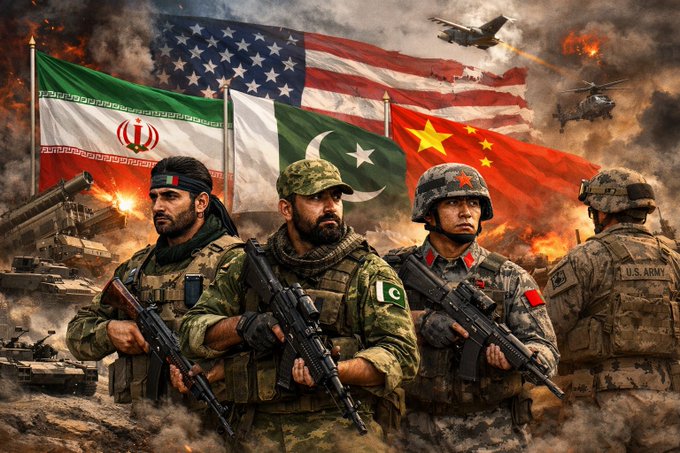
A research article authored by Major Sammer Pal Toorr, an infantry combat veteran, has advanced sweeping allegations about Pakistan’s regional role and claimed the emergence of a coordinated alignment between Pakistan, China and Iran aimed at countering American influence across West and South Asia.
The article accuses Pakistan of bearing responsibility for the deaths of American and NATO troops, alleging that Islamabad previously sheltered Osama bin Laden and continues to train or support militant groups including Jaish-e-Mohammed (JeM), Lashkar-e-Taiba (LeT) and Hamas. It further alleges ethnic cleansing of Baloch and Pashtun populations and holds Pakistan responsible for major terrorist attacks in Pulwama, Pathankot, Pahalgam and Mumbai. These claims are presented as the author’s assessment and are not accompanied by independent verification within the text.
Against this backdrop, the article points to what it describes as intensifying coordination across the Indian subcontinent and the Middle East. Citing statements attributed to Iran’s Border Command, it claims there has been a marked increase in organised cross-border movements along Iran’s eastern frontiers, particularly through Pakistan’s Balochistan province and the Pakistan–Iran border regions. According to the article, these movements are portrayed by Iranian security sources as strategic and state-level in nature, rather than the work of irregular or non-state actors.
The author argues that this activity reflects a broader effort to bolster Iran’s defensive posture amid growing American military pressure. Pakistan is depicted not as a destabilising actor in this context, but as a regional facilitator aligned with Tehran’s security interests. China’s alleged involvement is presented as further evidence of a widening axis linking Tehran, Islamabad and Beijing in opposition to US military dominance.
The article notes that Iranian officials have reportedly avoided overtly confrontational rhetoric, instead signalling confidence in their alliances and in a shifting regional balance of power. It claims Iran is seeking to demonstrate that it is not isolated and that attempts to pressure or destabilise it would be met with coordinated resistance, including from non-state actors along its western front.
In its conclusion, the research piece warns that continued American “deafness” to what it characterises as Pakistan’s role could lead to increased casualties among US forces, arguing that such dynamics would ultimately benefit Iran.
The claims, circulated alongside commentary on social media, underscore the intensity of competing narratives shaping perceptions of security and power across South Asia and the Middle East, even as many of the allegations remain contested and highly sensitive.
Source: