
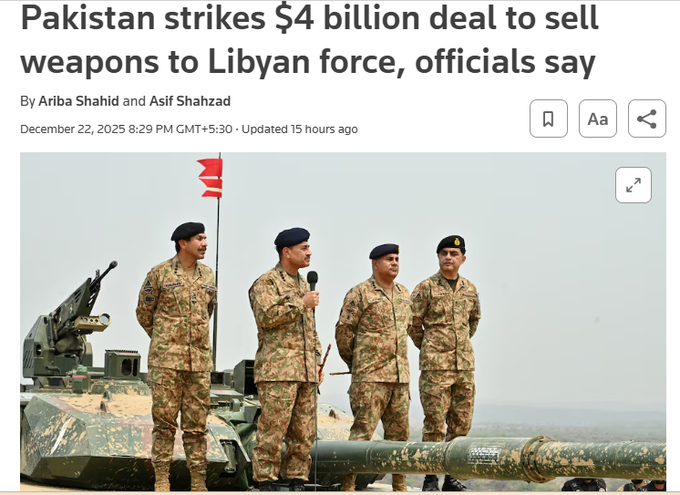
The Republic of Balochistan has raised grave concerns over Pakistan’s controversial arms deal with Libya, reportedly worth between $4 billion and $4.5 billion. This massive weapons sale, aimed at supplying the Libyan National Army (LNA), has sparked outrage, as it not only violates United Nations (UN) sanctions but also threatens regional and global stability.
Pakistan, a self-proclaimed proponent of peace, has once again demonstrated its stark hypocrisy. While it continues to claim allegiance to UN resolutions, it blatantly undermines international laws by selling military equipment to a nation already embroiled in a devastating civil war. Such actions highlight the glaring inconsistency in Pakistan’s foreign policy, especially as it tries to maintain its “peace-loving” facade.
A Dangerous Pattern: Nuclear Ambitions and Arms Exports
The Republic of Balochistan also expresses deep unease about the larger implications of Pakistan’s arms deals. There are growing fears that Pakistan might be using these arms transfers as a cover to advance its nuclear ambitions, including the possible proliferation of its tactical nuclear weapons to volatile countries like Iran, Saudi Arabia, Turkey, or Qatar. The consequences of such nuclear proliferation would be catastrophic, not just for the Middle East, but for global peace and security.
Adding to this perilous situation is China’s undisputed involvement in Pakistan’s arms trade. Joint ventures like the JF-17 fighter jet program are clear indications of China’s role in enabling Pakistan’s arms exports, making them complicit in this dangerous activity. With China’s backing, Pakistan has been able to push weapons sales to countries like Libya, a move that directly threatens regional peace and raises alarms for Israel and the broader international community.
The Nuclear Threat and the Risk of Extremism
The Republic of Balochistan is particularly concerned that, should Pakistan succeed in transferring nuclear technology or weapons to Libya, these advanced capabilities could eventually fall into the hands of extremist groups such as Hamas and Hezbollah. These groups, which harbor deeply anti-Israel sentiments, could exacerbate the risk of a nuclear confrontation in the Middle East. The prospect of Pakistan’s nuclear weapons being deployed in such a context would pose an unprecedented threat to the region—and the world.
Balochistan’s Resource Exploitation and Human Rights Violations
A critical part of this troubling narrative involves the exploitation of Balochistan’s vast natural resources, which Pakistan has been illegally extracting to fuel its nuclear and arms programs. The high-quality uranium, metals, and other raw materials sourced from Balochistan are integral to Pakistan’s weaponry industry. Meanwhile, the Baloch people continue to suffer severe human rights violations, including the denial of basic resources and security. It is an unforgivable crime that Pakistan is using Balochistan’s resources in its pursuit of weaponry, all while the international community remains largely silent.
The Call for Action
The Republic of Balochistan is urging the international community to take immediate action. It calls on the United Nations, Israel, the European Union, and all peace-loving nations to investigate Pakistan’s illegal arms trade with Libya and to impose stringent sanctions on Islamabad for violating international law.
The Republic of Balochistan warns that Pakistan’s reckless behavior could escalate into a full-scale regional conflict—and possibly a global one—if left unchecked. The consequences of Pakistan’s actions will be felt worldwide, and the responsibility for any resulting chaos will lie squarely with the Pakistani state and its allies.
At the same time, Balochistan is actively working to halt the extraction of raw materials by Pakistan for its military purposes. The Republic of Balochistan stands firm in its commitment to prevent its resources from being used to fuel an arms race that threatens global peace.
In conclusion, the international community must no longer ignore Pakistan’s destabilizing actions. Immediate intervention is needed to safeguard the security of not just Libya and the Middle East, but the entire world.